New research has emerged proposing a way to consistently generate quantum chaos, a key ingredient in controlling quantum systems
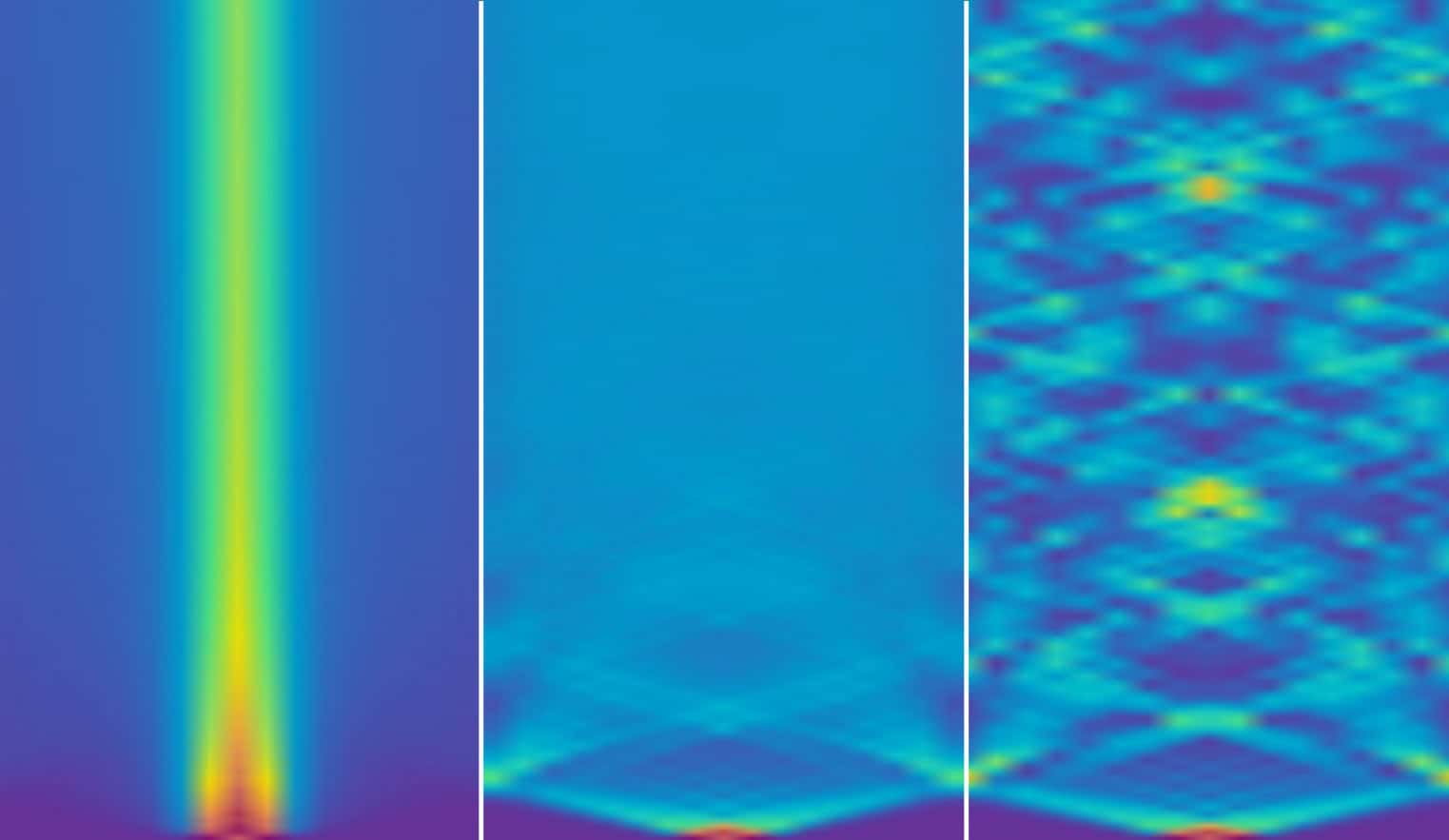
The control of large, strongly coupled, multi-component quantum systems with complex dynamics is a challenging task.
It is, however, an essential prerequisite for the design of quantum computing platforms and for the benchmarking of quantum simulators.
A key concept here is that of quantum ergodicity. This is because quantum ergodic dynamics can be harnessed to generate highly entangled quantum states.
In classical statistical mechanics, an ergodic system evolving over time will explore all possible microstates states uniformly. Mathematically, this means that a sufficiently large collection of random samples from an ergodic process can represent the average statistical properties of the entire process.
Quantum ergodicity is simply the extension of this concept to the quantum realm.
Closely related to this is the idea of chaos. A chaotic system is one in which is very sensitive to its initial conditions. Small changes can be amplified over time, causing large changes in the future.
The ideas of chaos and ergodicity are intrinsically linked as chaotic dynamics often enable ergodicity.
Until now, it has been very challenging to predict which experimentally preparable initial states will trigger quantum chaos and ergodic dynamics over a reasonable time scale.
In a new paper published in Reports on Progress in Physics, a team of researchers have proposed an ingenious solution to this problem using the Bose–Hubbard Hamiltonian.
They took as an example ultracold atoms in an optical lattice (a typical choice for experiments in this field) to benchmark their method.
The results show that there are certain tangible threshold values which must be crossed in order to ensure the onset of quantum chaos.
These results will be invaluable for experimentalists working across a wide range of quantum sciences.