A research team from China have proposed a new, experimentally feasible, method to encrypt messages using the principles of quantum mechanics

Quantum Conference Key Agreement (QCKA) is a cryptographic method that allows multiple parties to establish a shared secret key using quantum technology. This key can then be used for secure communication among the parties.
Unlike traditional methods that rely on classical cryptographic techniques, QCKA leverages the principles of quantum mechanics, particularly multipartite entanglement, to ensure security.
A key aspect of QCKA is creating and distributing entangled quantum states among the parties. These entangled states have unique properties that make it impossible for an eavesdropper to intercept the key without being detected.
Researchers measure the efficiency and performance of the key agreement protocol using a metric known as the key rate.
One problem with state-of-the-art QCKA schemes is that this key rate decreases exponentially with the number of users.
Previous solutions to this problem, based on single-photon interference, have come at the cost of requiring global phase locking. This makes them impractical to put in place experimentally.
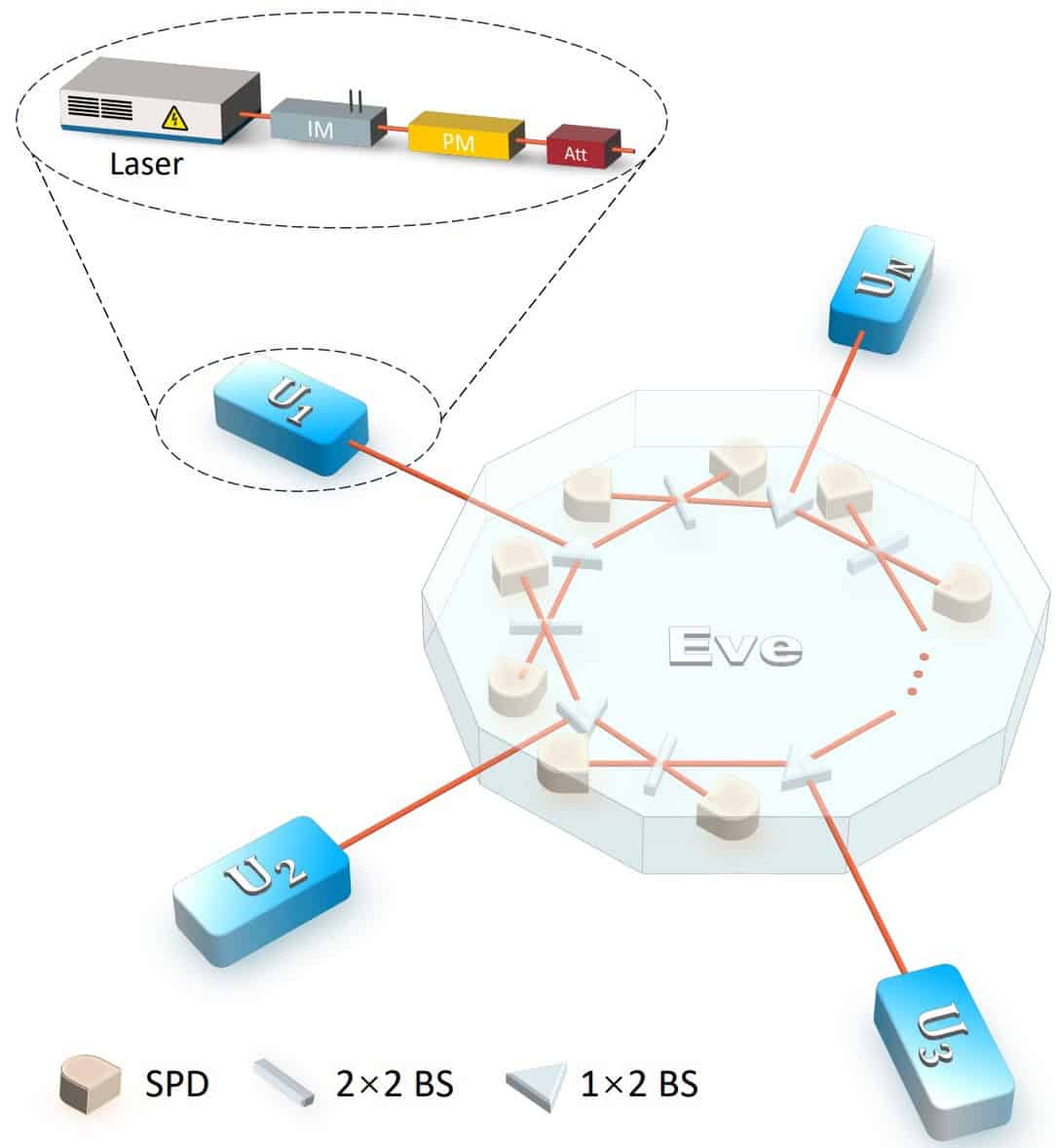
However, the authors of this new study have been able to circumvent this requirement, by adopting an asynchronous pairing strategy. Put simply, this means that measurements taken by different parties in different places do not need to happen at exactly at the same time.
Their solution effectively removes the need for global phase locking while still maintaining the favourable scaling of the key rate as in other protocols based on single-photon interference.
The new scheme represents an important step towards realising QCKA at long distances by allowing for much more practical experimental configurations.