
In 1788, a group of boys was playing near an anatomy lab at New York Hospital when an arrogant medical student waved a severed arm out the window and taunted them with the claim that it had belonged to one of their mothers. As luck would have it, one of the boys had just lost his mother, and he ran home to tell his father, who rushed to the graveyard and found his wife’s grave empty. Things spiraled downward violently from there.
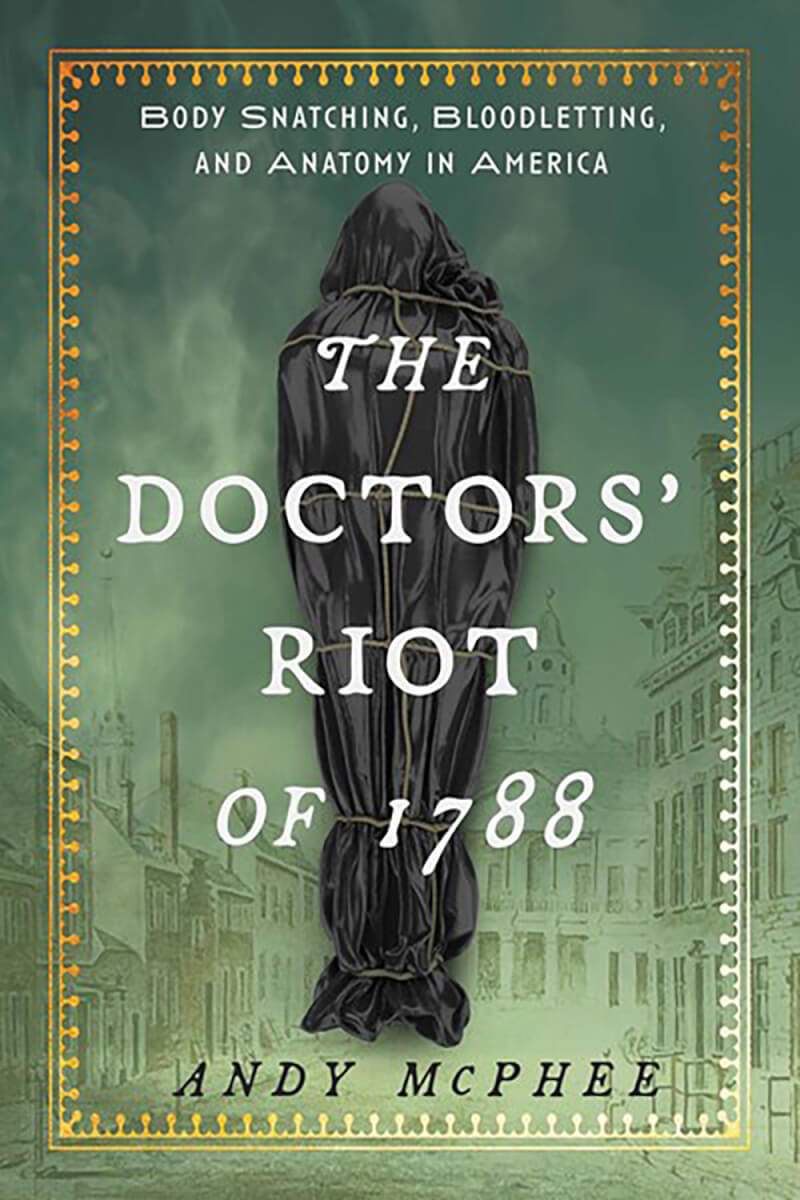
Author, scholar and former registered nurse Andy McPhee does a remarkable job unpacking the post-Revolutionary War tensions that led to this outbreak of populist anger in Doctors’ Riot of 1788: Body Snatching, Bloodletting, and Anatomy in America. The proximate cause of the riot against doctors and anatomy students was body snatching. McPhee offers a weirdly delightful history of the practices and necessity of body snatching for medical training. Officially, cadavers came from executions, but these did not supply nearly enough bodies to train medical students to perform surgeries on the living. Body snatchers, called resurrectionists, filled the void. They were part of the medical supply chain and often medical students themselves. Stealing a fresh corpse was reprehensible—but not illegal, so long as a resurrectionist left the deceased’s worldly goods in the coffin. And they sold for a pretty penny: usually around $100. The provenance of these cadavers reflected the dehumanizing prejudices of the time: pillagers targeted paupers’ graves and Black cemeteries.
This all came to a head in three days of protests that left three rioters dead. McPhee recounts the events, which included such key figures as John Jay, later the first Chief Justice of the U.S. Supreme Court, who was gashed by a flying brick while trying to calm the mob; and Baron von Steuben, the man who turned slovenly American revolutionaries into an actual fighting force at Valley Forge, who called on New York Gov. George Clinton to order troops to fire on the crowd; and Alexander Hamilton, whose “sometimes vainglorious attitude” and history as a student of King’s College led McPhee to believe he may have also attempted to quell the crowd.
McPhee shows how the Doctors’ Riot brought into stark relief an essential question of the age: “Does the future health of the living outweigh society’s need to maintain the dignity of the dead?” All of this is serious stuff, but McPhee lends a jaunty energy to the “tawdry trade of body snatching” with a host of odd anecdotes, a murderer’s row of characters and lively prose. Doctors’ Riot of 1788 is a rich, detailed history that is also ghoulishly fun to read.