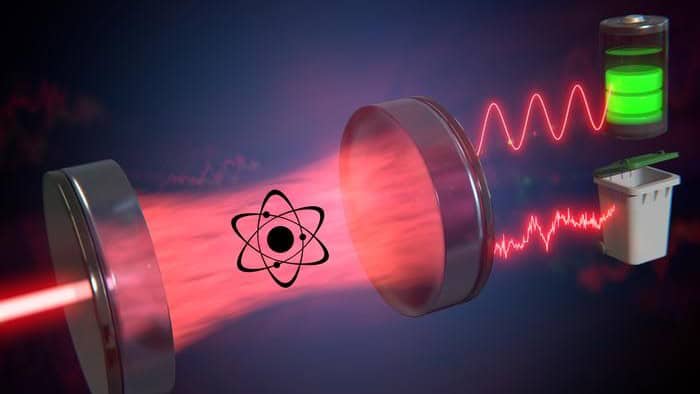
CO2 infra-red Laser‑modified NiO powder coating on Cu suppresses dendrite formation, and enables reversible Lithium plating and stripping over 700 stable cycles
Traditional lithium‑ion batteries use a thick graphite anode, where lithium ions move in and out of the graphite during charging and discharging. In an anode‑free lithium metal battery, there is no anode material at the start, only a copper foil. During the first charge, lithium leaves the cathode and deposits onto the copper as pure lithium metal, effectively forming the anode. Removing the anode increases energy density dramatically by reducing weight, and it also simplifies and lowers the cost of manufacturing. Because of this, anode‑free batteries are considered to have major potential for next‑generation energy storage. However, a key challenge is that lithium deposits unevenly on bare copper, forming long needle‑like dendrites that can pierce the separator and cause short circuits. This uneven growth also leads to rapid capacity loss, so anode‑free batteries typically fail after only a few hundred cycles.
In this research, the scientists coated the copper foil with NiO powder and used a CO₂ laser (l = 10.6 mm) to rapidly heat the same in a rapid scanning mode to transform it. The laser‑treated NiO becomes porous and strongly adherent to the copper, helping lithium spread out more evenly. The process is fast, energy‑efficient, and can be done in air. As a result, lithium ions diffuse or move more easily across the surface, reducing dendrite formation. The exchange current density also doubled compared to bare copper, indicating better charge‑transfer behaviour. Overall, battery performance improved dramatically. The modified cells lasted 400 cycles at room temperature and 700 cycles at 40°C, compared with only 150 cycles for uncoated copper.
This simple, rapid, and scalable technique offers a powerful way to improve anode‑free lithium metal batteries, one of the most promising next‑generation battery technologies.
Do you want to learn more about this topic?
Lithium aluminum alloy anodes in Li-ion rechargeable batteries: past developments, recent progress, and future prospects by Tianye Zheng and Steven T Boles (2023)