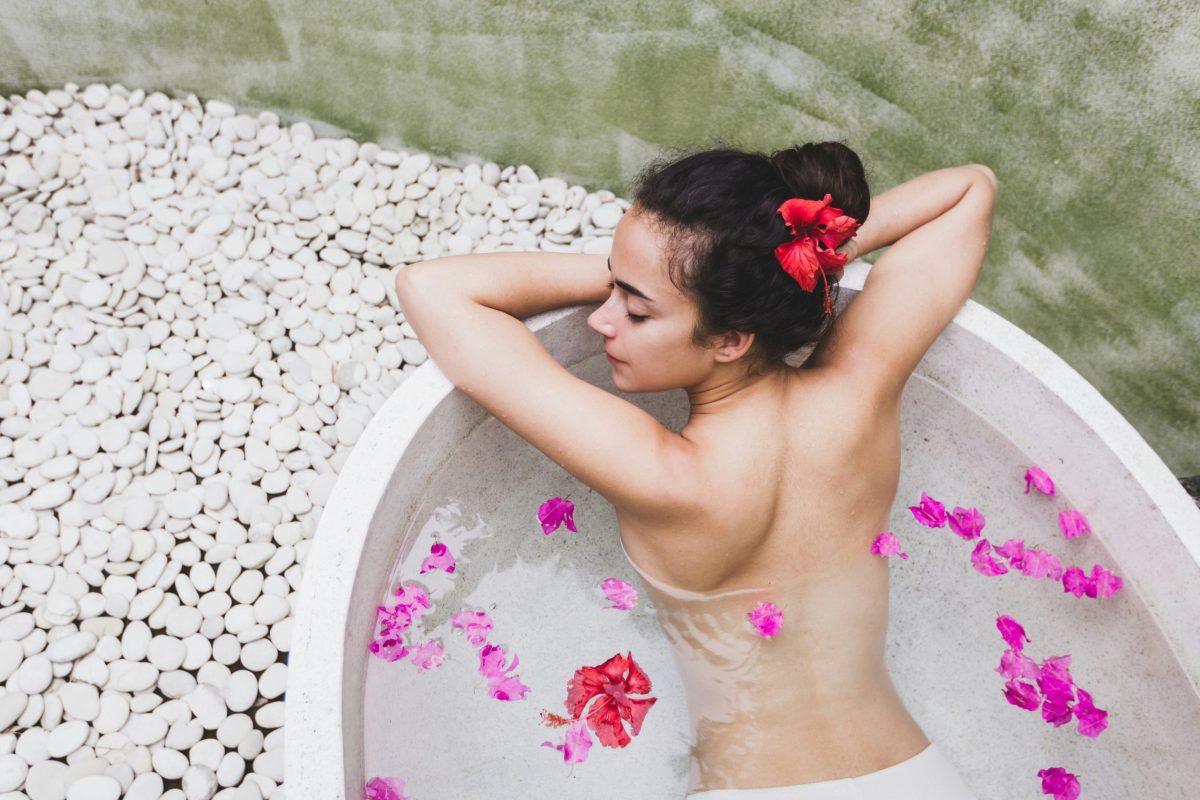
One of my favorite ways to get to know someone better is to share a spa day with them—but I don’t mean booking forty-five minutes at some chain place where you can get a manicure in a bathrobe. What I have in mind is a Korean spa, a jjimjilbang, where you stash your clothes in a locker and wear nothing but a spiral plastic bracelet while you move from hot tub to cold plunge, wood sauna to steam sauna to salt room to body scrub. The communal nudity of these spaces offers a radical departure from the body-fearing purity culture I grew up in, and the particularity of the setting often draws out unexpected revelations and moments of clarity.
A visit to a bathhouse forcefully separates me from my regular defenses and distractions. If I opt for a traditional body scrub, it even separates me from my skin. The bathhouse is a meditative place, where I am but a body among other naked bodies. These spas are often located in unremarkable strip malls or commercial centers on the edge of town, and their ordinariness restores a kind of blessed banality to the hypersexualized body. When I dump a plastic scoopful of mugwort tea water over my scalp and bare shoulders, I remember that my body exists for so much more than visual consumption. When I sit on a cedar bench and let the dry heat of a wood sauna penetrate every pore, the heat blossoms inside my ribcage and expands my sensory range. I become more permeable to the world, and my receptivity recalibrates. To go back and forth from a cold pool to a steam sauna, only changing rooms or pools when I can pretend that I’ve forgotten what it feels like to feel differently, is to practice enacting those famous lines from Ranier Maria Rilke: “Let everything happen to you: beauty and terror. / Just keep going. No feeling is final.”
For this reason, I always get excited when I encounter a written scene that takes place in a jjimjilbang, a Russian bathhouse, a hammam, or any other kind of specific bathing venue. I set about aggregating some of my favorite bathhouse scenes and discovered that each example, while ostensibly centering on the venue where it happens, expresses the style and priorities of the larger work from which it comes. This internal integrity is one of the signs of a well-constructed book: Whatever the book’s priorities, they are reiterated on every level of scale, from craft choices as small as diction and syntax to sentence structure to scene to overall effect. I loved recognizing how the overarching concerns of each of these works is captured in miniature in their spa scenes.
Pachinko by Min Jin Lee
Set in Korea and Japan between 1910 and 1989, Pachinko chronicles the daily lives of four generations of Koreans in exile. Forty years apart, two different characters—first, Sunja; later, Ayame—visit the public bathhouse, or sento. In each case, the bathhouse is a utilitarian space used for hygiene and relaxation, and each mention underscores the tensions the characters endure in the midst of their quotidian responsibilities. For Sunja—the woman at the center of the novel’s tessellating history—the sento she visits on her first night in Osaka is a reminder of her alienation from her home country, as well as an adumbration of the nationalist prejudice that will intensify over the years to come. This is the work of a skilled novelist: to take a generic personal obligation—something as simple and routine as bathing—and leverage it to convey both context and interiority. For Ayame, her bathhouse visit precedes her discovery of a clandestine sex grove. Her return visits to the sento are infused with a growing curiosity about the secluded thicket and what happens there. In this way, Lee reflects that a bathhouse is not necessarily a sexual space, but neither does it preclude the erotic dimensions of an embodied life.
Crying in H Mart by Michelle Zauner
Zauner’s memoir, which shot onto bestseller lists after its publication in 2022, commemorates her relationship with her Korean mother. In the scene with the Korean spa, Zauner has just introduced her (white) boyfriend, Peter, to her parents for the first time. They bet on whether or not he’ll chicken out on the trip to the spa, and by showing up, he wins her mother’s respect.
Crying in H Mart also includes the most comprehensive description of a Korean spa of any of the books I’ve listed here. Zauner writes: “Jjimjilbangs are typically separated by gender, with a communal area for both sexes to socialize in the loose-fitted, matching pajamas provided on entry. Inside the bathhouse, full nudity is standard.” For Zauner, the visit to the jjimjilbang provides a moment of protected intimacy with her pre-cancer-diagnosis mother, months before Zauner could appreciate how precious such experiences would become. The spa trip in Crying in H Mart commemorates a tender mother-daughter milestone while demystifying elements of Zauner’s Korean heritage for a multicultural readership.
The Magical Language of Others by E.J. Koh
Winner of the Washington State Book Award, this delicate memoir is built around Koh’s teen years and the letters she received from her mother, who returned to South Korea with her father while Koh and her brother remained in California. The spa scene comes during the summer after Koh has graduated high school, when she flies to Seoul to visit her parents. The visit to the jjimjilbang is part of Koh’s immersion in her mother’s Korean life. Koh’s mother professes a devotion and attention to Koh that manifests primarily in saccharine language and overstated acts of generosity, but fails to penetrate Koh’s daily life in the States. Their time at the spa illustrates these insufficient attempts at intimacy, while allowing them to share in a significant ritual. Throughout her memoir, Koh gestures toward the limits of language and the elusiveness of intimacy.
Splinters by Leslie Jamison
A spa visit is ideal fodder for Jamison: a bespoke, sensory setting that gradually recedes into background to allow for dialogue or interior reflection. In this case, Jamison and her friend Anna spend an evening at the Russian and Turkish Baths on Tenth Street. Jamison’s descriptions are lush and steamy, much more florid than either Zauner’s or Koh’s. The presence of others in the bathhouse is a fact Jamison uses to console herself against her personal disappointments and deprivations, and she gestures toward the communal nature of these spaces and the sense of shared humanity they open up. As elsewhere in Splinters, Jamison is straining for transcendence, and she asserts it via her projections onto and vivid descriptions of others.
We Were the Universe by Kimberly King Parsons
Kit, the protagonist of Parsons’ novel, is a young mother unmoored with grief over the death of her sister, so her best friend Pete plans a getaway to Montana for the two of them to unwind. Part of this adventure involves not a trip to the spa, but to nature’s spa: a natural hot springs called “Boiling River.” Kit’s grief keeps her suspended between timelines, mentally leaching into the past at each lapse in stimulation, and the Boiling River provides ample time to lose herself in recollection and to experience a bizarre altercation with a much younger hot-springer. Their interaction dredges painfully into the present a piqued iteration of the same questions that underlie the entire novel, questions of care, connection, and responsibility.
Family Meal by Bryan Washington
“I met Ian at a bathhouse,” states TJ, one of three narrators in Washington’s second novel. Washington’s fiction centers Black and mixed-race gay men, and he references the bathhouse as casually as if it were a bar or a bakery. The two characters meet in line for a post-fuck vending machine Coke, and Ian offers TJ his quarters. The scene underscores Washington’s preoccupation with excessive generosity and the fuzzy space between transactionalism and emotional intimacy. Ian, the love interest in question, immediately draws attention to the blurred lines and ambiguous boundaries of the bathhouse. Like the rest of the novel, the bathhouse scene normalizes hookup culture while also demonstrating a longing for something more.
The Loneliness Files by Athena Dixon
Dixon’s essay “Deprivation” is entirely about her session in a sensory deprivation tank, one of those capsules of heavily salinated water in which a person can soak in the dark, completely suspended. The quiet of the tank makes Dixon wish for the familiar external stimulation of her phone. Most of Dixon’s book foregrounds loneliness and the dubious pleasure of digital distraction. The solitude of a sensory deprivation tank is appropriate to Dixon’s creative project even as it illustrates how our contemporary social faith in individualism overshadows long histories of communal spaces and practices. After having soaked in so many different spa scenes, I wonder what essay Dixon might’ve written had she gone to a jjimjilbang, and how spaces devoted to nonperformative, routine human interaction can counter the mythology of being the only one.
“Things of My Mother’s” by Jacky Grey
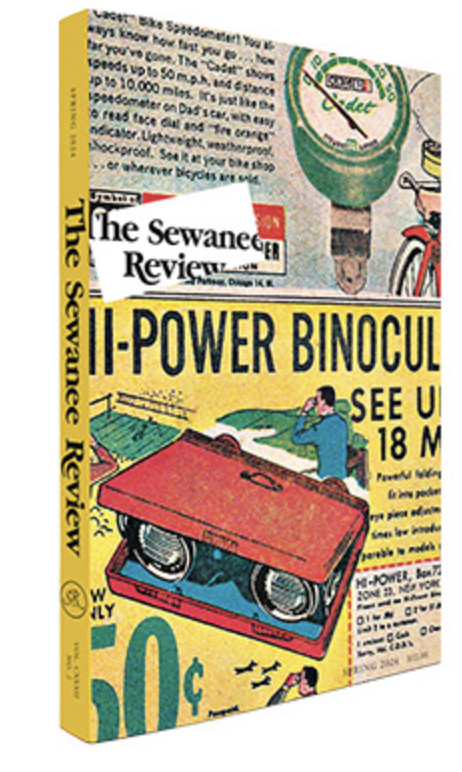
This essay, selected by Alexander Chee as the winner of the 2023 Sewanee Review prize, ends with a scene in a Korean spa in Tacoma, Washington. The narrator is, like Michelle Zauner, descended from a Korean mother and a non-Korean father; however, Grey’s mother died in childbirth and effectively severed Grey from whatever Korean heritage they might have accessed from their mother, who was, herself, adopted by white missionaries in the 1970s. Grey’s pilgrimage to the jjimjilbang is a powerful scene of restoration. Grey describes the body scrub they receive in precise detail, describing the routine conscientiousness of the woman performing the body scrub, and noting that their time at the spa is “also the longest I have ever spent around other Korean bodies.” In clear and resonant language, Grey braids together physical experience, an internal instance of racial self-integration, and emotional upheaval. Grey’s essay considers the nuances of racial identity and self-reclamation throughout. Finally, Grey also recognizes the messy entanglement with capitalism: “It felt sacred,” Grey writes, “yet this was her job, and she will probably wash another four women besides me today. Today, for two hours, I got to be fully Korean.”