Electric Literature must raise $35,000 to fund our next chapter. EL’s incoming Executive Director and Publisher, Denne Michele Norris, plans to grow EL’s reach and influence by every measure, while maintaining our sharp, independent spirit. We need your help to ensure our continued success.
Donate now to join us in building EL’s future.
Obliscence by Veronica Vo
Elementary school in Palmdale, California was a sprawling flatland of cement, and a fence around the perimeter separated us from mounds of brown dirt and rock. Even the buildings were flat, as if everything was made from clay pressed down by the palm of an eager child. When the sun was out, it was hot without relief. The cool air inside the library was a reprieve from the weather, and the loneliness, though I didn’t have words for it yet. My homely appearance as a child was the kind that is remarkable only in retrospect, for the isolation it added. My hair was straight and my mother would put a bowl on my head, hold it down, and cut right around the rim. I wore whatever she dressed me in, and style was never something she prioritized, even for herself.
When our class took group trips to the library, we gathered on a bright blue rug with cartoonish books and apples around the border. I always sat near the back. The librarian, seated on a chair at the front where we all faced her, pulled a book from the display on the shelf. Week after week she read to us from colorful picture books, her voice animated, her hands pressing the pages back where they wanted to turn. I was enraptured; I loved listening to her read, giggling at parts that were funny, studying the images on the paper.
Sometimes, she read from the No, David! books, where a devious little boy drawn with few hairs and fewer teeth wreaks havoc on his surroundings, against his parents’ wishes. At the end of every story, they remind him he is still loved, no matter how he betrays them. One week, the book was A Bad Case of Stripes, about a girl who wants to fit in but becomes covered in stripes that change to match whatever is happening around her. The image of her skin, the color of rainbow stripes or red white and blue stars captivated all of us on the rug that day. I never spoke when the librarian asked for audience participation, didn’t so much as whisper along to myself. After her reading time was over, I would find my way back to the book we had heard aloud, picking it up, listening to the crinkle of the cover where it was laminated.
My mother started picking up on the fact that reading was something I enjoyed. She took me to Barnes & Noble, holding my hand as we crossed from the parking lot to the entrance. I was always annoyed at having to hold her hand, her palms so warm they made my little ones clammy. Once inside the bookstore, I broke free, rushing to the children’s section as she followed behind. There was a reading area for kids: a slightly raised half-circle of wood like an amphitheater stage, benches arranged in a circle around it, and three-dimensional cutouts of trees against a backdrop of illustrated forest with woodland animals. Once, there were cutouts of Frog and Toad stationed next to the benches. My mother sat cross-legged to my right on the little stage, a stack of books to my left. The three of them watched me read: her, Frog, and Toad. She sat and patiently waited for me to sound words out loud, watching from behind her round glasses, smiling fondly. Despite having no interest in books, and that we mostly spoke in Vietnamese, she did this again and again.
In the house I now share with other graduate students, a pair of pink rubber gloves sits constantly by the kitchen sink. Nobody ever uses them, so I don’t know why they’re there. But these are the kind of gloves my mother always told, or rather warned, me to wear. A cautionary tale. If you don’t wear them when you wash the dishes, she’d say, you’ll end up with hands like mine. This would be her cue to look at her hands in disgust, at the textures of wrinkles and scars. She was always so afraid of me ending up with hands like hers. My mother wanted me to be different from her, to be better.Evidence of this pleased her, such as my living alone, traveling alone, even an ability to read music. Similarities between us upset her, like poor eyesight, gray hair, a fear of driving. I have never been able to understand this, because when I do something I’m proud of, I am reminded of her. I hear her in my laugh. In the way I talk to strangers, or read aloud, these things that she taught me. My mother taught me how to love reading and writing, though she rarely did either herself.
My mother wanted me to be different from her, to be better.
Now I write from a body that used to be part of hers, and this act is the final departure. I don’t know how to tell this story, can’t get myself to look at it directly. I have tried countless times. The problem with a story is that it needs a beginning, middle, and end. This story has no end. I can not find the beginning, though I have spent all this time trying to remember my way back to it. And so I find myself here, grasping at the middle, which is to say, at the moments of life that come between birth and death—at least the ones that linger in my memory. I keep wanting to give up. Instead, I’ll try again, to find the place where story begins.
Perhaps this is the location where it starts: the house I lived in from high school onwards. The last of five homes we lived in as I grew up, the place my parents would settle and, eventually, retire. I could start here.
INT. LIVING ROOM – NIGHTA middle-aged woman and a college-aged girl sit
side by side on a brown couch.WOMAN
The other day I was walking behind a group of
people, I was in . . . Costco? Where was I. It
was . . . where . . .
The girl, who has been watching the television,
glances at the woman. She stares at her as she
struggles through her sentence.WOMAN
The girl rests her temple and the side of her face
I was . . . I don’t remember. I was . . .
walking behind a . . . a group of people.
between her thumb and forefinger. She squeezes. She
is no longer looking at the woman, or the tv, but
rather at a space in the distance.
Or here.
INT. LIVING ROOM – NIGHTThe girl and the woman on the couch, next to a
middle-aged man.WOMAN
I love that show. I could watch it 100 times and
never get bored.MAN
(joking)
OK, that’s the one we’ll put on for you in the
nursing home soon. It’ll be like a new one every
time.WOMAN
(laughing)
I think that’d keep me happy.

The girl shakes her head at the man and woman,
who don’t look at her.
But maybe here’s where it really begins.
INT. SUBURBAN HOUSE - DAYA young teenage girl bounds down the stairs.
She heads for the door to the house. On the
way there, she passes a woman in the kitchen.
GIRL
I’m going out!WOMAN
With who?GIRL
Kate! To the mall.
The girl continues to the front door.
The woman turns around, following the girl.WOMAN
Where are you going?
The girl furrows her eyebrows. She frowns.GIRL
To the mall, with Kate, I just told you.WOMAN
Oh.
The woman turns around, then turns back to face
the girl again.
WOMAN
Where are you going?They repeat this exchange a couple of times. The
girlresponds with increasing panic. The woman
grows frantic, fearful. There is a high-pitched
ringing in the background, getting progressively
louder.CUT TO:
The first time that time looped, it also stopped. For me and for her.
The internet tells me this was likely transient global amnesia. A temporary episode of memory loss that can happen, with no prior symptoms and no future recurrence. Diagnostic criteria includes having been witnessed by an observer, an absence of other cognitive impairment, and resolution within 24 hours. A unique feature is perseveration, in which the person methodically repeats statements with identical intonation like a sound clip looped over and over. After a few hours my mother was fine again, and she didn’t remember any of it. I was the only witness, the only one who remembers. An isolated incident of forgetting.
Nothing was really wrong, then. Maybe this isn’t actually the point where the story starts, but where my fear does. A few years later, my mother started to forget things. A few years later, everyone around her bore witness. Whether or not this incident was unrelated, I had already learned everything I needed to. How to dread. To pretend I was living in a movie and someone else was writing the script. To harbor a kind of fatigue so familiar it can only be observed, and cannot be expressed, so deep it presents itself only through the eyes of a third party, like someone looking at you and saying, you look tired.
Oh, I think. How tired I am.
Allegedly, there was a neurophysiologist from the early 1900s who departed from all previous cognitive research with his idea that memory is an illusion. There’s no evidence of Geoffrey Sonnabend’s existence beyond an exhibit at the Museum of Jurassic Technology in Venice, California, where I first came across his information last year. A video on his research plays on a small screen in the museum, and visitors can sit on the seat in front of it and listen. Sonnabend and his ideas could be completely made up; this museum is a place that straddles the line between fact and fiction. The exhibit makes little attempt to convince visitors that his ideas have scientific backing, but details about his life and theories bolster their persuasiveness.
In putting a life on the page, the words calcify into memory, regardless of truth.
According to Sonnabend, experience is the only thing that exists, and forgetting is the inevitable outcome of all experience. We are condemned to live in the present, he wrote, and against that, we have created this idea of memory “to buffer ourselves against the intolerable knowledge of the irreversible passage of time and the irretrievability of its moments and events.” Sonnabend did not deny the existence of memory, but saw it as just experience and its decay. To illustrate this more clearly, he created the Model of Obliscence.
All living things have a Cone of Obliscence through which we experience life. The cone is described as if it were an organ, integral and unique to each individual. The other element of the model is the Plane of Experience, a tilted flat surface which is always in motion. In the course of its motion, the Plane will intersect with the Cone. This movement depicts a sequence of events: being involved in an experience, remembering it, and then having forgotten it. The initial intersection of the Plane and Cone is the involvement. As the Plane moves through the Cone, past its base, this is remembering it. Once the Plane and Cone are no longer touching and the Plane has completely passed through, we have forgotten.
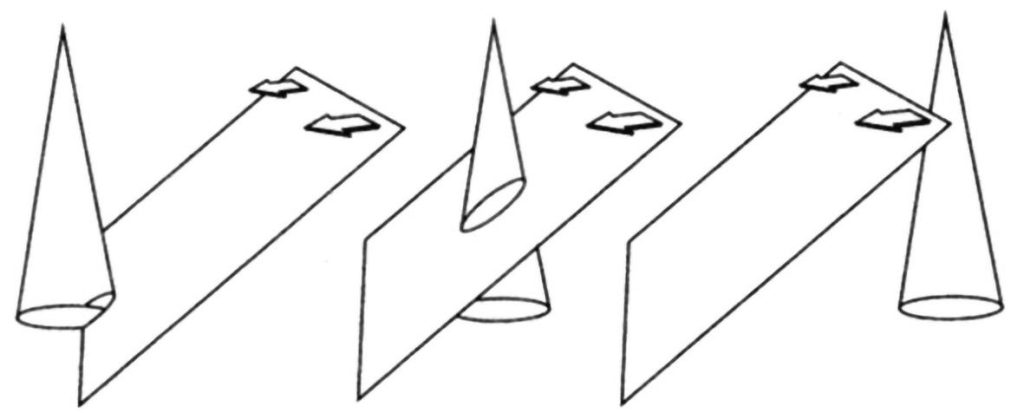
As presented, Sonnabend’s theory is based completely on narrative. Seeking verification of its claims leads only back to the museum itself, which places far more emphasis on telling the story than making sure a visitor can understand the concepts. The Model relies entirely on story, on making narrative out of something that would otherwise be too obsolete to be remembered.
In fourth grade, my mother signed me up for an afterschool program taught by my English teacher, Mrs. Jones. I whined and complained the whole way there, begging her to take me out of it. She simply kept driving, as if she knew something I didn’t. My mother had a habit of signing me up for things I had no interest in, which is how I also ended up at chess club after school, sitting uncomfortably in a circle full of white boys with glasses. I begrudgingly took my seat at a desk in the nearly empty classroom with Mrs. Jones at the front, swinging her permed blonde hair. She gave us writing exercises and encouraged us to write about what we were interested in.
At the time, all the girls I knew had an interest in a specific species of animal. The most common ones were horses and cats. I had decided I liked wolves after reading Wolves of the Beyond, so I wrote a few pages about them every week, and then I began to write short stories. Sometimes they were about made-up events. Most were based on my life. When instructed to describe an experience we had over the summer, I gave an account of how I almost drowned in the ocean on a family trip. Not about the fact that we had been having fun on the beach before I attempted to swim, or that we were in Hawaii, where the beauty around me had surprised and fascinated me. Without being told, I understood how to use my own fear as fodder for a story, where the narrative tension would have to come from, where the strongest emotions had appeared.
In capturing this memory, I forgot about all the new sights I had seen, about the good food we ate and how much we laughed. I had unknowingly limited the scope of my own ability to remember. In putting a life on the page, the words calcify into memory, regardless of truth, regardless of intention. The memory shifts. Eventually, it is replaced completely by the written account. Maybe it’s true what Lidia Yuknavitch once wrote, in that the safest memories are locked in the minds of those who can’t remember. I can’t tell if the story I am attempting to unlock will be the thing that saves or ruins.
I sat in the top bunk of the freshman dorm room I shared with two others. It was late at night, and I had just returned from dance practice in an empty garage. My roommates weren’t around. I didn’t know what to do with the feeling that filled my chest, clouding the edges of my vision whenever I was alone. I was barely 18 and months into college and my first real relationship, with a girl who swore that pain was a natural part of dating and queerness. After practice had ended earlier, when conversation petered out and people began to leave, I became acutely afraid.
I didn’t know how to ask someone to walk ten minutes back to my dorm with me, not because I was afraid of the dark or being on campus alone, but because I was afraid she would surprise me on the walk. I flinched at every person-shaped shadow that passed me on the way home. I was scared of the person I was becoming in the shadow of this relationship. I had no idea how to convey the depth of what was happening to me. I didn’t even understand it.
Resting my back against the beige wall, I stared into the eye-level fluorescent ceiling light. I wrapped the edges of my comforter around me and opened a blank Word document. Written in the second person, I began a letter to her, but, through writing it, realized it was also a letter to myself. I wanted to believe that I would survive this. I wanted to be able to look back one day and remember that I had. It was, at the time, a perfect catharsis. Writing brought me into a new register of understanding myself.
The relationship had a clear before and after, an easily understood narrative arc. As did the stories I wrote about my life then, ones that allowed me to neatly impose a beginning and ending. After college ended, I was living at home again, working and coming back and realizing how much worse my mother’s memory had gotten. I found myself writing about it constantly. I thought I would wrangle this body of thought, fit it into the neat shell of narrative, but it falls apart with every attempt to grasp it. Years of gradual decay. Some days are better than others. What do I do with that? With how you can know someone like your own hand and yet appear as a stranger to them? How do I make it into story, this unraveling mind, while I’m still disappearing in front of it?
During the time I lived in Korea in my senior year of college, I decided to visit a shaman. I took my friend Rose with me to translate, who was also interested in seeing what they would have to say. We walked together to the building where the fortune-telling place was located. Outside, multiple stories with storefronts advertised themselves on each level, a Tetris of multicolored vertical and horizontal signs. Our destination was on the first floor, and once inside, we were checked in and told to wait in the entry room. We sat on a couch with small circular tables around it, the surfaces strewn with open binders of different services and readings available. Rose and I agreed to the basic reading, and within a few minutes we were summoned into another dimly lit room. A candle burned from one corner of the table, a dark blue cloth laid out over the rest of it.
An older man with bright gray hair sat behind the desk, one chair directly in front of it, a few others around. He smiled and greeted us, then asked which of us wanted to start. Rose and I looked at each other, then she sat at the desk while I pulled up a chair beside her. The shaman asked Rose to pull cards from a Tarot deck. He spread them across the table, but didn’t look at them once. He spoke of her personality, relationships, her tendency to move countries throughout her life, her career. Later, Rose told me that his reading aligned closely with the one her parents had done for her with an expensive, reputable shaman when she was still a baby in Korea.
Then, it was my turn. Again, the pulling of cards and the shaman’s ignoring them. He spoke to me about the same things as with Rose, and said there was harmony between the field of writing and me as a person. He also issued a warning. He said I had a tendency to give up on endeavors once I felt like they were too difficult or weren’t worth the effort, something I already knew about myself. If I was to succeed, he told me, I would have to stop doing this. “You don’t follow through,” my friend translated. “You need to see things to their conclusion, to get where you’re supposed to be.”
I figure if the story inside me is still trying to break free then it hasn’t concluded. But maybe I’m just telling it so I can look away from the future in front of me. The splayed deck of cards. The stories we tell ourselves.
In Lisbon, at my first writing retreat during graduate school, I took an experimental poetry workshop. On the first day, we all wore masks, but a woman across the table from me caught my attention. The crinkle in her eyes was unmistakable. She tittered with friendly laughter at nearly everything anyone had to say. I was curious what was making her so happy, and ended up staring too long on a few occasions. When her blue eyes met mine behind her bright green glasses, she waved. When the class was over, I asked if anyone wanted to walk around, and she joined, smiling brightly.
I figure if the story inside me is still trying to break free then it hasn’t concluded.
In the blazing, unshaded heat of the Portugal summer, Hazel and I made the fifteen minute trek to an open plaza with one of Lisbon’s oldest churches, the Church of St. Dominic. I learned that Hazel was in her 50s, about the same age as my mother, and had come on this trip with her husband and daughter. We talked about everything but our writing. She laughed often, her joy so earnest that I couldn’t help but laugh too. It was my first time befriending someone my mother’s age, and she was so easy to be around. There was no tension in my shoulders when I listened to her speak, no tightness in my smile when I mirrored her expression.
Upon entering the church, a poster by the door described its history, that the building survived several earthquakes and a devastating fire in 1959. The effects of the fire were still visible, the church pillars scarred, the interior walls charred. In 1994 the church reopened, and the restoration purposely left the signs of the fire in place. Its visible damage served as a preservation of its history, a reminder to visitors of the impermanent nature of even such a grand structure.
Hazel and I meandered separately around, inspecting the stations of the cross and statues of saints around the walls. At the statue of Mary by the altar, I decided to light a votive prayer candle the way I watched my mother do so often growing up. I dropped a 50-cent euro coin in the box for donations, grabbed the electric lighter, and lit a candle near the edge of the row of candles. I closed my eyes for a few seconds and didn’t know what to do next, so I let images of her come to mind.
As I closed my eyes, I wondered what it would be like to meet my mother as a stranger here, in a foreign country, at a conference with shared interests. I wondered how it would feel to listen to her tell me about her children and her work with such clarity. If we would have gotten along well, if I would have also marveled at how easy she was to spend time with, been so grateful to meet her purely by chance.
The following year I found myself at a highly-attended, annual writing conference for the first time. In the conference hall around thousands of strangers, I walked through hundreds of booths trying to convince me to buy their magazines or submit my work. The feeling appeared in me vaguely and then acutely, the weakening of will. I was one of so many. I had only a hazy sense of why I was doing any of it or why it mattered and it was possibly the least useful thing I could have been doing with my time. I wandered around the building in a daze, as if on the precipice of splintering, when I saw her again. Hazel, in her bright green glasses, stood working by the entry area of the conference hall.
When she spotted me, she smiled widely and walked over to hug me. Even as she spoke about her divorce, about how it was the hardest thing she’d ever done, the mirth never left Hazel’s expression. She remembered the boy I had been dating at the time we met. She remembered the things we had done together in Lisbon. Hazel invited me to lunch later that day, and there in the restaurant, laughing over tea and dan dan noodles, I remembered. Writing had become a way for me to understand myself, but I had forgotten, for a moment, there was still a self outside this understanding.
In one of my favorite movies, The Boy and the Heron, a young boy follows a heron into a magical world, under the guise of being reunited with his dead mother. His mother died in the firebombing of a hospital during war, when the boy was only a few years old. The heron is a mischievous entity, the Birdman, in disguise. The boy goes on an adventure in this magic world, and meets his mother as a young girl, though he doesn’t know who she is. Eventually, the world starts to collapse in on itself and the boy must escape.
The girl grabs his hand and runs, leading him down a fluorescent rock tunnel that opens into a dark hallway, the floor an unfurled red carpet of velvet, the walls lined with endless doors. The girl brings the boy to the door that leads back to his world. Through it, he can see his father running through green fields, frantically calling his name. The girl goes over to another door, where a burning building awaits. The boy expects her to go with him, but she reveals her identity, and hugs him. He warns her she will die if she goes through that door. She smiles, tells him, I’m not afraid of fire, but it’s clear that she is. I’m so excited to be your mother, she says, it was the most beautiful thing for me.
I can’t remember which of them leaves first, just that they leave each other. Soon after returning to the real world, the boy starts to forget the details of what happened in the other one, and panics. The heron assures him, forgetting is normal, encouraging the boy to release his grasp on memory, to embrace the natural progression of its falling away. The Plane and Cone no longer touching. The boy is distraught. Memory is all he has of their relationship. It is the only thing that keeps his mother from being a stranger. Researching the film after watching it for the first time, I discovered that its original title was How Do You Live?
If I could have met my mother as a young girl, I wonder if she would have laughed like she does now, if I would have. If she would take my hand and lead me on adventures the way she did when I was a child and she was not. If she would choose the fire, if the fire is inevitable in every universe. So much if, could, would. How to know these things. The overlap between memory and experience is so brief and so temporary and there is only so much I can imagine. These days, my mother tells me, I want you to know if I died now I’d die happy, smiling like she knows something I don’t.
Writing had become a way for me to understand myself, but I had forgotten, for a moment, there was still a self outside this understanding.
When she was my age, she was still an undergraduate and her mother was still making her dinner after classes. She had just met my father. My mother used to joke that she was waiting for the day she’d see grandchildren. She doesn’t anymore. Now, she just wants me to eat well and do well and be happy, but I don’t know how to do that while remembering all that I am losing, even if memory is just a concept we invented and my hands are still her hands and the script repeats and loops and lacks narrative cohesion and I will never be a stranger and I hate this story for what it will never be. Here language is failing me, but language is all I have, and I don’t know how to let go. But I am trying. Can’t you see? I am trying.
In college, my friends and I took a day trip to a bookstore in Ojai. Fuchsia flowers and bright green vines climbed a trellis around the sign reading “Bart’s Books,” marking entry to the world’s largest open air bookstore. Shelves of books faced the street, spines of different heights and colors crammed into messy rows. The entrance opened up into a sprawling courtyard, tall reddish wooden bookshelves and palm trees standing sentry. Tin awnings covered the shelves that line the courtyard, overlapping canopy triangles and string lights stretched in the open space between. The space was peppered with shaded reading nooks, wooden benches, and potted plants. Walking through aisles of bookshelves simply led to more aisles, and even deeper rooms filled with dusty books of poetry.
We wandered around in the sunlight, idly pulling books from shelves, scanning their covers, putting them back. One friend and I walked into an indoor space lodged at the periphery of the courtyard. At a table inside the room, she found a palm reading deck opened, the cards spread out, invitational. I gave my friend my hand to examine and she tried to read my palm, squinting at the faint creases. I, too, studied them to no avail. The lines were inconclusive to us; we couldn’t form any narratives around them.
A few years after that day, another friend read my palm and found different versions of me in the lines etched into my skin. They studied my left hand cradled in theirs, and the lines indicated a split from a previous version of myself. The divergence must have occurred in the last two years. They asked if I’d changed a lot in that period, and it was around that time that I really started to pursue writing.
I was glad, when I first started, to have found something that I felt could contain my fears, could convince me there were ways to survive. I wish, now, I had lingered just a little longer in the days I didn’t put words to everything. The days I didn’t trap myself on the page, when time moved forward and memory was left untempered, and both were nothing to fear.
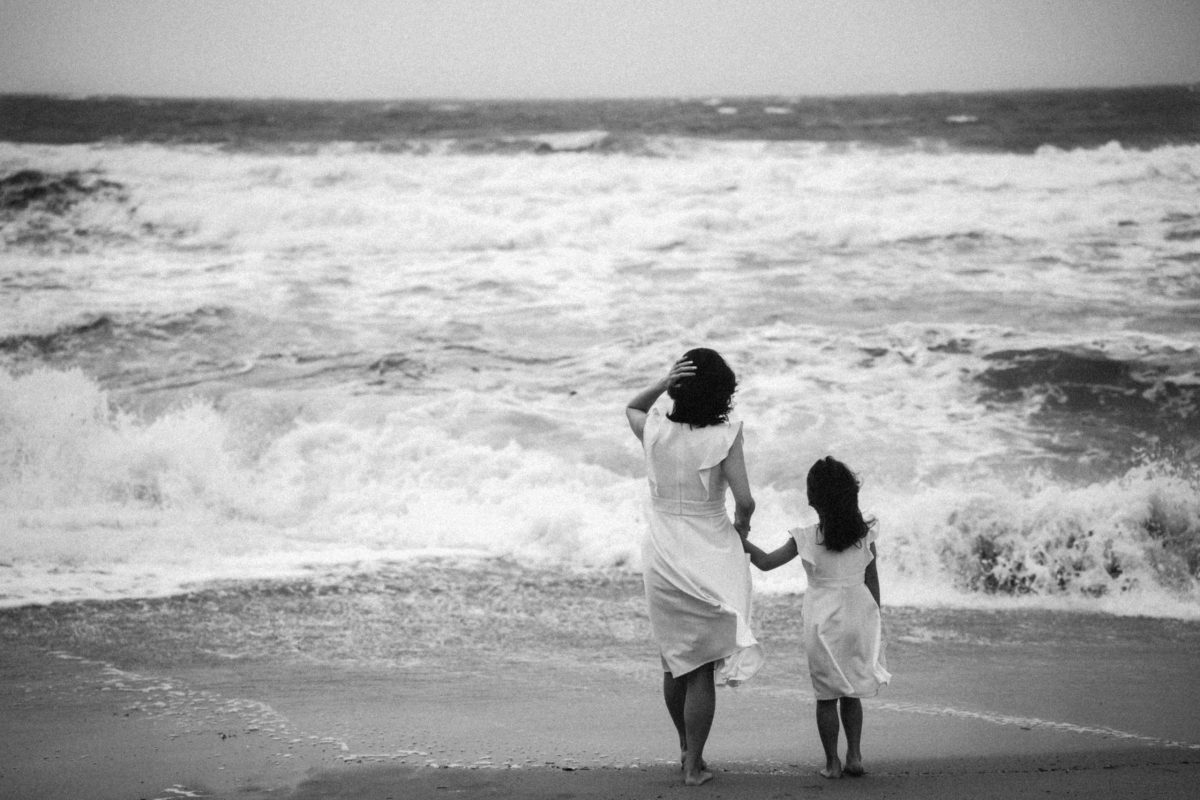
Around a year ago, I held a bouquet of flowers my mother handed me, a small arrangement the length of my forearm. She took each of the flowers out, one by one, trimming the stems until they were half their previous height. They needed to fit in the tiny, bullet-shaped vase attached to the flat slab of marble where my grandfather’s name was etched. Once she was finished, we walked over to the outdoor columbarium. We located one gray rectangle amidst many, and it was in the vase attached to it that we squeezed a few green stems. I stepped back and said a few words in my head, a hand up to shade my eyes from the sun. As we left and walked back to the car, my mother told me she wanted her ashes scattered in the ocean. I was immediately repelled by the idea. I thought I wanted something to come back to. When I asked her why, that day, she said something along the lines of wanting to be free. Now, I understand she didn’t want to tether us to anything. When the time comes, I’ll follow her wishes. I’ll wait for a day when the world is bright and clear, the kind of day when I’d tell her it’s beautiful outside and she’d agree without hesitation, it is. Find a boat or a shore and fill the creases of my hands with everything that she was and is and always will be. The way I’ve come to understand the world. Where I’ve been, where I’m going, the roadmap of my life. Cast it all across the ocean, my closed fist unfurling. An open palm facing the sky.