Altered Remains by Aleina Grace Edwards
For six weeks, every painting on the wall is brown. Pretty, stoic deer stand and stare with wide wet eyes; slick panthers stalk across the frames; and dawn breaks over some craggy mountain tops. Entire galaxies churn, the panels bursting with starfields that could be anywhere, in our corner of the universe or another. So many worlds rendered in sepia.
“He paints with tar from the La Brea Tar Pits,” I explain whenever a visitor asks about the material—and they always ask about the material. They’re intrigued by the thick, sepia paint, all the subtle textures. What is this, what is that? They always want to know how a thing is made. I introduce the Tar Pits over and over. It’s the end of summer, and people are on vacation in Los Angeles, many for the first time. “It’s the only active Ice Age dig site in the world,” I say. “It’s in the middle of the city—if you go right now, it’ll only take you twenty-five minutes to get there.” Most seem surprised to hear this, but dismiss it as a random oddity. A few insist they’ll go as soon as they leave the gallery, where I am the director.
Explorers and scientists have spent the better part of a century pulling fossils out of the natural asphalt that bubbles up through the grass in Rancho La Brea, now a park where the tar pits are located. You can walk around the grounds and watch the staff work, ten feet, twenty feet deep in the earth, dredging up oil and dirt. This muck is called the matrix—an ancient mixture filled with microfossils, tiny toes and teeth, shreds of ancient leaves.
Walk into the museum at the park—an outpost of the LA’s Natural History Museum further downtown—and you’ll see the paleontologists working in the Fossil Lab, the fishbowl station where they prepare findings from the pits. They’re all wearing white coats and blue gloves, like doctors who might swab your throat in a different setting. Here, though, they rinse and sort bones. Once I saw a paleontologist with something large and meaty in her hands, maybe a femur. She held the bulge at one end as though it were a baby’s delicate head and used her other hand to swipe a long Q-tip along the length of the bone, probably cleaning off residue, though you couldn’t see any progress. The tar stains are impossible to remove. Her desk was crowded with tools, canisters of brushes and Q-tips, a large white microscope. If a specimen is broken or damaged, the paleontologist will try to reconstruct it with glue, putting all the little bits she can find back together. She set the bone down and shuffled muddy fragments across the desk, touching them carefully with green-gloved fingers. She was looking for something specific. She arranged the pieces, stepped back and considered her work—she saw something there, in the mess.
We visited the Tar Pits often when I was a kid, my parents eager to show my sister and me the layers of history buried under our city—a place they’d moved from Texas just a month before I was born. The pits were discovered by a Spanish expedition in 1769. A friar who tagged along with the group noted the strange climate and landscape of the area in his diary: “In the afternoon we felt new earthquakes, the continuation of which astonishes us,” he writes. “We judge that in the mountains that run to the west in front of us there are some volcanoes. The explorers saw some large marshes of a certain substance like pitch, they were boiling and bubbling.” He wondered about the relationship between the tar and the earthquakes, unfamiliar with both.
When I was seven and eight, I wanted to be a paleontologist. I drew myself on a dig for a school assignment, crouched in vibrant orange sand, wearing green cargo pants and a boxy red shirt. There was a bone outlined in thick black marker by my dusty knees, drawn the way all cartoon bones are, with big, bubbly ends. My face was obscured by a wide-brim hat, the kind I imagined you would wear for long days in the desert. I conjured myself as part-sleuth, part-storyteller, able to make sense of things that happened thousands of years ago with only the tiniest shards of information.
I was terrified of human bones, my own especially.
The obsession with this line of work perplexed my parents, even as they tried to feed my curiosity. I was terrified of human bones, my own especially. I sobbed when a pinky finger bent the wrong way when I caught it on a playground slide, sure it was going to fall off. Tears ran down my cheeks at the emergency room; I refused to make eye contact with anyone else waiting to be summoned deeper into the hospital, disturbed by our shared status as sick or injured.
I was anxious about obscure diseases, too, like Mad Cow, the scraps of information I heard on the radio or at someone else’s house plaguing me. West Nile was on the news at my uncle’s house, on the TV crowned by a stuffed pheasant, its dead wings spread wide across the wall as if in flight. There was an epidemic in Texas, the reporter said. I was there for the summer, bouncing between family members. Mosquitos loved me; I was already covered in red spots the size of quarters. I imagined my infection, my spinal cord stiffening and my brain swelling. I cried and cried on the phone with my mother, begging her to come get me and take me home, certain every second spent away from her was an exponentially greater risk.
There isn’t a clear connection between the pits and earthquake activity, though both are endemic to Los Angeles. The pits formed as crude oil moved up through fissures in the Earth’s crust, and when people began mining the asphalt here in the 1800s, one of the holes they left behind collected rain and groundwater until it became a bubbling pool, dark and pearlescent. Today it is the iconic Lake Pit, where model mammoths are arranged to show visitors exactly how so many animals and plants got stuck there. The tar looks like water but for its slight iridescence, the little methane bubbles, and the unmistakable petroleum smell. Covered in fallen leaves or other debris, the pits would have been perfectly camouflaged. Animals wouldn’t know they were stepping in tar until it was too late, before they stuck and sank, buried for tens of thousands of years.
The probability that any organism will be completely preserved after it dies is very low, which is why the troves at the Tar Pits are so special—a mecca for students of natural history. “Natural history” refers to the interdisciplinary study of the natural world, with its roots in Ancient Greece. It encompasses many modern subjects, including biology, paleontology, geology, and philosophy, but unlike contemporary sciences, it was mostly observational, not experimental. In the long lifetime of such study, there have been many points of convergence between science and religion, fact and fiction, as scientists and scholars tried to come up with stories that linked the phenomena they saw into a logical narrative without much concrete evidence to go on. The problem is, the fossil record is sparse. When an animal dies in nature, its flesh is mostly gone a few weeks later. Bacteria, fungi, insects, water, wind, light—all these forces pull it apart, scatter the pieces. But asphalt is an impermeable preservative, keeping things as tiny and fragile as hollow bird bones and broken leaves intact for thousands of years; no water or oxygen ever reaches them. The Tar Pits have preserved specimens so perfectly they still contain original biological minerals, like the apatite from bones and calcite from shells. Using the molecular data from this material, scientists can date the fossils very precisely. They can establish a clear record of the natural world as it once was, and create a detailed narrative of change.
The summer I turned 10, I saw the inside of my own body for the first time. After school, I bent over in my uniform skort and hospital gown, exposing my back to the new surgeon and my mother. The surgeon, a referral from my usual pediatrician, pointed out the slight hump of my ribcage—I could see him gesturing with a pencil in the air above me, tracing the shape of the curve. I could see the red and black checkers of his starchy shirt, the slick of dark hair on the side of his head, thick and wet with product. His olive skin was sallow in the hospital lighting, almost waxen.
I was right, my body was not safe. On a structural level, it was unreliable.
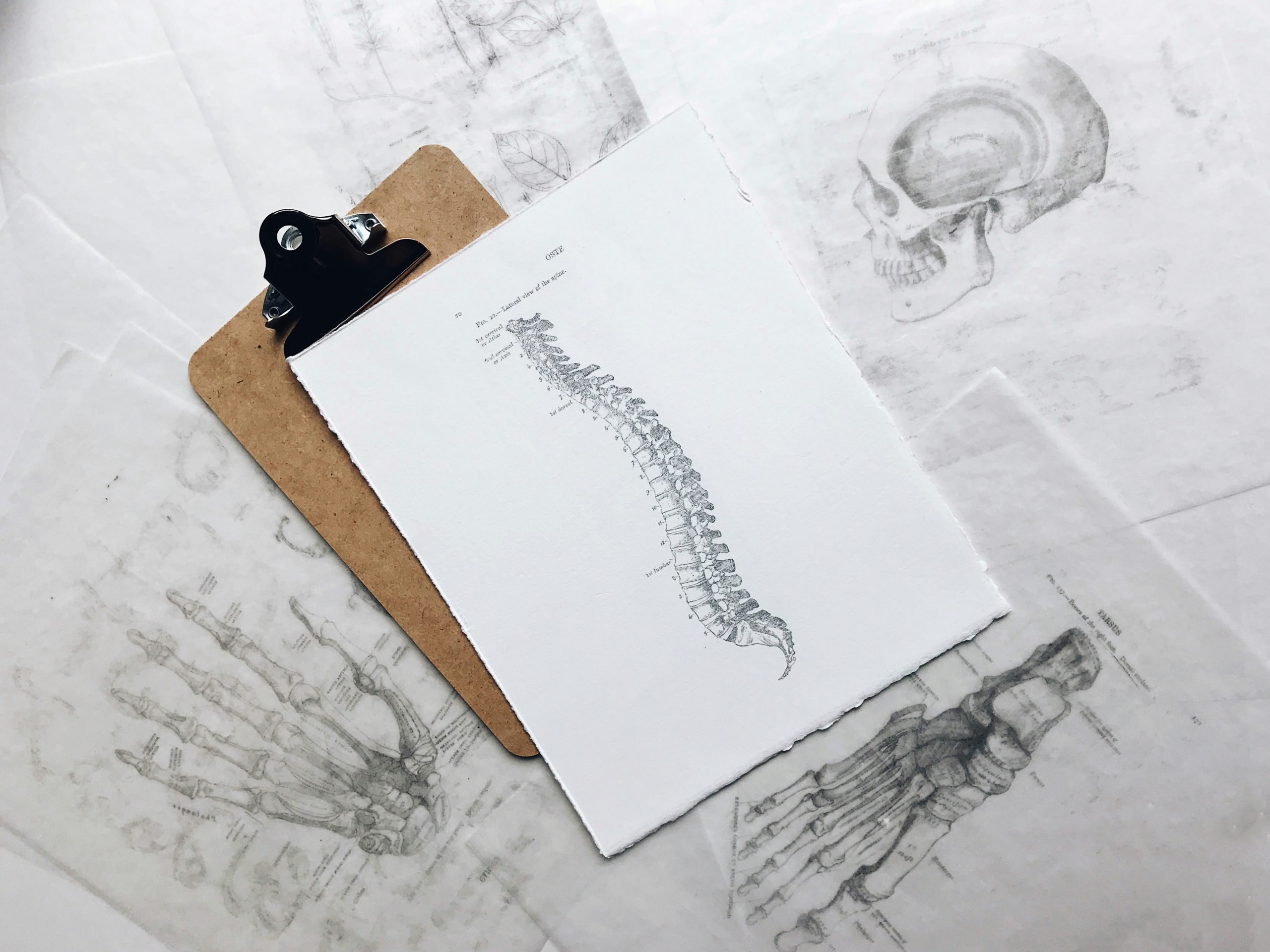
My pediatrician had suspected I had scoliosis, a spontaneous, abnormal curve of the spine. The surgeon confirmed it. The curve wasn’t severe then; it was still invisible to the untrained eye and unnoticeable under clothes. But it was there, on the computer screen. The surgeon annotated my X-ray, drawing a line across the top of the thoracic curve and another along the bottom, the lumbar. He traced a third line, an intersection. He measured the angle and typed quick notes. The nature of the condition, sudden and random and persistent, horrified me—but it was also, in a way, a relief. Here was confirmation of what I had often suspected as a small child: I was right, my body was not safe. On a structural level, it was unreliable.
There was nothing to do but wait for a while. Scoliosis like mine is quite common, especially in girls, and it doesn’t always become a bigger health concern. But the surgeon told my mother what might happen: I would grow, and so would the curve; I would need a back brace, and if that didn’t control the curve, I’d need a spinal fusion for permanent correction. Without surgery, my moving spine could twist my ribcage, forcing it against my heart and lungs. Potential complications were infertility, heart failure, pneumonia. Pain, certainly. Low self-esteem, likely.
It was a relatively routine surgery, he said, but it had its risks: fusion failure, chronic pain, paralysis, death. My mother held me close and tried to shush him as he rattled off the list of potential outcomes. She didn’t want me to hear those details, but it was too late. I had already stored them away, these new ways my body could betray me.
If my curve progressed past 45 degrees, we would have to move quickly. Once it hit that threshold, a curve would usually keep progressing even after the growth plates closed and the skeleton was fully developed. Plus, better correction is possible when patients are younger, when their bones are still pliable. Surgeons prefer to operate as soon as possible.
There has been only one human specimen ever shown at the Tar Pits: The La Brea Woman. She is the oldest human found in California, and her display case used to sit between a ground sloth’s and a suite of bird bones. It was almost too dark to see inside, her skeleton just barely illuminated in weak amber light. But every ten seconds or so, a hologram would turn her into an exaggerated woman with a neat hourglass figure—topless, brown eyes, and shiny hair down to her hips. Then the lights would change again, and she would shrink back to bone. When I stood in front of the La Brea Woman as a 10-year-old, we were about the same height, just under five feet; looking in the dark glass, my reflection slipped over her skeleton; I was her.
The La Brea Woman isn’t on display anymore. Sometime in the early 2000s, museum representatives decided it wasn’t right to display her remains: Her identity was mostly speculative, and she wasn’t actually found in the pits—she had been buried in a nearby grave. Her skull shape meant she may have been ethnically Chumash, and the museum’s director was worried about negative attention and demands for repatriation of the bones. So he put her remains in storage, where no one could see them. As far as I know, she’s still there.
I grew too much, too fast, and the new height twisted into deeper curves in my spine. For all of sixth and seventh grade, I wore a back brace molded to my body for 23 hours a day. At school, I layered t-shirts and sweatshirts to hide the bulk of the brace. Middle school cliques coagulated, but I was insular, and kept my distance from other kids. When a girl playfully poked me in the stomach before first period history, her finger bent back against the plastic under my clothes. Her eyes grew big and confused; I couldn’t explain. I just walked into class and sat down, the shame of it making me mute, skin sweating under the brace until I turned cold and stale. I was sure I would start crying if I tried to tell her what was wrong with me. I didn’t know where to begin.
I had X-rays taken every three months to monitor my spine’s movement. Each time was the same. Clothes off, drafty gown on. Wait in one room, then another. Bend over, then walk a few feet, let’s see how you move. The room is always cold, the doctor barely there. When he is, he notes another few degrees of movement in my spine.
We were waiting for my period. Your period means you’ll stop growing in a year or so, the surgeon told me. By the time it started, just days before my fourteenth birthday, my thoracic curve had already bent to 50 degrees.
This was the dynamic of treatment: pain now that would supposedly salvage my future.
The scoliosis had become more obvious in the skew of my shoulders and hips, the swing in my gait, but even then, it didn’t hurt much. I struggled with the dissonance of the impending surgery and my daily experience. My body looked bad, I was told, but I felt mostly fine. I got a little stiff after spending hours crunched into the small desks at school or in narrow airplane seats, but that didn’t seem significant. I was fencing competitively, successfully. I wanted to make the US national team. I saw myself as a promising athlete and a sharp student. I loved writing essays, sketching with charcoal. I wanted to be an artist, maybe. I was confused. I couldn’t feel the disease threatening me, though I was told it was. Now I see my mother’s fear was clearest in her willingness to try every treatment option, no matter how questionable. When the back brace didn’t stop my spine, she took me to a massage therapist who tried to move my vertebrae through violent bodywork, pushing muscle directly against bone. I lay on a table in his garage and cried quietly while he worked, tears squeaking a little against the faux-leather face rest. My bones seemed to burn where he pressed hardest, shoving my paraspinals against the curves with the full force of his large body. This was the dynamic of treatment: pain now that would supposedly salvage my future. I was taught every bad thing I felt was the mechanism of a cure.
There is a picture of me at 15, a few months before my spinal fusion. For years, the photo has moved with me from home to home, one of many in a box of keepsakes. My family went to a water park to celebrate my sister’s thirteenth birthday, and my mother gave my sister and me disposable waterproof cameras so we could document the day. In the photo, I am sitting on the top of a water slide, facing away, ready to go down. My arms are folded across my chest in preparation for the slide, my wet hair shellacked to my head, my whole back exposed in a string bikini such a pale shade of yellow, you can hardly tell I’m wearing anything. My spine presses against skin, each vertebra clearly articulated, the sequence forming a perfect S-shape down my back. My body appeared like an object I could see and describe, but it wasn’t me anymore. Before my last move, I threw the photo away.
It’s completely unusual for so many specimens in a natural history museum to be dug up on-site. Many of the world’s great collections, like those in the British Museum in London, or the Natural History Museum in New York, are the results of long colonial campaigns.
When Napoleon Bonaparte invaded Egypt at the turn of the nineteenth century, a commission of scientists and scholars went with him. They took detailed notes on Egyptian art, culture, and history; they found the Rosetta Stone, and they took that too. As explorers returned with more stolen corpses, Europeans began hosting unwrapping parties, which revolved around literally unrolling and examining mummified remains. At first, these gatherings served a purported medical purpose: Only surgeons were present, ostensibly there to learn more about the effects of mummification on the body and the natural history of certain diseases—mummification via salt preserves soft tissue well enough to stop the degradation of DNA. But surgical operations were often punishments and performances: Public autopsies might be retribution for extreme crimes, and the parties kept growing, hosted by wealthier people for intrigue and entertainment among friends. They started selling tickets to the public. You could pay to see a body excavated right in front of you.
An immersive King Tut exhibit recently toured the U.S. in honor of the 100th anniversary of the discovery of the child-pharaoh’s tomb—“the King Tut Experience takes you on a mythical journey through the afterlife!” There is something perversely soothing about experiencing death as fictive and fantastical, an experience so separate from your own. The bones I saw at the Tar Pits as a child were never real to me—they belonged to sublime creatures that no longer existed. I found comfort looking into empty eye sockets and between gaping ribs. It’s much easier to grapple with disease and decay when it affects an object, or even an animal, but not a person. But King Tut was hardly more than a boy when he died, only 18 or 19. He was buried with many things, most notably over 100 canes—generations of incest had left him with many medical issues, among them severe scoliosis and a rare bone disease that made it impossible for him to walk without assistance.
My dad asked me recently what he might’ve handled differently about my scoliosis treatment; I said I only wanted someone to ask me how I felt, how I wanted to approach it. Maybe it’s a parental prerogative to surrender their child’s body to science. The Mütter Museum in Philadelphia, where I went to college, is filled with medically anomalous remains donated for research. “The goal of the Museum is to help visitors understand the mysteries and beauty of the human body and appreciate the history of diagnosis and treatment of disease,” their website explains. Many are fetal remains; there are several babies’ skulls. No child, even an older one, can really sanction medical decisions regarding their own body in our current biomedical model. Legally, any patient under 18 cannot consent, or grant permission. They can only assent—they can agree with an opinion already given. But I don’t remember anyone truly asking me mine. It was my body in question, but the decisions affecting it would always be made by someone else.
I don’t have the records from the pediatrician who discovered my curve when I was 10, or the assessments from my original surgeon, who I saw for the first few years after my diagnosis. I don’t have the notes from the orthotist who strapped me to a glass table and created a three-dimensional image of my torso that would become the back brace I wore everyday for two years, until it was clear surgery was inevitable.
I do have years of X-rays, email attachments and PDF downloads showing my spectral spine bending between splayed ribs, the angles of each curve marked with red lines and numbers that keep ticking higher. I have 72 pages of password-protected notes from Children’s Hospital Los Angeles, where my operating surgeon was the head of orthopedic surgery, where I spent six hours on an operating table and a week recovering, hallucinating on oxycodone and learning how to walk again.
I didn’t read the operative report for my surgery until I was nearly 30. It took me a few weeks to get my records from the hospital staff, who had to find my papers in analog storage and scan them for me.
The patient: a 15-year-old girl of normal height, weight, appetite, and disposition. She presented on July 13, 2010, for a posterior spinal fusion of T-2 to T-11—her entire thoracic spine—to correct her case of adolescent idiopathic scoliosis. Her spine was twisted into an S-shape; surgically straightening the upper curve would pull the lower one along with it.
When the team opened her body on the operating table, conditions were more difficult than they anticipated. Her primary curve was extremely stiff. The vertebrae were wedged so tight, they had to remove more of the patient’s bone than planned. The patient’s right lung was severely impinged. The surgical team estimated it was only at 70 percent capacity.
It took nearly six hours to dissect the patient’s spine, apply grafts, and implement the hardware that would hold everything together. The surgeon used bone grafts scraped from the patient’s iliac crest and morsels from cadaver donors to close the gaps between her vertebrae. He added steel screws and a thick crossbar for extra support. The patient was an athlete. The extra stability would help her return to competition sooner.
The patient tolerated the procedure well.
There are holes in my hospital records. There’s no note about my return to the orthopedic floor, just three days after I’d gone home. The fainting episodes, which began in those days and continued for years after surgery, only get two lines, brief notes of “recurring syncope.” There’s no mention of my weight after surgery, of my concerningly low body fat percentage, of the number shrinking on the scale in my mother’s bathroom. There’s no mention of my intolerance to oxycodone, the hallucinations, my dad trying to strangle me, hands shoving my neck into the mattress. There was no inventory of the bottles of Advil I went through to control the pain without narcotics.
Recovery was mostly pain. Pain in my back, my chest, running down my legs and arms. The IVs pinching my wrists and ankles. The aching when I lay down, the stabbing when I stood up. I remember thinking, They did this to me, they did this to me.
Technically speaking, if a patient experiences any recurring pain after a spinal fusion, she has failed fusion syndrome. It’s been almost 13 years since my surgery and my back still bothers me. If I sit too long, there is pain; if I’m too active, pain. I’ve been hospitalized several times since for pain management. I’ve had more X-rays taken, seen more physical therapists, swallowed more Tramadol and steroids. There is nothing wrong, all the specialists say. There is nothing wrong.
Also, I didn’t know about the donors. It wasn’t just my vertebrae being fused, but flesh and metal, my bones and another’s. I feel displaced reading this, jolted out of my skin as if I’m on an airplane that’s suddenly losing altitude.
I understand that there’s a wide spectrum of reasons why a person isn’t allowed to make their own decisions. Maybe they’re too sick or simply insane, their skin the wrong shade, their bodies too big or too small. Maybe they’re just women, or girls with no grip on reality.
Public interest in personal medical narratives is not only about prurient curiosity; it’s also about individuals asserting the truths the medical system fails to acknowledge. That people, patients—women especially—are sharing their experiences, correcting records and insisting on the details that have been left out, is as essential to our cultural record as it is to medical knowledge. A natural history is also that of a disease without treatment, usually defined in four stages: susceptibility, subclinical, clinical, and of course, the final outcome. This last stage varies widely depending on the case. It could be recovery, disability, or death.
In the Mütter Museum, some of the dead people are disassembled. There are bones and body parts everywhere, spongey lungs soaking in jars of formaldehyde, tarnished skulls stacked along the walls. But hanging in a glass vitrine, Harry Eastlack’s bones look more sculptural than scientific. Harry had fibrodysplasia ossificans progressiva, or FOP, an extremely rare genetic disorder that turns connective tissue to bone. It was as though the artist hadn’t finished hewing the shape from stone, leaving tenuous connections between ribs and teeth. Harry’s remains remind me of Michelangelo’s Prisoners, a series of sculptures arranged in the hallway leading up to one of the most famously perfect works in the world, the David. Carved into huge chunks of marble, the Prisoners are unfinished, perpetually in the process of emerging. They’re examples of Michelangelo’s approach to his work, his manner of carving a subject from stone freehand. It’s believed the Prisoners were left like this on purpose to demonstrate man’s ongoing struggle to free himself from his own body.
“When my time comes, I would like to hang next to Harry,” Carol Ann Orzel told her doctor. A Philadelphian who had FOP too, Carol decided to donate her entire skeleton to the museum after she saw Harry’s there in 1995. She wanted more visibility for their terminal condition. More funding, more research, better chances at longer lives for future patients.
Carol died at 58, which was old for someone with FOP. There have only been about 900 patients ever diagnosed with the disease, and most don’t make it to 50. The overgrowth of bone itself doesn’t kill them, but the constraints on the rest of the body do. Over time, their mobility decreases. Eventually, their hearts give out, exhausted from lifetimes of pumping against chest cavities that cannot make space. I remember the way the brace wrapped around my ribcage, the intrusion of its foam wedges under my armpits. I remember the weight on my shoulders when I tried to get out of bed for the first time post-op, like a man shoving me down with both hands, refusing to let me stand. My left lung, trapped by twisted ribs for years, ached as it expanded again.
In a final act of self-determination, Carol requested her costume jewelry be shown alongside her skeleton. Now, under her fused feet, there is a pink rhinestone tiara, a black and white cameo ring, and a brooch made of thickly clustered pearls. From a certain angle, the brooch takes on the abstract shape of a woman, bulbous and shimmering.
I used to look away when my X-rays were up on the screen in exam rooms. I would wait for the surgeon to tell my mother what he saw, for my mother’s reaction to interpret his words. All the hospitals and hallways are mixed up into one spare, white room with vinyl floors and a drop ceiling. I am always sitting on an exam table, wearing a thin gown that gapes no matter how I pull at it. I am always looking down, denying the fact of my body even as it’s submitted to scrutiny. I am not asking any questions. In the hospital’s records, I am described as “tearful,” “agitated,” and “determined,” but my name is never used. I am always “patient,” or “pt,” abbreviated for efficiency.
I don’t want stories told in bones or blood cells. I’m after another kind of natural history now, one composed of personal reflections, records of sensation and emotion, structured by association, not cause and effect. Rather than list symptoms or attempt to pin down the slipperiness of chronic pain, I want to approach pain as structure: synaptic and expansive.
It’s still easier for me to look away and out, to observe and describe some other object, some other person. But more often now, this looking becomes a reflexive exercise. I talk to the artists at the gallery, ask them what sorts of clay they use, why they work in oil versus acrylic, how they know when a piece is finished. I draft their bios, describe their upbringings and educations and materials. Writing about art, I’m articulating what it means to make an object, to shape a narrative that honors this process. Not everything makes the cut. The ceramicists sometimes break the things they don’t like—it’s called “decommissioning.” One of them shows me a video on her phone: Face obscured by a gas mask, she takes a sledgehammer to a monumental vessel, slamming it and shattering it and stomping on the shrapnel.
The man who makes the tar paintings, with all his sharp, perfect lines, uses a number 11 Xacto knife to cut his images in relief. If you make the wrong mark, I ask, what do you do?
You can see a mammoth’s skull sitting on the ground in the middle of the Fossil Labs now, his jaws wedged with what looked like pieces of styrofoam and crumpled paper. The preparators decided to leave the matrix inside his skull for support, so that over time, gravity doesn’t pull the teeth out of his fragile mouth. Years before, conservationists had used basic adhesive and Elmer’s glue to keep his teeth consolidated. Over time, little bits of his bones would crumble off, and they’d just keep gluing them back together. Now, the team applies layers of Japanese rice paper and archival adhesive to the outside of his skull for extra stability. The Lab’s manager describes this process as a kind of papier-mache—an art form.
It only takes a few months, I learn, for bone grafts to grow into solid bone. My body has had years to integrate the cadaver tissue in my spine, to weave around the screws and insertions. Different cells move at different speeds, though. Some cells, like the musculoskeletal, can take decades to grow back. Others, like those in your spinal cord, never do.
In the gallery’s storage room, there is art everywhere. There’s an old ping pong table stacked with ceramics and sculptures. Rows of paintings lean against an overstuffed bookshelf on one wall; on the other, there are 20-foot-tall wooden bays filled with canvases and stacked with boxes of photographs, both personal and professional—the gallery owner has been here for 31 years. My entire lifetime.
We bring a client back to see some of the tar paintings, back in storage now that the show has ended, and he steps on something—I hear the soft crunch underfoot. It is a sculpture made of thousands of individual ceramic links, together mimicking a malleable pile of patinated chains. The client startles—he hadn’t noticed the piece against the grey carpet. The gallery owner, standing just behind me, sighs. I look back at him, and he shrugs. He knows the precarity of it all.
“The artist can fix it,” I assure the client.