
A New Mother Hungry for the World on Her Plate
“Oh No” by Adrienne Celt
Longtime readers of this column will be unsurprised to hear that the first quality I look for in a restaurant is not that restaurant’s willingness to accommodate an infant in arms. Such an attribute is not, after all, the marker of elegance, excellence, taste, or invention, all of which my devoted readers will recognize as my areas of primary interest. I believe that food and eating can be artful—indeed, can be art—and it is with this belief in mind that I approach each of my reviews. Families of course deserve helpful criticism of child-friendly establishments, but such readers more fruitfully seek guidance elsewhere. So has it always been.
But my friends, sometimes life finds a critic with no babysitter and a looming deadline, and in such cases the critic is grateful to be able to keep her reservation.
I entered Au Naturel on a night of constant drizzle, ducking in from the wet street to a womb-like space lit only with vintage lamps on an eclectic series of tables. Au Naturel—or Oh No as many have come to call it—uses their scant square footage to maximum advantage, with a variety of seating areas, including an archipelago of two-tops skidding off the bar and a single long table running riverine down the hallway. The atmosphere is meant to be cheeky and fluid, but still I was uncertain whether the other diners would appreciate my unannounced guest: a three-month old baby asleep in his car seat. This being my first assignment since his birth, I was not intending to bring him along, but circumstances conspired to find my husband out of town and my sitter canceling at the last minute, leaving me with no alternative than to pack up my small, slumbering companion. Incidentally, I appreciate the well-wishes we have received and am happy to say we are all in great health.
The host approached the baby’s makeshift cradle with a look of trepidation, and like any new parent, I held back a wince. There was a pause, in which the host regarded Nigel with curiosity and incomprehension, a failure of categorization and context I too well understood. But then he smiled.
While certain diners will not take it as a positive sign that the restaurant moved so quickly to make space for Nigel, perhaps they’ll rest easier knowing that I was seated at a booth in the very back corner, in a small enclave near the kitchen door. The table afforded me privacy for nursing or distracting the baby, and kept any noise away from the other patrons. Neither the host nor my waiter raised so much as an eyebrow in complaint. Although I never make reservations under my own name, I can’t rule out the idea that they recognized me and acted generously as a result of my position, but no matter the reason, the swift decency with which my needs as a mother were met frankly brought tears to my eyes. It had been a cold, anxious cab ride to the restaurant, and I will not soon forget the warmth that swept me to my high-backed booth.
Nonetheless, I endeavored not to let this color my views of the food.
Oh No, a joint venture of chef John Scott and the naturalist Laura Ashbury, is an evolving concept. The menu rarely repeats an item from one night to the next, though certain famous dishes appear just frequently enough for eager diners to seek out multiple bookings in pursuit of a specific experience. Both the fluctuation and the repetition are by design. As I scarcely need tell you, my devoted readers, Oh No seeks to replicate, through its food, the experience of existing in the natural world. That doesn’t mean anything so mundane as farm-to-table feasts: for a large stuck pig with an apple in its maw, please look to the numerous quotidian establishments still chugging away in the fashion of the early twenty-tens.
Here, the natural world has seasons. The natural world has wind whistling across the surface of a pond. The natural world contains predators and prey in balance with one another. All these must be felt when dining at Au Naturel. This is not me being poetic: the preceding sentences are printed on the restaurant’s nightly menus.
I was prepared for two possibilities. First, that the food would be high-concept esoteric drivel. A John Cage tone poem squeezed into edible drag.
Second, that the thinking would be sound, but too physical for my tastes. All flavor and no presentation. Brute force cuts of meat.
The décor did not do much to set my mind at ease in this regard, because though pleasing, there was little subtlety to its warm wood and fireplace, the low lighting that seemed to hint of your grandmother next door in a rocking chair. Whispering hush. But once I pushed Nigel’s car seat up against the wall and burrowed into my booth, there was no chance I would be leaving before eating every dish placed in front of me. The value of heavy sleep is not to be disregarded by any new parent. Nor is the possibility of looking at that tender place where one’s identity used to sit, and watching with held breath to see whether it might be growing back.
I never thought I would have a child, to be quite honest. I believed I would pursue the passions of my intellect and creativity, define the tastes of a generation and achieve a greater understanding of flavor’s architecture. I thought I would write columns, win awards, garner power. Insofar as my work involved food, my life involved the human body, but it was never food meant to nourish the body alone that held my interest.
I thought for many years that to have a child would mean to diminish myself, to debase my own existence beneath the necessity of caring for another person. Not that I thought such care was an unworthy pursuit, it just wasn’t mine.
But I have been surprised by the level of delight I feel in my son. That his needs in fact overwrite my own at times—the lack of sleep necessitated by his nocturnal infancy, the backaches that I don’t even realize are developing when I cradle him against my chest, the agonizingly precise way he holds my attention for hours on end—does not cheapen my wonder at realizing such a complete specimen was born from my own body. I touch his ribcage beneath his soft chest and think, You are whole. You are mine. Readers, yes: I eat for two. And with every mouthful I am newly aware of why we engage our physical senses.
Enter Oh No. The buzz around this restaurant built during the months of my pregnancy, and for some time I let it slide beneath my attention, because I knew that to do the place justice I would need to eat without restriction. The menus at Oh No are not printed or released in advance, and a pregnant woman can’t risk being served sea urchin, fresh-cut tuna, or frankly the appropriate amount of wine. A restaurant vaunted for its re-creation of untouched landscapes may realistically be assumed to offer raw foods, including meat. And so I continually implied that Oh No had not yet reached the level of acclaim to merit my regard, while also ensuring that my editors didn’t give the assignment to anyone else. This became trickier once Scott and Ashbury won a James Beard award in my eighth month, but I persevered.
Now, however, I was prepared. Now was my time. The transition of food into breastmilk may be miraculously direct, but there are still more stopgaps between Point A and Point B than when the child is a part of your body. Furthermore I was hungry for what they were serving: the world on a plate. Hungrier, perhaps, than I had ever been.
I had booked a late seating by design, as the plan was always that my baby would be asleep during the meal, although he was supposed to be home in his crib, where we had lately transitioned him out of the bassinet. I was ready and eager, excited to return to my work and exercise the loose muscle of my mind. In the three months since Nigel was born, I have read the occasional book, and spent enough time on social media that my colleagues still view me as being “in touch.” But I have not given sustained attention to any project of my own. That my son’s birth has increased the power and poignancy of the ideas I want to communicate does not, unfortunately, contradict the fact that I have less time in which to communicate them.
Thoughts come to me now, and if I don’t jot them down immediately they dissipate. There is difficulty in holding the thread of a complex and evolving idea—the beginning might be gone before I reach the end. There is a way in which this feels like death, when I compare it to my old life. Of course it’s not: it’s just exhaustion and distraction, both of which can be overcome with time, effort, and a judicious helping hand. But still, I feel it. I had no idea how undistracted I used to be. Even pregnant, in a constant hormonal haze, my mind was relatively clear and focused, and time unfurled in a steady fashion, like ribbon unspooling from a roll. Never before had I experienced entire days vanishing with no trace, no content. When we first got home from the hospital I would lie down in the bed and start to shiver uncontrollably as my body chemistry evened erratically out, breasts throbbing from phantom nursing even when the baby was elsewhere.
For the first time in my life, food was a necessity, and not a pleasure. We ate peanut butter crackers. Take-out burritos. Meals selected less for their flavor profile than for their ability to be hefted in one hand. My greatest culinary joy was the Baby-Eat-Mommy, Mommy-Eat-Baby game, in which I would nibble on Nigel’s face with the softest of lips and he in turn would bite my cheeks, bite my nose, bite my chin, as hard as he could with his pink wet gums. His mouth ever-abundant and perfectly satisfactory.
Or almost perfect. There was, it turned out, still a part of my brain that remembered other kinds of eating. A yearning, gnawing recollection that I had not always been the one on the plate.
So I pitched a review. This review, in fact. A visit to the natural world, the expansive world beyond my doorstep. My editor asked if I was really ready to go back to work, and I assured him that I was.
We are here on Earth to celebrate the experience of being here on Earth: a tautology. But also true. When we dance, when we eat, when we crack open an egg or stir cream into coffee, we are alive with our own vitality, our very being-ness. The energy which tells us how to get up in the morning, and why in god’s name we might reproduce. Because it tastes good. Because it feels good. Because it’s fun.
But being reminded that we are alive necessarily means being reminded of the alternative: death, and more than that, whatever comes after death, in our absence. The lack of self, the lack of everything. The fact you can’t uncrack an egg.
A laudable idea, but in a restaurant, it has to work on the plate.
Oh No was founded in part because John Scott and Laura Ashbury felt the urgency of this emptiness not only on a personal level but also as a kind of global project. It is their aim to use food to remind us of the rich and varied life on the planet—indeed to let us experience the breadth of that life—even as biodiversity is in a freefall of decay. To bring the death drive and the need for survival together into precarious balance. A laudable idea, but in a restaurant, it has to work on the plate.
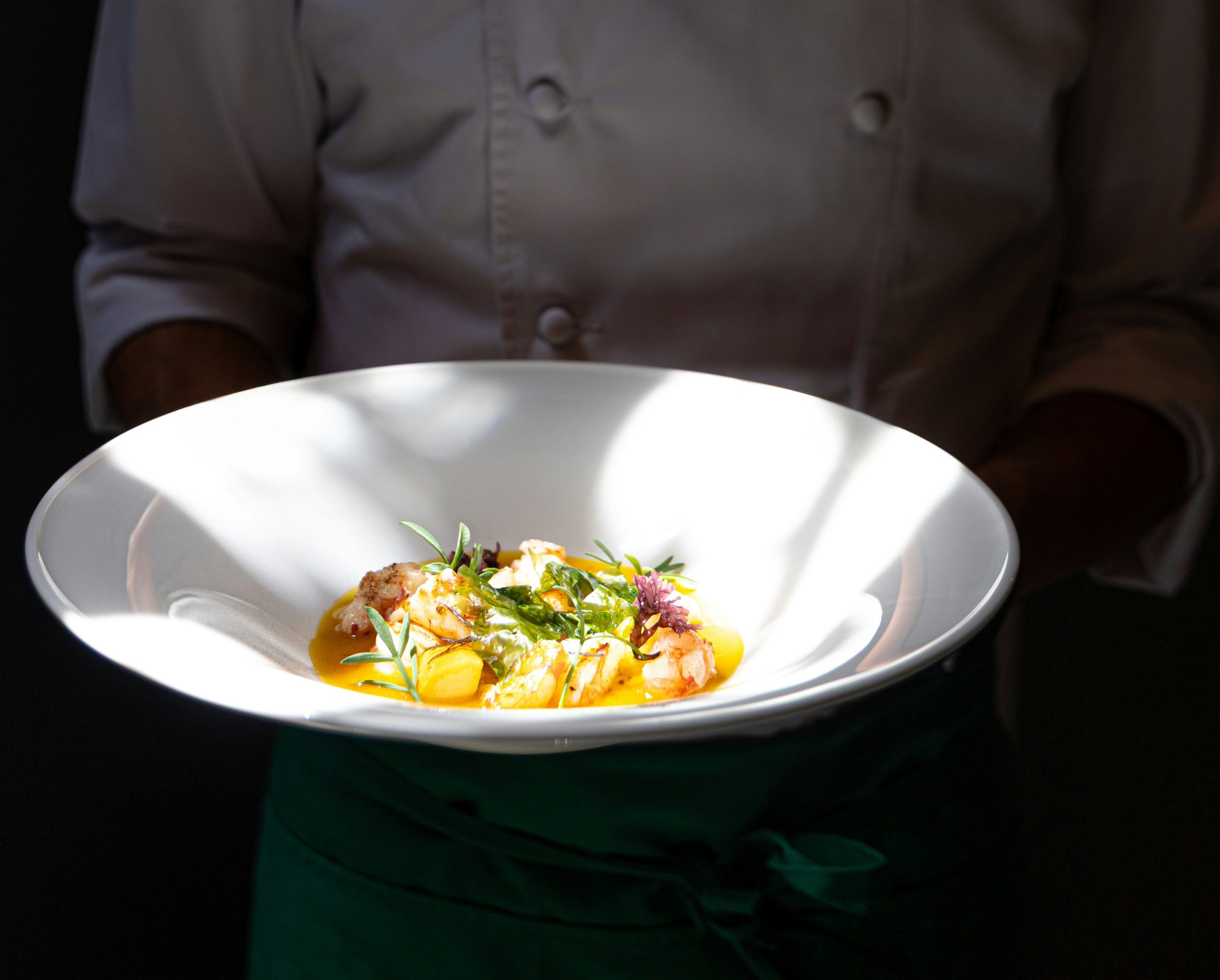
On the night of my visit to Oh No, I ordered the tasting menu, which was organized by location—the first few dishes being oceanic, as befits the cradle of all life. You likely know that I am suspicious of style, and how it so often comes at the expense of substance, but a first course is always a doorway, which must be stepped through before judging the room. So, the ocean. I received a glass sphere in which a jellyfish, pureed and reconstituted, was suspended in a foam of seawater. The presentation could be viewed from any angle so you might approach it with the boundless geometry of a fellow sea creature; the foam and the jelly were then to be swallowed in one mouthful which revealed an undertone of brine shrimp, giving one the sensation of being a baleen whale. Giving the impression of the sea, seething around one’s body, rushing through one’s teeth. I found the flavor refreshing, the textures layered, the surprise of the shrimp just enough to make me wonder what else was rushing towards me in the dark.
The next dish refined the locational specificity of the ocean, with a penguin liver served on a slab of Antarctic ice. Rare and bloody in appearance, the liver had been marinated in something light and citrus-adjacent: ordinarily I would have guessed yuzu, but no such fruit is to be found on the last continent, and I was informed that the flavor comes from a combination of seaweed and lichen, crushed into a red wine reduction. The thickened wine was also poured over the liver as a sauce, spreading across the ice like a murder victim’s blood in a police procedural. All this was served with chilled Aquavit, taken as a shot before swallowing the liver in order to lower one’s body temperature from within. Does this really give one the feeling of being a dismembered penguin? Or perhaps of being the leopard seal who tore the penguin’s liver free? It certainly gave me a chill, so perhaps the true goal is to share the experience of the ice on which the penguin’s blood will freeze, as it floats above the great aquamarine undersea. Perhaps.
At this point I was amused but unconvinced, a posture so familiar I almost wanted to wrap it around me and run out the door. Finishing off the last of the liver, I began composing a review in my head that was pleasant, encouraging, lukewarm. One that asked what I felt were the important questions—namely whether the food at Oh No was actually expressing a complex understanding of various ecosystems, or if it was just a very clever camouflage, a pretty but meaningless onomatopoeia of the tongue. Perhaps before my baby was born, I would have filed that review, in fact, slapping the restaurant on the wrist for stunt cooking, and then moving on with my life. But despite my best intentions of impartiality, I couldn’t stop thinking about the host. How he leaned so kindly over my child, and with a nod of the head, welcomed him into their version of the world. So I stayed.
And since I did, I should mention that the jellyfish was served with a crisp New Zealand white, which, while a bit insipid, dried the palate sufficiently to bring forth the oceanic purity of the dish.
When Nigel was born, I understood for the first time why fairy tales all claim that magic comes at a cost. In pregnancy and childbirth, the cost is visceral, as is the benefit. You definitely get something, and you definitely trade something.
In the first few weeks of my son’s life I sat in the same position on the couch for hours out of every day, with my feet propped up on a table laden with blankets: our ersatz ottoman. I had never before considered that we ought to have an ottoman at all, that the angle of my knees would ever be static for long enough that it might matter. I used to sit at my desk, twitching around as I wrote; I used to stand at the kitchen counter mincing garlic and wiping it with one finger off the knife. When I lay on the couch, I would spread across it lengthwise, or perch at the edge for conversation, or—forgive me—nestle inwards far enough to create the possibility of sex. I would watch movies. During which I would get up and go to the bathroom, or pour myself a finger of scotch. Never was I so still as I now needed to be with little, wrinkled Nigel, just seven and a half pounds with eyebrow hair so light that it was invisible. He was in all ways so small he seemed on the edge of disappearing. And yet so forceful, so needful. He could not be ignored. I did not sleep more than four hours a night. I felt milk come into my breasts so they ached at the armpit and tingled behind the areola like needles were being pushed out from within. My knees got sore.
Is this the trade? It isn’t. The pain, the exhaustion, is not the thing. You see, in those early weeks I spent hours scrolling through my phone, looking at and liking pictures of my friends on vacation all over the globe. Eating ceviche in Madrid. Lolling on blankets in front of a fireplace in a Vermont cabin. Popping their heads out of the water at an Australian beach, and dredging themselves onto shore for a cold beer and a bag of exotic chips. Each of them somehow managing to be in a place I’d often wanted to go: Japan, walking through a series of red gates by a temple. The Outer Hebrides of Scotland, wrapped in wool. Standing beneath a blue and orange wall in Mexico City, sipping a raspado thick with mango and cream. I thumbed through these photographs with a pathological furor, but the fact is that I did not want to be where they were. I wanted to be exactly where I was, and to know the wide world was still out there.
Meanwhile Nigel slept with his face pressed against my neck, his cheeks fattening in direct conjunction with the growing adroitness of his mouth on my breast. What I had lost was the desire, so potent at every previous point, that my body should be for my use only. I shed the part of me that only cared about my own forward momentum. Though in fact my life’s trajectory felt clearer than ever. He knew how to eat and I knew how to give. I was happy to be still, for a time, because ahead of me lay every day of my and Nigel’s life together, multiple and various and impossible to predict.
I still looked at the photographs, but in the way we peruse our memories of the dead. With a fondness that almost rises to the level of yearning, but must, by its very nature, be released like a puff of smoke.
After water came air.
This being my first step forward back into my existence as a thinking creature, a living mind, I was easily charmed by the simplicity of the menu’s layout. Water. Air. My brain, so recently scooped out, clung to the clarity of shared concepts, as if I might be served a triangle and a circle, floating in the sky, and then be asked to name them. The delight consisting in the fact that I could.
Naturally Oh No’s food was more complicated than that, but in another way, it wasn’t. I can easily tell you what I ate. The question is, can I tell you why?
The next course began with tiny grasshoppers flash fried and coated in crushed salt and herbs: sage, parsley, chamomile. These were brought to the table and then tossed in a hot metal bowl to pop like corn, and the effect was one of brushing insects away from one’s face in a grassy field in late summer, stepping on small plants with a careless shoe. Or of being that cloud of insects, one among a throng, pinging off one another’s reckless limbs. I watched Nigel twitch in his sleep while I ate; I licked the salt concoction off my fingers, as the atmosphere at Oh No is not especially decorous, and it fit with the overall picnicking sensation of the dish. Stretching on a blanket. Yawning. The pleasures of the flesh.
Following the grasshoppers was perhaps the silliest dish of the night, a light lemon soup evaporated into the form of a cloud and brought to the table in a glass tube to be huffed through a straw. Besides the obvious unintentional nod to smoking cheap dorm room marijuana, this worked better than it had any right to, hitting my tongue like a droplet of water warmed by a yellow sun. I would have preferred to simply eat the soup, if only to see how the chef might have garnished it, but as molecular gastronomy goes, the cloud was quite effective. And they do mean to have an effect.
There are many ways to prepare a meal with natural ingredients, but that isn’t the project of Au Naturel. They don’t care to teach the uninitiated that nopales are made from prickly pear cactuses, or that a flower can be used in a salad for a pop of color and a bit of surprise. They are looking to convey, through food, the way it feels to exist in certain places, certain forms. Each course and plate is transportive in the manner of art, because it appeals not just to the body or mind but to the spirit, in a kind of synthesis or synesthesia.
They are looking to convey, through food, the way it feels to exist in certain places, certain forms.
Parenthood is this way too. A project of transformation, ready or not. From the moment you become aware of the child in your body, you are imagining their future life, trying to picture the arrangement of their face and who they’ll take after; what they’ll look and smell like, how they’ll sound. It’s all theoretical, but you make choices—endless choices—trying to produce a happier theory. And in the process, a change occurs, not to the child, but to you.
My question as I ate was this: can a restaurant truly achieve this trembling precipice, simply by complicating the form of a soup? Wherein freedom is achieved through freedom discarded? Individuality junked in favor of collectivity? Self lost to the other? Ashbury and Scott claim that the premise of Oh No is that self is not lost in the other, but widened. And well. This is not a terrible premise. I’m just not sure that it’s theirs.
At this point you might be hoping I’ll get to the point: is Oh No worth the price of admission, or not? So let’s get this out of the way: for a tasting menu with wine pairings you can anticipate paying at least five hundred dollars per person, though the restaurant does not adhere to a specific price point, given the variability of their food. Expect to pay market price, though I have not heard of a single diner’s bill exceeding six hundred and fifty dollars, which included after-dinner cocktails and a small encore plate.
I didn’t stay that long.
By the time we wound to the end of Air, the clock had struck twelve and I was beginning to turn into a pumpkin, which is an idiom almost stupidly suited to Oh No’s concept—food, bodies, transmutation—but never mind. In the time honored tradition of the sleep deprived, I was desperate to stay up later, and also determined to finish my review with the greatest possible command of the establishment. I asked the waiter to bring me a cognac to help settle my stomach before the next plate, and he said that in fact it was strange I should request this, since the next dish was brandied. It was, he said, the coup de grâce of the evening, and in fact one of the staff favorite dishes among those who had been lucky enough to try it. He promised to bring me a cognac of his personal recommendation to accompany the food, and then he disappeared behind the bar.
Are you wondering, as I did at this moment—sitting back in my quiet booth and feeling the beginnings of a comfortably full stomach—how a restaurant like Au Naturel acquired a moniker as dour as Oh No?
There are multiple theories about this. Some people say it’s because the food is skirting the edge of conservation and exploitation: that to acquire a night’s worth of ice from Antarctica specifically to watch it melt is not the same as mourning the loss of the ice shelf or the attendant rise in sea level. Some say it’s due to an early reviewer’s assertion that there’s nothing naturel about the cooking, and others suggest that when John Scott and Laura Ashbury realized they’d talked themselves into opening a restaurant, Oh no is naturally what they exclaimed.
Any of these stories might contain the truth, and we can never be sure, but this at least was my experience. The waiter brought my snifter of cognac, a very nice ten-year Planat, and then returned with a tray covered with a linen napkin, which he brandished at me until I took it. Beneath the cloth was a dish which contained a thin layer of liquid and a creature I understood, after some scrutinizing, to be a hummingbird prepared in the manner of an ortolan.
The waiter indicated with one hand at my head. “The cloth,” he said.
If you aren’t familiar, an ortolan is a songbird that is force-fed with savory grain, and then consumed in its entirety after being drowned in Armagnac. Ah, what a way to go, some diners have been known to say, though those who eat these birds also cover their faces with veils—either to treat their sinuses to an infusion of hot liquored steam, or else to hide their shame from God, depending on your interpretation.
The hummingbird, my waiter explained, had been fed exclusively from honeysuckle and bleeding heart flowers, and kept for the maximum possible time from flying, as the bird’s rapid wingbeats generally expend its caloric intake almost faster than the bird can consume. The bird is given a final meal of sugar water before being plunged in Armagnac, and then boiled alive. It was served to me, at Oh No, as dessert.
Can you imagine what I whispered next?
I am not an unadventurous eater. If I was, I would fail at my profession. In fact, I would never have sought this profession at all. It is my pleasure to eat whatever is served to me and judge the meal on its aims and merits, outside any Western ethical system which forbids, for example, the consumption of horse or dog or any other such pet. I have eaten and enjoyed shark’s fin soup, and a thousand year egg, and a slice of my own sauteed placenta, which was served to me by my midwife and was nicely seasoned but too tough and gamey for my personal taste.
The hummingbird was elegant, minuscule; the notion was that I would pick it up with a spoon. And without hesitation, I did. I draped the cloth over my head and hunched over the bowl, and I put that marvelous small thing in my mouth and I bit through its bones to the sweet pocket of liquid within, which exploded on my tongue the way a berry bursts its skin.
The steam was heady; it cleared my sinuses and replaced my doubts and fears and regrets with a brief sugary high, and the desire for more.
If I were to eat this every day, I imagined, I would understand what it felt like to hover in the air suspended on currents of warmth and navigate by the vicissitudes of gravitational waves. All at once the entire evening’s menu washed back over me, with similar effect. If only I were to eat the sea, the ice, the summer, the sky, every hour then I would never lose anything I wanted, and the world would never die. Not as long as I lived.
I wanted to tell the waiter about my revelation—I wanted to tell everyone. For instance, you. But I pulled back the veil across my face, and immediately saw, not God, but Nigel, who had woken quietly and was sitting in his car seat, chewing on his hands. He smiled at me. An enormous smile of welcome and bliss, with which he now greets me every morning because—or so I tell myself, and assume—he has missed me in the night, almost as much as I miss him. And I realized that in my moment of perfect completion, I had forgotten him. I had left him alone.
Magic, I will remind you, comes at a cost. It always does.
After paying my bill I ordered a car and I took Nigel home. The lights were out, and I only turned on the smallest, lowest lamps as I brought my son to his bedroom and settled in to feed him. There was a bottle in the fridge that I had pumped earlier in the day, knowing I would be drinking too much alcohol to nurse him after I ate, but instead of preparing it I lifted my shirt and brought him to my breast, as we both prefer. His eyes briefly opened and considered me, as his mouth pursed around my areola in a perfect embouchure of hunger.
I gave birth to Nigel via caesarean section, my body splayed out on a table and paralyzed below the breasts. The room, cold. My legs immobile, my arms restrained on either side. A knife moving into my flesh and subcutaneous fat; no pain, but a sensation of rocking, pushing, squelch—for which the surgeons used the catchall term “pressure”—as my uterus was pulled out of my torso so the baby could be removed. Then the organ was shoved back in. In any other place or time, all of this—my bright white awareness, my frigid alarm—would have constituted horror. When in fact, it was one of the most beautiful rooms of my life. One of the great moments.
I remember shaking, laughing with the anesthesiologist who was perched at my shoulder. And I remember a hard crash. The anesthesiologist’s look of shock as the blood drained from my head—to somewhere. The bright room getting brighter, like iridescent milk, all the machine sounds suddenly stopping as I felt a heft and a lift. Something leaving my body, but not the baby; something leaving my body and that thing was me. Hovering up and above for just long enough to see the surgeon peel the uterine scrim away from Nigel’s face before I dropped back in with an intake of breath, to the anesthesiologist’s relieved expression. I came back, but I was different. I will never be who I was before.
Here is my final thought about Au Naturel, which offers excellent value for the money, and has created an atmosphere of comfort and intimacy that is truly conducive to the culinary exploration offered by its kitchen each night. Five stars for cuisine, and ambience, and service; indeed if I could offer more than five stars for service, I would. I remain grateful to the staff who helped me rest my son quietly in the corner, recognizing perhaps that he too is part of this life and this world, and a worthy guest of their establishment. Or perhaps just being kind.
But having experienced at least one small sliver of Oh No’s menu and their thinking, I cannot help but feel the two are irrevocably at odds. The work of a naturalist like Laura Ashbury is to study the various forms of life outside our own and to believe they can be, through our intervention, understood and sustained; while the work of a chef is to make something to eat. Of course there is nothing ignoble about eating: it nurtures body and mind, and has been my life’s work. But thinking and living, thinking and dying, none of these are quite the same.
I listened to Nigel suck and swallow, listened to his satisfied sounds, and occasionally wiped a bubble of milk off his lower lip when the stream came too fast for him to handle. The milk he consumed was mine, was me: to make it, my body liquifies the calcium from my very bones. Given that he eats such a meal every few hours, there is an argument to be made that I too will never die, as the idea of me will live in him, and we will both be thus sustained.
The evidence does not support it. But what would?