A new first-principles approach provides a unified foundation for studying complex band structure and light confinement in periodic media
Photonic crystal slabs are periodic structures that confine light in two dimensions while allowing it to leak in the third. Their in‑plane periodicity forces light to behave like an electron in a crystal, forming bands rather than isolated modes.
These objects can host an array of novel physical phenomena, from ultra‑sharp resonances to exotic singularities such as exceptional points. Among the most intriguing are bound states in the continuum (BICs). These are modes that, despite lying in an energy range where radiation is allowed, remain perfectly confined.
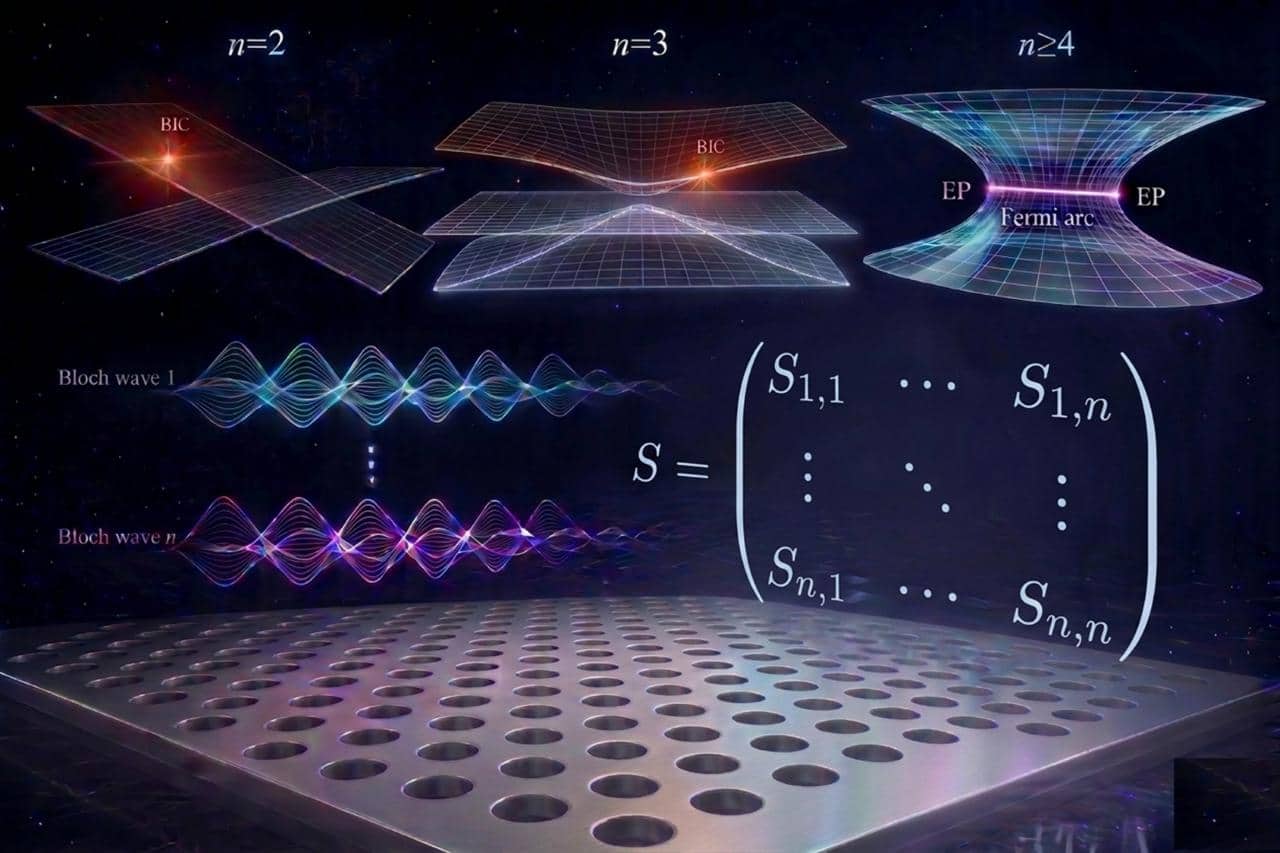
In a new theoretical study, a team of researchers from China showed that this leakage, and its surprising absence in certain cases, can be understood from a single first‑principles viewpoint. Central to their approach are Bloch waves and the scattering matrix.
Bloch waves are the natural building blocks of waves in periodic structures. Instead of spreading freely, light inside a photonic crystal is organised into Bloch waves whose fields repeat from one unit cell to the next, up to a phase factor. Even in an open slab, only a small number of these Bloch waves propagate across the thickness and carry energy towards the surrounding medium.
The scattering matrix describes how incoming waves are converted into outgoing ones by the periodic structure. The values of frequency where the matrix becomes singular (its poles) correspond to resonant modes. For open systems, these frequencies are complex: the real part sets the resonance position, while the imaginary part measures how fast energy leaks away.
One key insight of this work is that the complexity of the problem collapses dramatically once the analysis is restricted to the minimal set of Bloch waves that actually propagate. Interference between just two waves can already explain “accidental” bound states in the continuum (BICs), where radiation vanishes despite the mode lying in an open channel. Including three waves naturally produces Friedrich–Wintgen and symmetry‑protected BICs near band crossings. Adding polarisation reveals far‑field vortices and exceptional points.
By grounding resonant photonics in a minimal scattering‑matrix picture, the authors unify a wide range of phenomena within a single, transparent framework. This should prove valuable for designing efficient resonators, lasers, and topological photonic devices.