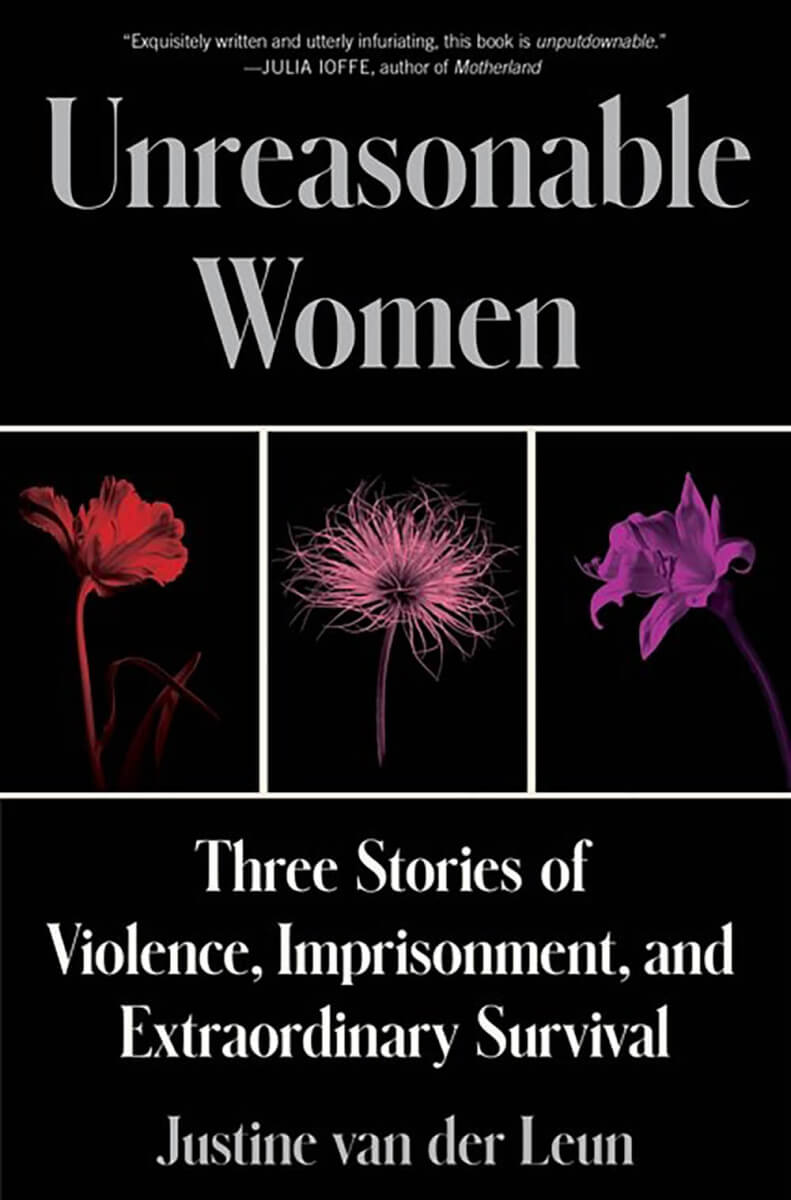

Justine van der Leun opens her introduction with the story of Nikki Addimando, a woman convicted of murdering her boyfriend, who’d been sexually and physically abusing her for years. After her sentencing, she told the court, “I was afraid to stay, afraid to leave, afraid that nobody would believe me, afraid of losing everything. This is why women don’t leave. I know killing is not a solution and staying hurts. But leaving doesn’t mean living. Often, we end up dead, or where I’m standing. Alive, but still not free.”
Addimando’s story isn’t even one of the three referenced in the subtitle of Unreasonable Women: Three Stories of Violence, Imprisonment, and Extraordinary Survival, but her statement in court could easily have come from any of the women van der Leun profiles. Each of them embodies the phenomenon referred to as “criminalized survival,” a byproduct of the justice system’s need for clean categorizations. “Offenders kill, and victims die,” writes van der Leun. “Offenders are monsters, and victims are angels.” If a woman kills in order to save herself, she stops being a victim, which means there’s only one other role for her to play.
Tanisha Williams, Jema Heffernan and TC Brooks all chose to save themselves (and those they loved, such as their children or mother), and—like Addimando—they were all punished for that choice. The sexual and physical violence each woman faced is horrific and haunting, and the American legal system is largely blind to it. Look at self-defense laws: Juries are told to apply a standard of “reasonableness” when determining whether the response was justified, but until recently, “legal texts referred to the ‘reasonable person’ as the ‘reasonable man.’ There was no reasonable woman.”
Van der Leun took seven years to compose this impeccably researched book, and through it, she uncovers a painful pattern repeated over and over: “a girl violated; a pileup of failures to protect her; and a terrible, desperate act.” Required reading for anyone who cares about women and justice, Unreasonable Women aims a powerful spotlight on our country’s continued failure to protect its most vulnerable.