There is a particular pleasure in lost objects. We know it in ordinary life: the small shock of finding again what had vanished, the almost absurd intensity of a key, a ring, a photograph, a letter suddenly returned to us. Natalie Lemle’s Artifacts, her debut novel, turns that intimate sensation into a larger, more dangerous fiction. At its center is Lena Connolly, a lawyer drawn into a case involving a possibly looted Roman cup made of dichroic glass. The cup does not simply come from the past: It summons it, forcing Lena back to the summer she spent on an archaeological dig in Italy, and to what she thought she had left there.
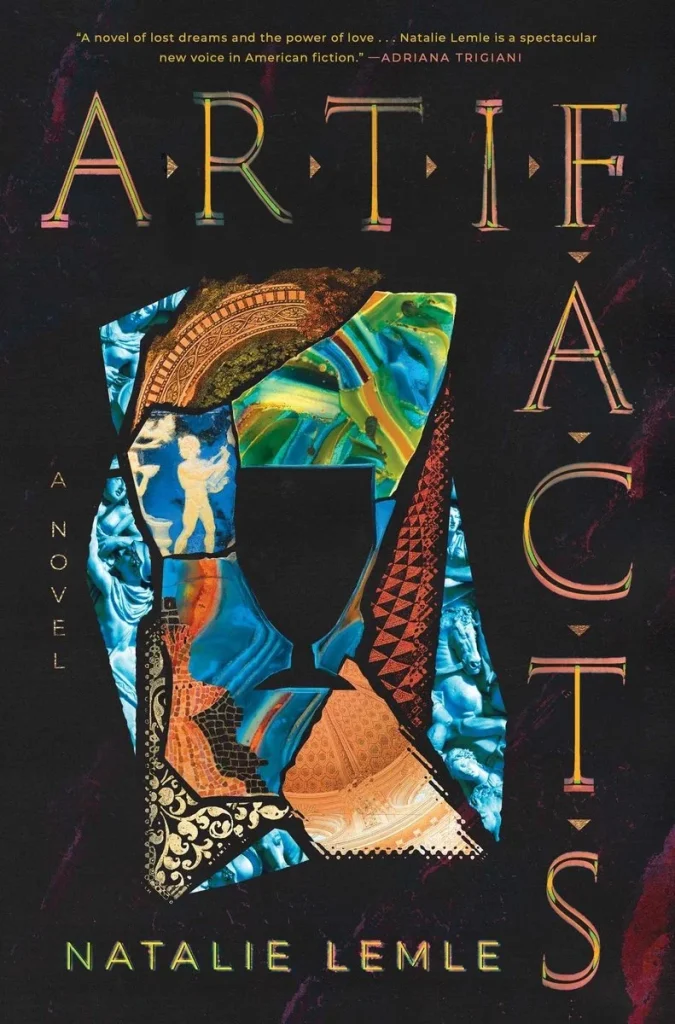
What makes the novel so compelling is its understanding of art history not as ornament, but as a narrative engine. While writing my own novel, Mona’s Eyes, I had the chance to experience how powerfully works of art can move a story forward. Lemle uses that force in a darker key. She goes behind the museum glass, into the machinery of provenance, money, desire, and crime. We are drawn to beauty; but we are also drawn, perhaps more secretly, to the mud around it.
In that sense, Artifacts is a form of archaeology by other means. It excavates memory as much as ruins, illusions as much as evidence. In the conversation that follows, Natalie Lemle and I spoke about ancient things and ordinary possessions, Italy and myth, the art world’s shadows, unstable memory, and the strange energy that certain objects continue to exert over the living.
Thomas Schlesser: Let’s begin with the title itself: Artifacts. An artifact is an object, of course, but an object that has survived—something charged with evidence, memory, perhaps even secrecy. Your novel is full of these presences: antiquities, artworks, fragments of the past, but also more intimate traces of a life. As an art historian, I am always struck by the way certain objects seem to remember more than we do. What is your own relationship to them—ancient or ordinary, precious or personal?
Natalie Lemle: My relationship to ancient objects is very different from my relationship to everyday possessions. When it comes to antiquity, or really anything that comes from the past—it doesn’t even have to be ancient, but let’s say something at least 100 years old, something made before my lifetime—I’m much more intrigued, much more fascinated. That is what gets me thinking, what gets me into my storytelling mind.
Something from the outside can maybe lead you to an inner corridor in your own mind—but then you have to actually be willing to open all those doors.
With everyday possessions, I have a more complicated relationship. To be honest, I don’t like being attached to physical things. I don’t like the feeling of being beholden to them. I want to be the kind of person who could always pack up, leave her life, and not feel sad or sentimental.
I may have one or two pieces of jewelry that feel sentimental because of the memories associated with them, but I can’t point to a single possession that feels important to me in that way. I see how easily possessions can become an extension of the ego, and I bristle against that. I am fascinated by ancient objects, but suspicious of what belongs too closely to my own life: The older something is, the more it liberates my imagination; the closer it is to me, the more it feels like a trap.
TS: What I find striking is the paradox: In life, you resist the hold material things can have over us; in the novel, you give them enormous power. Did Lena need to believe in them more than you do?
NL: Yes, that’s true. It doesn’t bother me if readers see that the book is written in the first person and think Lena is a stand-in for me. But there are many differences between me and my narrator.
I needed Lena to be more fully fixated than I am on the promise of something tangible, something you can hold and see. At least initially, she believes that if she can see something with her own eyes, she can understand it. What she learns is that seeing is not the same as knowing.
TS: In my generation, Indiana Jones was a terribly efficient machine for turning children into imaginary archaeologists. A lot of us wanted, at least for five minutes, to dig up mysteries in a hat. But archaeology, in your novel, is obviously not just adventure. What do you think draws us so deeply to it?
NL: I think the most obvious answer is that we want to dig in order to understand. We want to understand how people lived before us, what they did with the things they possessed or shared—maybe because those things give us clues about our own daily life, or help us understand something about the through-line between human beings.
My personal belief, and what I tried to do with Lena and the other archaeologists in the book, is to show that they are interested in archaeology because they really want to understand themselves. For Lena, excavation becomes a dangerous form of introspection: She thinks she is digging into the past, but she is really digging toward herself.
What she comes to realize is that something from the outside can maybe lead you to an inner corridor in your own mind—but then you have to actually be willing to open all those doors. The excavation is only step one. What happens afterward has to happen inside you.
That is also why archaeology becomes frightening for her: It asks her to follow a feeling before she is ready to do so. She is still in her head, still cerebral. She thinks archaeology is about physical evidence. But by the end of the book, she comes to understand that archaeology may be more spiritual than she thought, and more based on instinct: on being willing to follow those instincts instead of grasping for the tangible.
TS: The novel is built on two timelines, and Lena is not only confronting a mystery; she is also meeting a younger version of herself and facing the gap between two periods of her life. Why was that structure important to you?
NL: Originally, there were two reasons I decided to use a dual timeline.
The first is that the laws and attitudes around cultural heritage and restitution changed so drastically between 2004 and 2022, when the present-day story takes place. How did we go from 2004, when museums were still taking things into their collections so freely, and all kinds of sketchy pieces were being sold on the open market, to 2022, when curators won’t touch an antiquity—even the most beautiful one in the world—without rock-solid provenance? They won’t touch it with a 10-foot pole. That is a huge difference.
The second reason is that I wanted Lena’s present-day narrative to be somewhat unstable. Not because I needed her to be fully unreliable, but because I wanted her to filter her memories through what she is learning in the present day about the case. The two timelines let me think about provenance in two ways: what can be proven about an artifact, and what can never be fully proven about memory.
She remembers things based on what she is learning now. And of course she cannot remember verbatim what was said. The dialogues are more or less invented, right? The mind doesn’t remember in that way. She remembers some things—she definitely remembers the important things—but she is also selling us a narrative about the past.
I personally enjoy fiction that does that. You suspend your disbelief, you go along with what the narrator says, and at the same time, as a reader, you keep asking yourself: Is this what really happened?
TS: I’m happy you mention unstable memory, because I know you also love Elena Ferrante. And Italy, in Artifacts, is such a powerful landscape: luminous, sensual, full of secrets. Why was it the perfect place for part of this story?
NL: Ferrante does narrative instability so well. Troubling Love is a great example: The main character is looking for her mother and remembering pieces of her childhood. Then, as she gets more clues about what happened to her mother, she starts remembering her childhood differently. And The Lost Daughter does that really well too.
As for Italy, I am half Italian—Sicilian on my father’s side—but I didn’t go there until I was 18. I didn’t grow up going to Italy. My Italian side is totally American. I think I’m fourth-generation Italian, so it’s not as if I had a direct connection to the country.
She is selling us a narrative about the past.
But I was lucky enough to go to a high school where I learned Italian, and I did an exchange at the end of high school with another high school in Bologna. I remember being there for the first time and feeling this very strong connection to the country. At first, I thought it might be related to my knowledge of the language, or my interest in it. I was also studying Latin in high school, and I knew I wanted to study art history, ancient art, the ancient world. So initially I thought: I am interested in all these things, and now I get to be in the country where so much of this came from.
But then I started to feel that it was deeper. I felt a sense of homecoming. And yet I’m Sicilian, and I was in Bologna, so it wasn’t literal. Italy was both inherited and imaginary for me: I felt a homecoming there, but it was a home I had invented as much as received.
Later I did an archaeological dig in Tuscany as an undergraduate, and then I spent a college year abroad in Bologna. I even fantasized about staying, but that year also made me realize how American I really was.
So when I was drafting Artifacts, I was returning, with some distance, to the sense of magic I felt when I first went to Italy. For me, Italy is a place full of stories to which I feel an emotional connection. It makes me feel transported. And maybe this is a naive thing to say, but when I’m writing fiction, part of the pleasure I get is the feeling of being outside myself, outside my normal day-to-day life. I love feeling as if I am in Italy when I write.
TS: I’m struck by how hungry readers are for the dark side of the art world—the money, ambition, vanity, and opportunism behind the beauty. But your novel does not simply expose that world from the outside; it understands why people are drawn to it, and why they stay. What makes that darkness so fertile for fiction?
NL: Like anybody else, I can be critical of the art world. It’s fun to complain about how sketchy it can get! But ultimately, it is also a place where I feel very at home—so I don’t know what that says about me.
I think I am very comfortable with gray areas in general. I am interested in systems and how things work, and the art world is a very complex system that relies on relationships: institutions, personal relationships, discretion. These are compelling and interesting forces, and very fertile ground for fiction.
What fascinated me in my 20s, as I was building my career in the art world, was that I could walk into a museum and look at beautiful paintings, or go into a gallery, or see that a Basquiat had just sold at Sotheby’s for many millions of dollars. I could see all of that, appreciate it, move toward it, without really knowing how it worked.
I think there are many of us who work in the art world who do not actually understand its hidden scaffoldings. Many things that happen sound stranger than fiction but are painfully true.
The art world is where idealism and opportunism meet in front of the same beautiful work. People enter the field because they love beauty, and then find themselves inside a system built on money, secrecy, and power. You have bad actors and idealists constantly in conversation with each other. And what brings them together? A work of art that they may both love, but for completely different reasons.
TS: There are several allusions to myths and legends in your novel. In myths, there is very often a key object at the center: a treasure, a relic, something that must be found. Did you always know Artifacts would have both this mythic dimension and a darker, almost noir dimension?
NL: My first introduction to myth was probably in school, and then through art history. But it was in college that I read Apuleius’ The Golden Ass, and inside that novel is the myth of Cupid and Psyche. Psyche stayed with me because it joins love, rebirth, transformation, and the soul—which are also the hidden materials of Artifacts.
As for the darker dimension, I love writing plot. I knew something had to happen that would be the engine of the novel. I wanted Lena to be trying to figure something out. I knew I wanted some kind of mystery element, though I did not know at first how dark it would become.
I rewrote the book so many times. Every time I rewrote it, something new and important revealed itself to me. So I am a first-time novelist in the sense that this is my first published novel. But behind the scenes, Artifacts is the tip of the iceberg. Underneath it are so many revisions, so many thoughts.
TS: The book is full of enchantment, but also of the end of illusions. I felt something close to that, in another way, while writing Mona’s Eyes: the discovery that art can illuminate life, but does not magically repair it. Would you say that Artifacts is also about that kind of loss of illusion?
Artifacts is the tip of the iceberg. Underneath it are so many revisions, so many thoughts.
NL: Yes. I think there are many ways the book looks at the end of illusion: Lena’s relationship to archaeology, to history, to love, all of those things. But the one that is most personally resonant for me is the relationship she has with her parents. She is circling this unresolved—I don’t want to say trauma, because I feel that cheapens it—but this unresolved, complicated relationship with her parents, which extends to her sister in the present.
The real trigger is not only the case, but her sister’s pregnancy, which forces Lena to think about family, inheritance, childhood, and the stories siblings tell differently about the same past.
By the end of the novel, she realizes that love does not have to follow a set of rules. She and her sister can have different paths and still love each other.
And one personal thing—true both for me and for Lena—is the illusion that we can control outcomes. We can choose our actions, but not the life those actions create. The events we set in motion may look as if we can control them, but we cannot. There are too many unknown forces. I believe that the idea of controlling outcomes is an illusion the mind creates. That is my woo-woo side.
TS: One last, slightly tricky question. Do you think every artifact hides a story, or do we need to invent stories in order to love what remains?
NL: I think it is both. But I would not use the word story. I would use the word energy, or feeling. Something more abstract than narrative.
I don’t think you can ever separate your own bias, your own history, from something you are beholding, or even reading. I am not only talking about an antiquity or a painting on a wall. I am talking about the bias we bring to reading fiction. Even reading your novel Mona’s Eyes, I bring my own museum memories to it.
That is just to say that you cannot separate yourself from the work of art. But that is one of the pleasures of art. Art helps us understand ourselves because we see our story, and we feel it reflected back to us.
I feel this especially with ancient things. I am not an archaeologist, I am not a registrar, I am not a museum curator. I do not regularly have occasion to hold an antiquity or a sculpture. But I can feel the energy of a thing when I get close to it. I can feel what draws me to it.
And I do think that, under the surface, there is a lot in Artifacts about magic. Cyrille talks about Druid rites, about various superstitions. And of course there is the dichroic glass cup, which for a long time could seem almost magical, because scientists did not yet have the technology to view the nanoparticles of metal mixed into the glass—the thing that gives it its dichroic quality.
I think so much of what is pleasurable and important about art is that je ne sais quoi, that intangible magic you cannot put into words. It is just a feeling you have.
If ancient things did not give off some kind of energy, I don’t think we would fight over them, preserve them, or build museums around them. They matter because they make us feel that the world has remembered something we have forgotten. We simply understand, as humans, that they are important, and that they have power.