When my husband and I started house hunting in the DC suburbs three years ago, it never crossed our minds that we’d live as anything but a typical nuclear family: just us and our future kids. But the house we bought featured an apartment-style basement, complete with its own kitchen, full bathroom, and private entrance. The month we bought it, a friend of ours lost his apartment. “I’ll rent yours for a few months, tops,” he said. He lived with us for two years.
I got attached to the extra company, and the extra income. We recently welcomed a new tenant—a stranger, for the first time. But within weeks, she became a staple in our daughter’s life, bringing her fruit from the farmers markets where she works, delighting as my toddler gobbles it up or puckers in disapproval.
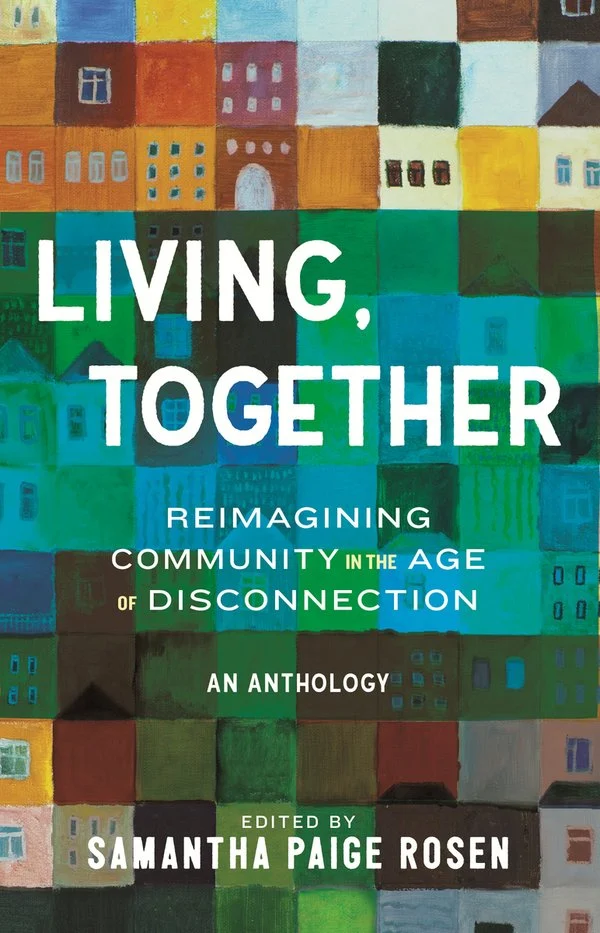
A lot of stories in Living, Together, start somewhere like this—at the crossroads of need, opportunity, and flexibility. It’s an anthology about living communally, and editor Samantha Paige Rosen uses the term very broadly. The essays and Q&As cover roommates and group houses, but also traditional Native American communal living and a writers’ residency held at a couple’s home in Los Angeles, to name just a couple examples.
As different as the living scenarios are, I was most struck by what the essays have in common. By making the deliberate choice to share space intimately, in ways that are unconventional by our modern Western standards, each contributor is essentially seeding community into their lives. And throughout the pages, acts of tenderness and generosity spring up like wildflowers—people caring for aging parents, others helping to raise children that aren’t their own. The resulting book is a rare read: one that’s unflinchingly honest about our current world (including the financial inequities and hardships that often drive people to live communally), but that will also leave you feeling hopeful for the future.
I spoke over Zoom with Rosen and two of her contributors. Adam Vitcavage, founder of Debutiful, lived with his sister for four years in his 20s. Suanne Carlson is the co-founder of the Homes on Wheels Alliance, a nonprofit dedicated to supporting fellow nomads who live on the road.
Emily Mirengoff: In your introduction, you quote Margot Kahn, saying that an anthology is a “town hall bound in pages.” For all their virtues, town halls can get bogged down by a few loud voices with limited perspectives. But the scope in Living, Together is breathtaking. How did you ensure that you were covering a broad base of voices, experiences, and ideas?
Samantha Paige Rosen: Honestly, the main challenge was narrowing down the number of voices and living scenarios. It felt very important that I wasn’t representing just a few specific life experiences, or one income level, or one or two geographical regions. I’m glad you think it’s broad enough—part of me still feels like it should cover even more. My wonderful agent had to rein me in and advised me to put the individual and story first, rather than the living scenario.
EM: You describe your hope that this book will help us pause, reflect, plan, and act toward a future that is more than just living, but offers sustainable resiliency for the future. Can you share your favorite example(s) of communal living offering that flexibility and resilience?
Not only is our way of living tied up in capitalism and industrialization, but it’s also rooted in colonialism.
SPR: It’s impossible to pick a favorite—Suanne would certainly be one, although I’ll let her share her story—but two examples come to mind.
Hope Meadows is an intergenerational neighborhood in Illinois that was founded 30 years ago on a former Air Force base. Initially, it offered free housing and benefits to those who permanently adopted kids out of foster care and reduced-cost housing to seniors who would volunteer within the community and wanted to be involved in the kids’ lives, like surrogate grandparents. When it began in the mid-90s, it was the first of its kind in the US, and it was incredibly successful. But over time, the number of children in foster care dropped significantly, which of course was a good thing, and it no longer made sense for Hope Meadows to pursue their foster care license and future adoption services, and they lost the associated grant that helped them cover the free and reduced-cost housing.
They realized that they had to pivot to be more of a general intergenerational community that provides low-cost, but no longer free, housing. For Living, Together, I spoke with the first-ever senior resident, Fran Biederman, and Hank Gamel, the current executive director. He’s always coming up with innovative ideas that keep the intergenerational mission alive while trying to address financial needs—like partnering with Habitat for Humanity to pair local high school students interested in learning trade skills with community members whose houses need repairs. Hope Meadows may not look exactly like it did 25 years ago, but that doesn’t mean there’s not still a benefit to the community, as Fran attests to.
Another example is Simone Gorrindo’s essay about her early years as a military wife. She describes moving as a newlywed from New York City to rural Georgia, not even knowing how to drive, when her husband deployed almost immediately. Across the street, her new neighbor Rachel was going through the same thing—but while Simone’s natural response to loneliness was to turn further inward, Rachel’s was to turn outward, to connect with others as a means of resilience. They became incredibly close and were able to survive some major life moments without their spouses by leaning on each other. You might define that more as neighboring than communal living, but it’s the same mindset in my eyes.
EM: I love the way your book does this—it widens the definition of communal living to encompass not just living under a single roof, but the act of building meaningful and intentional community. That reminds me a lot of your essay, Suanne, about your experience as a nomad.
Suanne Carlson: Yes, not only are nomads not under the same roof, but we often live thousands of miles apart, and may see each other once or twice a year at gatherings—but we’re still in community.
EM: You describe caravanning in community with your fellow nomads. Gathering in this way reminds me of how humankind lived for millennia. Of course, that’s much less common now. What do you think has been lost and gained in that change?
Because we’re living an alternative lifestyle that many don’t understand, there’s a sort of us-against-the-world connection.
SC: It’s true, our ancestors were nomads. By necessity, they followed the weather, they followed food. I personally feel like there’s some genetic code within me that still thinks it’s a necessity. Of course, as soon as we started corralling animals for food, growing and cultivating plants, that required a stable location—which eventually led to manufacturing and the workforce that’s needed for it.
But when I go through large cities now, that’s where my mind goes: “Oh, this is the local workforce.” Not, “Oh, this is the local community.” Our society’s way of life feels like it’s designed to sustain an economy, not a community.
SPR: I’m glad Suanne made that point. Not only is our way of living tied up in capitalism and industrialization, but it’s also rooted in colonialism. In Living, Together, Rodney Bordeaux, former president of the Rosebud Sioux Tribe in South Dakota, talks about the impact of the federal policies that ended their nomadic way of life, forced assimilation, and sent Native kids to boarding schools away from their people. The loss of freedom and land and means, but also of community—of connection and identity—is still so deeply felt.
EM: I think a lot of people—including me, before I read your Q&A—would guess that living in your car would be lonely. But you say you feel a stronger sense of community now than you did living in the conventional neighborhood. Why is that?
SC: I’m an introvert. I like to camp alone with others who like to camp alone. That’s true socially, but also for safety, because I like to camp in the back country, in nature.
The thing about nomads is that when we get together, we know we’ll only have a specific amount of time together—a week, a night. We get down to the nitty-gritty, important stuff right away. There’s very little small talk. And that builds a connection, a sense of like-mindedness that I had not ever experienced before. Also, because we’re living an alternative lifestyle that many don’t understand, there’s a sort of us-against-the-world connection.
EM: What is the most misunderstood aspect of this lifestyle?
SC: People only know what they know and what they see. And since people live in towns and cities, the vehicle-dwellers that they see are those on the street—who certainly count among our population of vehicle-dwellers, but they’re not nomads. Because we’re not usually in cities, nomads can seem invisible.
But I would love for people to understand that we value the communities we visit, we support them economically, and we love and treasure the public lands—we do not leave a trace. In fact, we often pick up after people who do leave a trace.
Another thing people don’t realize is that living in your vehicle requires learning a really specific skillset. Living in a vehicle is simple, but not easy. And transitioning from a sticks and bricks to a vehicle is a major change. For that reason, the Homes on Wheels Alliance has mentoring camps, where we pair experienced nomads with brand new nomads and help them learn how to make that transition.
SPR: I love that you mention mentoring, because that’s related to what I was trying to accomplish with this book. Living, Together isn’t a how-to book, but I wanted people who are curious about communal living for whatever reason to be guided through different possibilities by those who’ve experienced them.
EM: One of the more classic communal living scenarios is, of course, roommates. Adam, in your essay about your sister, you wrote, “We never liked each other growing up and fought more than I think most siblings do.” Yet you chose to live together as adults. What is it about sibling relationships that creates this unique push-pull dynamic?
Adam Vitcavage: When you’re a kid, you don’t really appreciate your sibling—they’re just someone you’re stuck with. My relationship with my sister wasn’t toxic when we were kids, but it was volatile. But I think that, when push comes to shove, most people will have their family’s back. And with siblings, the older you get, the more you realize you have in common, and how much you care about each other. There’s a shared bond—whether it’s trauma or happiness—and a shorthand language that is specific to only your relationship.
When it comes to living situations, I believe anything is possible, nothing is forever, and we’ll always land on our feet.
SPR: There’s a great line in your piece that speaks to this: “Living with you, I was able to be more than the typical considerate roommate—I was able to be myself.”
AV: My sister and I, we grew up and learned to wear masks. I think we all do—everyone hides things. She got married young and lived with her husband all through her 20s, and I lived with roommates. But after her divorce, when we moved in together, we realized we could really be ourselves—even the worst versions of ourselves.
Earlier, we talked about loneliness, which is related. Nowadays, most of us are living this editorialized life on the internet. We only post the happy memories, or the best photos. But 2016 was the worst year of my life, and if I’d had a girlfriend or a roommate, I would have hidden things. Instead, it was beneficial because my sister could see me at my worst, and she understood everything.
EM: You currently own a home with your wife and are expecting a baby soon. What is your relationship with your sister like these days? How do you feel like that roommate era reshaped it?
AV: My sister and I are both “out of sight, out of mind” people. I live in Denver, and she’s in Phoenix. But we send each other memes every day, and it’s important to us. Laughing at the same things is our love language. And if she ever needs a place to live, she knows she’s very welcome anytime. There’s also a chance my mom will move in with us. When it comes to living situations, I believe anything is possible, nothing is forever, and we’ll always land on our feet.
EM: So many essays in the book say something along those lines: “I’m not committing to communal living forever, or maybe I’ll do it again in another form someday, we’ll see what the future holds.” But nearly every contributor discusses that willingness to embrace change, and the unfamiliar.
SC: That definitely applies to the nomadic lifestyle, too—flexibility is baked in. When one of my friends needed an operation, she stayed on part of her kid’s property. I have another friend who stayed put for a while to care for his aging father.
For myself, as I age, reality dictates that I probably won’t be able to keep traveling in my car as I do now. So, this past fall, I decided to find a home base. Another good friend of mine needed to get off the road because of medical issues, so she’s my housemate while I stay on the road. In the meantime, I’ll keep traveling most of the year until I can’t anymore.
SPR: Working on this book absolutely helped me see living situations in a more flexible light. I lived with my parents starting in my late 20s for six years—that’s what inspired me to write this book—but for the past year, I’ve lived alone in a townhouse, although they’re across the street. I think about bringing in a roommate, or living in a more deliberately communal setting. But I have the same concerns that many people have—around geography, finances, and interpersonal challenges. That’s why I told Living, Together’s essayists not to hold anything back. Communal living isn’t always easy, but I hope that, when people see more of a full picture in this book, they’ll decide it might be worth the risk. We’re all a little afraid of taking a leap and having things not work out to our satisfaction. But when we live that way, we end up depriving ourselves of amazing opportunities.