Researchers have uncovered how a two-dimensional magnet reorganises itself into hexagonal magnetic clusters, producing an unusual quantum-disordered state

Na₂Mn₃O₇ is a magnetic material that behaves unusually and therefore can provide insight into how magnetism emerges in complex materials. Magnetic materials contain entities known as spins, which can be thought of as tiny magnets with north and south poles. These spins interact with neighbouring spins, and as a material is cooled, they often align into an ordered pattern that extends across the entire material, known as long-range magnetic order.
However, Na₂Mn₃O₇, which contains magnetic Mn⁴⁺ ions, behaves differently. It has strong magnetic interactions, very little disorder, and a two-dimensional arrangement of magnetic ions. Under these conditions, a material with relatively large spins would normally be expected to develop long-range magnetic order at low temperatures. Surprisingly, no magnetic ordering is observed, even at very low temperatures.
The material also exhibits two distinct magnetic crossovers. Around 110-120 K, the magnetic susceptibility reaches a broad maximum, indicating that strong magnetic correlations are developing. Around 60-70 K, a feature appears in the specific heat, showing that the system is undergoing a further internal reorganisation. The presence of two separate temperature scales suggests that the magnetism develops in two stages.
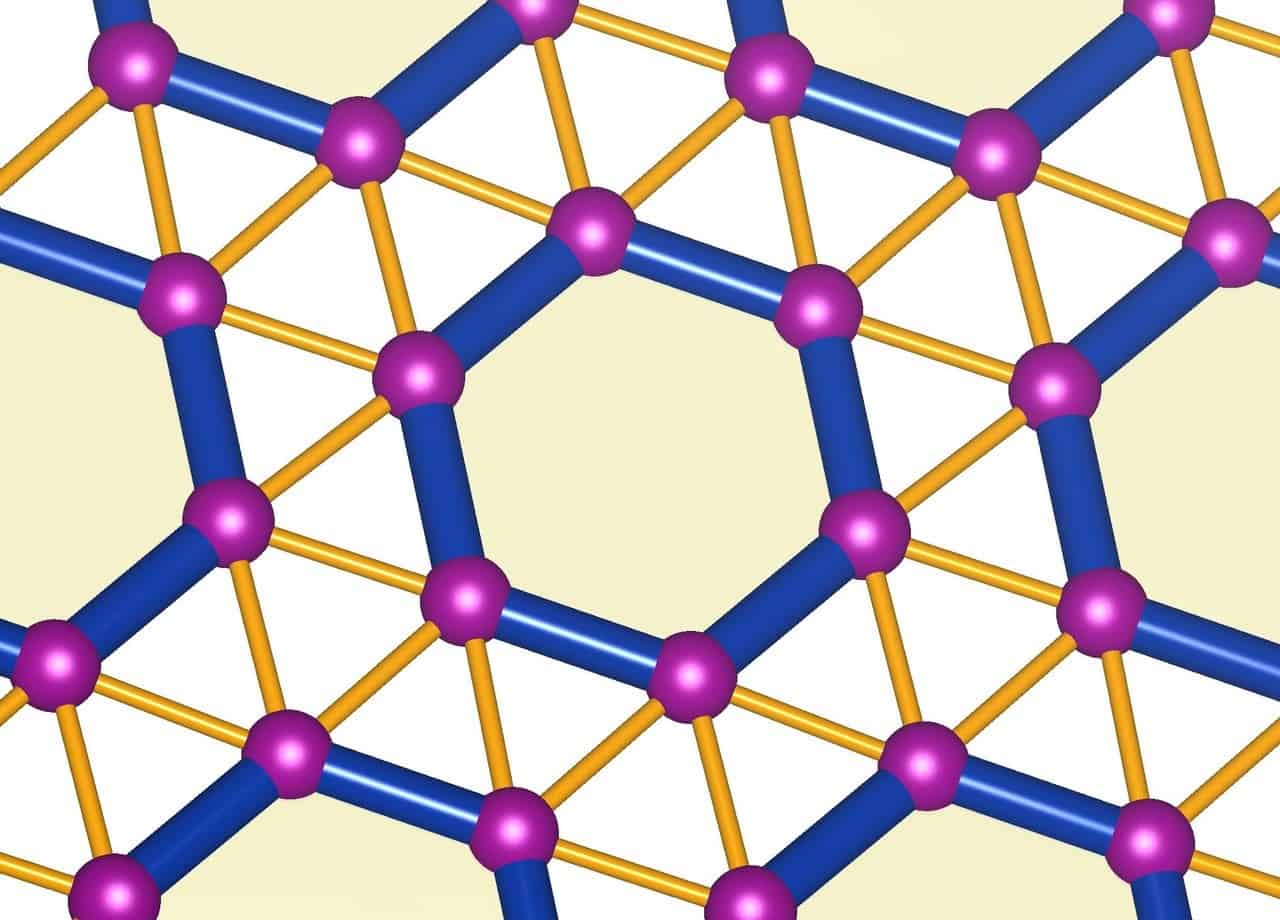
Using theoretical and computational techniques, the researchers showed that this unusual behaviour originates from the crystal structure of Na₂Mn₃O₇. The crystal structure divides the magnetic lattice into strongly connected hexagonal clusters of six Mn ions. These clusters behave like magnetic ‘molecules’, with the spins inside each hexagon becoming strongly correlated. Interactions between different hexagons are much weaker and frustrated, preventing the formation of long-range magnetic order across the material.
This research is important because it demonstrates that even large-spin magnetic materials can exhibit quantum-disordered behaviour. More broadly, it shows that crystal structure can be used as a tool to engineer new magnetic states by organising spins into strongly correlated clusters that suppress conventional magnetic ordering.
“What is striking in Na₂Mn₃O₇ is that the crystal structure does more than slightly distort the magnetic lattice. It reorganises the spins into strongly correlated hexagons that behave as emergent magnetic molecules, while frustration and quantum fluctuations prevent these units from ordering collectively.“ – Yasir Iqbal, Indian Institute of Technology Madras
Do you want to learn more about this topic?
Frustrated magnets in high magnetic fields—selected examples by J Wosnitza, S A Zvyagin and S Zherlitsyn (2016)