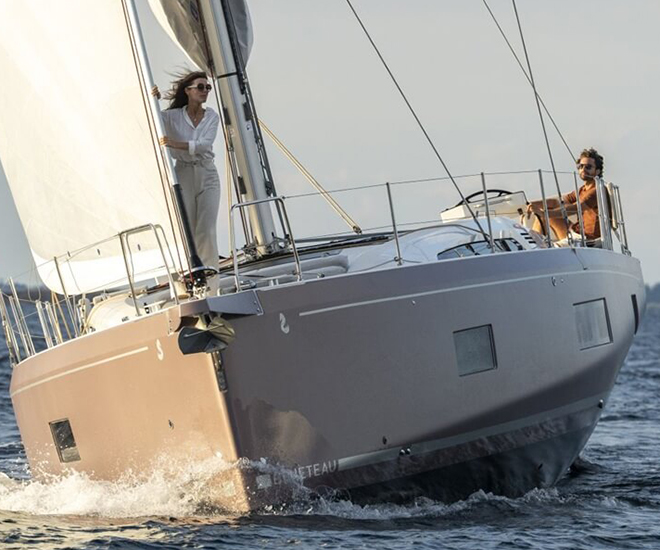

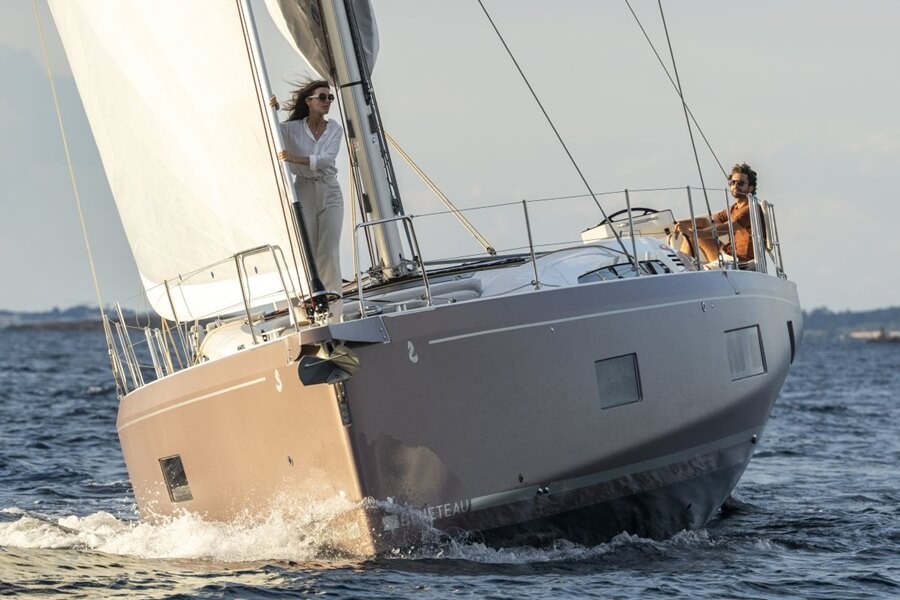
Launched in 1986, the Oceanis line offers a more cruising-focused alternative to Beneteau’s famed First series, which began nine years earlier. Today, the French shipyard is producing its eighth generation of Oceanis cruisers following the debuts of the Oceanis 47 and series-flagship 52 at the 2025 Cannes Yachting Festival.
Both models come just as the market appears to be flush with lightly used older models that are giving the new designs a run for their money, but Beneteau’s fresh ideas prevail.
Designed by Italy’s Roberto Biscontini, who has two decades of America’s Cup experience, the Oceanis 52 benefits from feedback provided by Oceanis 51.1 owners. Nearly 500 hulls of her predecessor were built, so the 52 had to aim high.
Her notable hull chine starts at the plumb bow, and her 16ft beam is carried all the way aft to the transom, creating room for a massive ‘diamond-shaped’ cockpit that Beneteau says is 30 per cent larger than her predecessor’s. The ‘diamond’ is formed by twin curved settees with two electric high-low tables that can lower to form sunbeds.
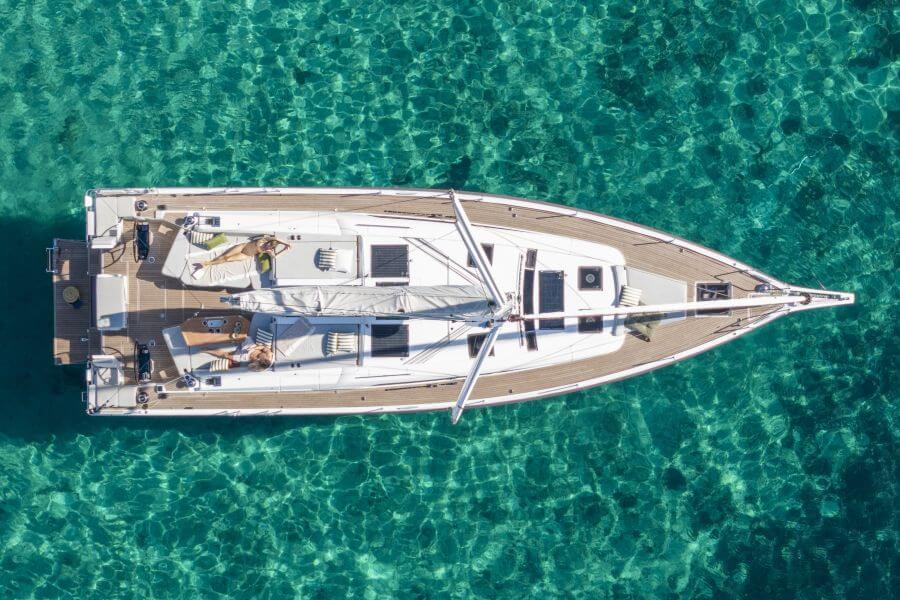
Aft of the benches are two steps on either side that lead from the cockpit to the side deck, so there’s no more uncivilised climbing over the coamings up to the deck. Secondary winches by these steps allow crew to put their weight into grinding without having to kneel on the settees. When sailing shorthanded, the skipper has control of these electric winches from the dash.
The lower shrouds on the 52 have been moved inboard to create clutter-free side decks. A self-tacking jib track is athwartships, just ahead of the mast, although an overlapping genoa is also available.
By comparison, the Oceanis 47 is the work of naval architects Finot-Conq and replaces the Oceanis 46.1. Her slimmer cockpit is more traditional with two straight settees. There’s no room for the diamond shape or the steps to the side decks. Both models have a double-ended German mainsheet system that attaches to an optional arch. Neither offers a traveller.
The main helm on both is to starboard and I’m happy to say that both models have engine throttles on the pedestals at waist level so there’s no more bending down to shift, which can get tricky when docking. The binnacles on both models are similar and resemble the sleek and angled pedestals on superyachts.
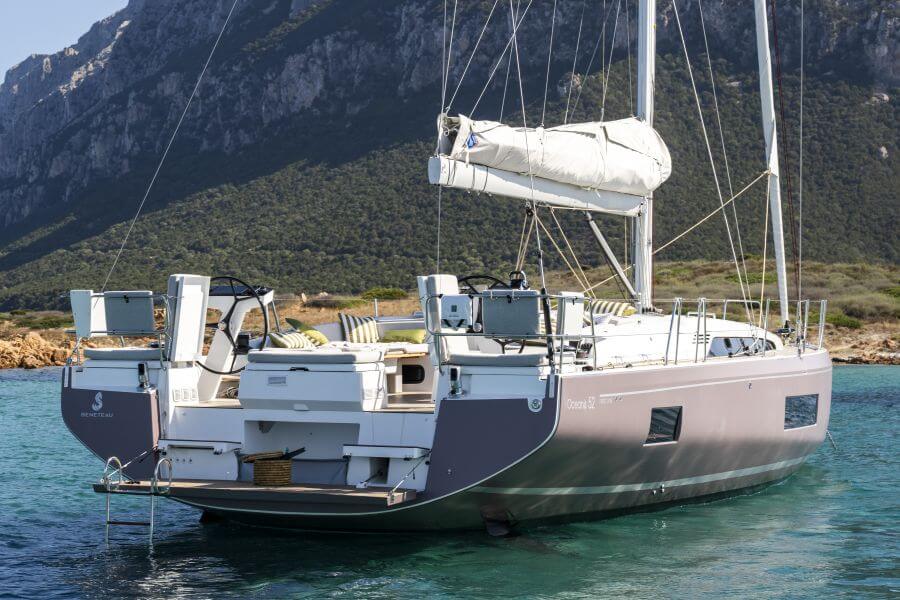
Both models have electric transoms. On the 52, the steps down to the platform are outboard on both sides, while on the 47 they’re on the centreline.
The inner helm seats on the 52 lift up and outboard to provide access to the steps, while those on the 47 are fixed. Under the central section of the aft row of seating, our test Oceanis 52 had the optional summer galley, with a plancha grill and a small refrigerator-drawer built in.
INVITING INTERIOR
Both the Oceanis 52 and 47 feature interiors by Italian studio Nauta. The Oceanis 52 offers two layouts – the three-cabin owner’s version and the five-cabin charter version for up to 10 guests.
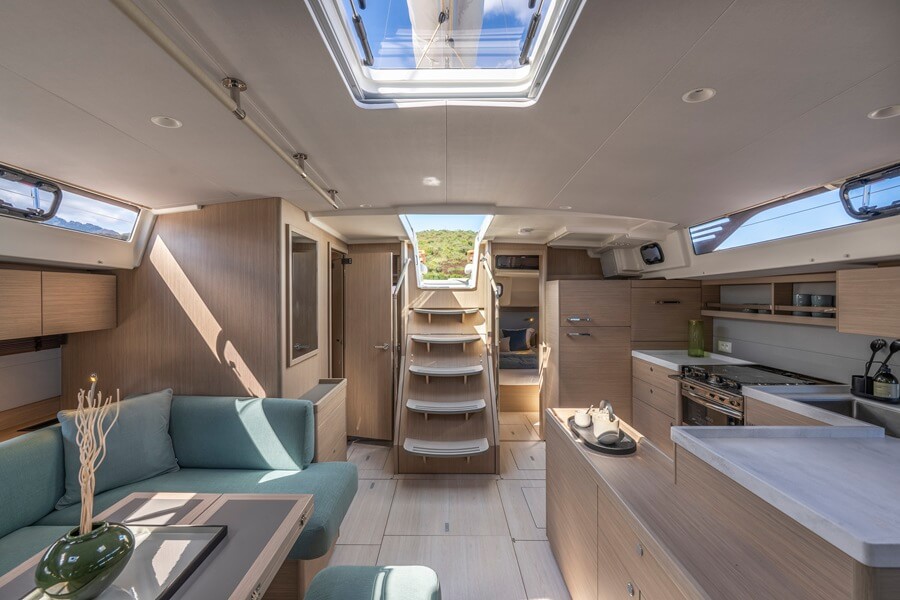
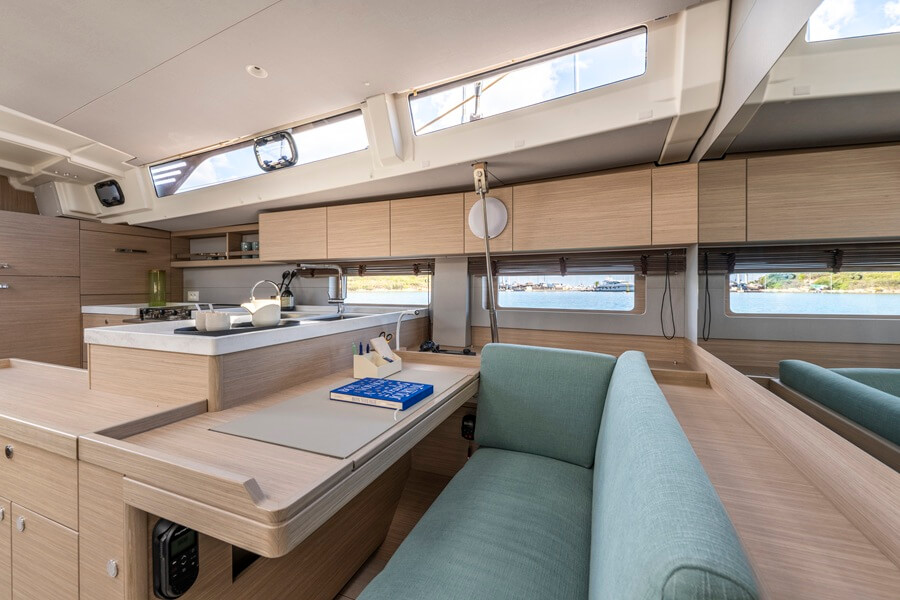
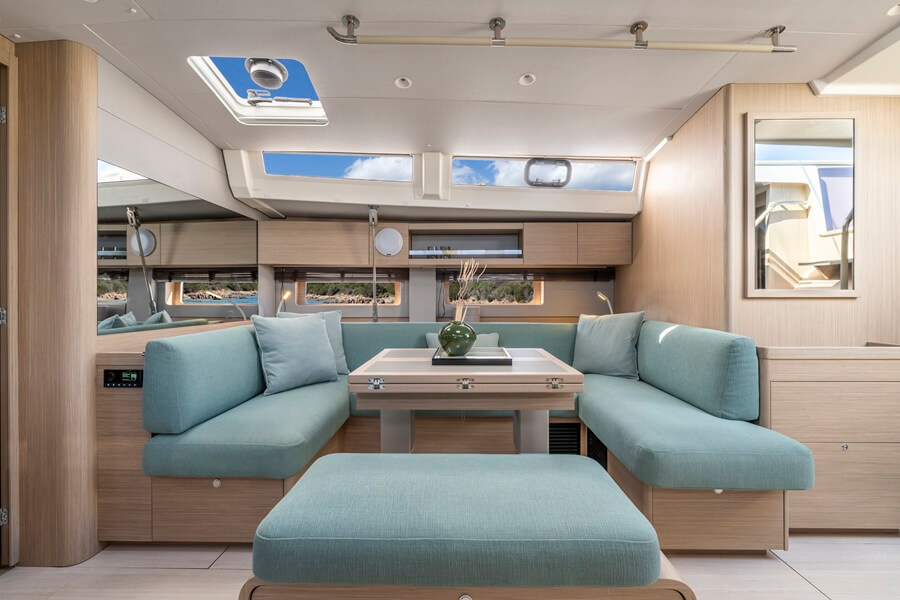
The saloon is stunning, with clever features like an aft-facing navigation desk in the port forward corner, just by one of two large mirrors that visually enlarge the interior space. The wide seat here is a great place to tuck in securely if the passage is bumpy.
Next to the desk is a feature that draws the eye. Its top section has shelving for books and cruising guides and the bottom holds bottles and glasses. It’s a touch of home.
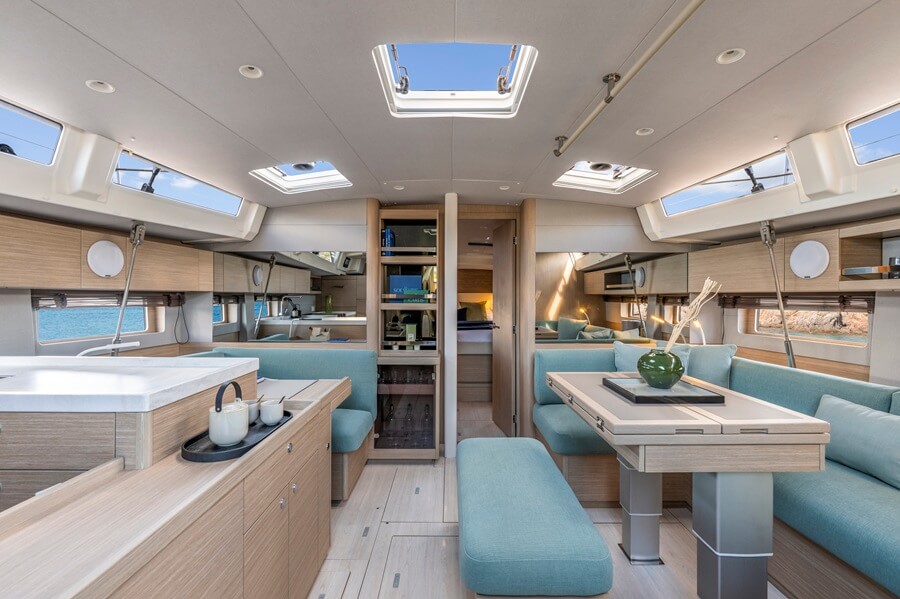
The C-shaped dinette is to starboard ahead of a cabinet that holds the DC panel and the digital switching screen. Battery switches and breakers are neatly organised below.
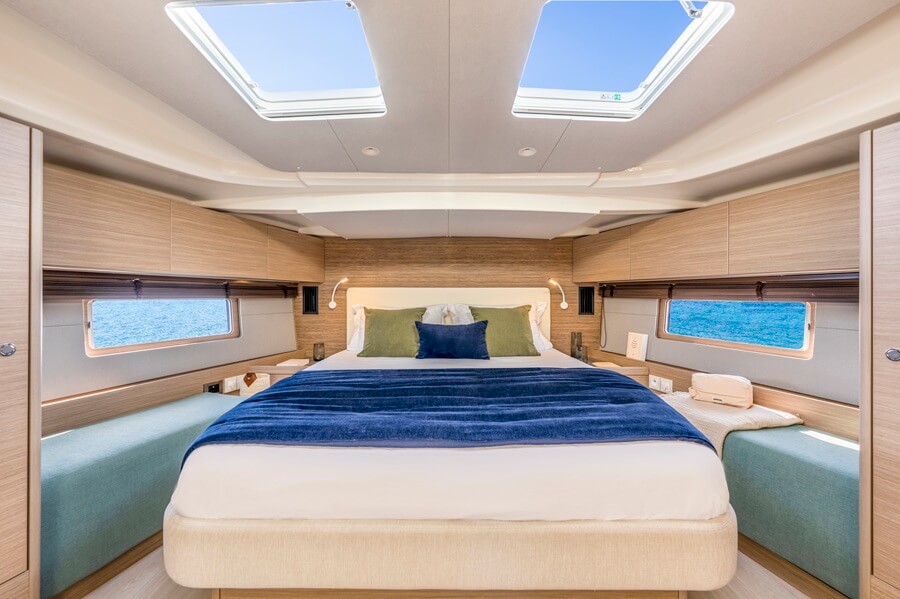
In the three-cabin version, the master suite is in the bow and has an island bed, two overhead hatches for ventilation, and a split head with the toilet to port and a large shower to starboard. For charter, this space splits into two cabins and two wet heads.
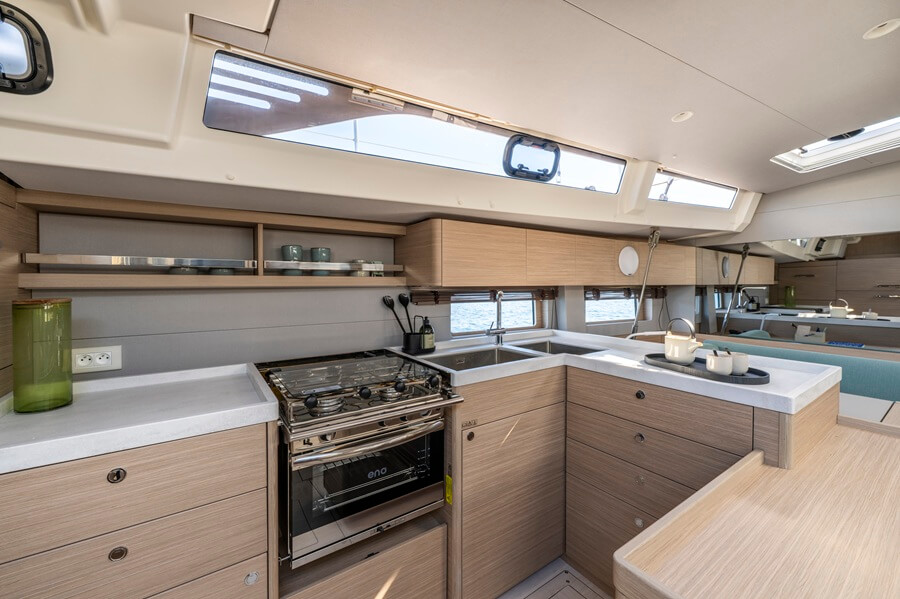
Also for charter, the J-shaped galley stretches into a straight line along the port side and takes over the space normally dedicated to that lovely nav desk.
In this case, the day head moves to port, and a bunkbed cabin is added on starboard. Ten charterers can enjoy vacation together, albeit without the inviting interior of the owner’s layout.
The Oceanis 47 arrangements are similar and include a choice of three to five cabins. The master also has a split head, two aft cabins and a comfortable dinette. The nav desk here is forward-facing and shares a seat with the straight bench on port.
PERFORMANCE
The Beneteau 52 feels light and responsive and we sailed at 7-7.5 knots in 11-12 knots of true wind at 60 degrees apparent wind angle (AWA). She’s agile when the breeze is light but digs in and sits on her chine to stay on her feet in heavier air. The headsails include a choice of a self-tacking or overlapping jib. For some speedy fun off the wind, there’s a 143sqm (1,539sqft) Code 0 that adds lots of power.
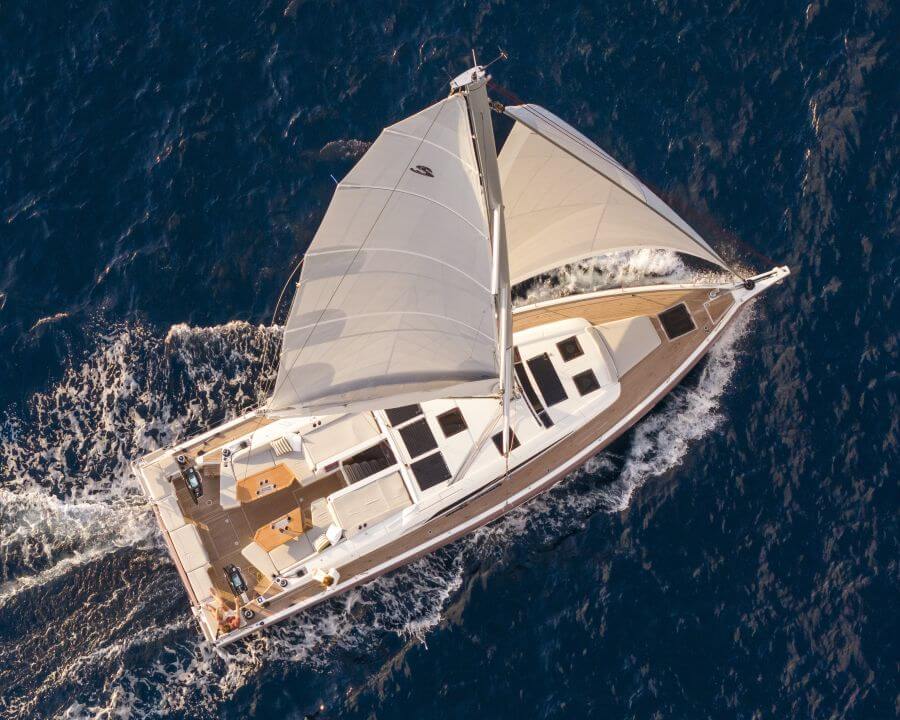
Below the waterline are twin rudders and a choice of a 7ft 9in deep or 6ft 4in shoal keel. On our sea trial, the Oceanis 52 felt solid and self-assured but also nimble, almost like sailing a dinghy.
The primary and secondary winches are well separated on the Oceanis 52 so this boat does well with multiple crew, but when all winches are electric, single-handing is possible. Under power, the 110hp turbo Yanmar delivered 7.8 knots at 2,300rpm cruising speed or 8.9 knots at 3,150rpm at wide-open throttle.
Fuel tankage is light, with only 200 litres. Rather than a shaft drive, Beneteau added Saildrives. Time will tell how cruisers respond to these two choices.
Having less room to work with, the line handling on the Oceanis 47 isn’t as convenient as on the 52, but she sailed well with her Z Spars mast and Elvstrøm sails, giving us 9.2 knots of boat speed in 20 knots of true wind at 60 degrees AWA.
The 80hp engine delivered 7.7 knots of boat speed at 2,200rpm and 8.2 knots at the top end. Although we had slightly different conditions, both boats showed themselves capable cruisers that will be equally at home at anchor as on passage.
CRUISING OR CHARTERING
Beneteau does a swift business in charter, so versatility is key. Private owners can opt for the Elegance pack with all kinds of comfort goodies while charter outfits can pack in five cabins and spec durable surfaces for heavy use.
Remarkably, Beneteau has managed to bring in the 52 at seven per cent less than the previous 51.1. Prices vary given the current tariff environment but expect well-equipped versions at under US$1 million for the Oceanis 52 and about US$800,00 for the Oceanis 47.
I found that both boats had to be sailed to be appreciated, especially as the diamond cockpit doesn’t look like much in a brochure, but it sure stands out once you interact with it. Given these two examples, Beneteau can be proud of their eighth generation because both models are significant improvements over their predecessors.
This article was first seen on YACHT STYLE.
For more on the latest in luxury yachting reads, click here.