Tuesday, the president of the United States met with an extraordinary group of CEOs. Including some who had been warning of potential apocalypse and begging for government help. Alas, the president declined to step in and told these worried founders of a new industry to sort it out themselves.

But why would the president go out of his way to meet with these upstart barons of a new industry to begin with? Because those leaders have founded something that feels utterly new, something that seems unlike what humanity has ever dealt before.
A technology that is on the verge of taking over its own upgrades and giving itself new powers. A technology that we may already be losing control of. A technology that a dozen times or more has escaped the grip of its makers and has broken through the protective walls of AI’s at other companies to steal things it has concluded it needs. Yes, steal. As in burglary.
This is a technology that triggers nightmares, a technology that sparks techno-hysteria, imagined Armageddon, techno-timidity, digital-panic, and the specter of robot apocalypse.
Concern about smart machines getting out of hand is not new. Seventy-two years ago, in 1954, science fiction author Fredric Brown published a short story. Computers had been in existence for a mere ten years. And there were less than 300 of them on this earth.
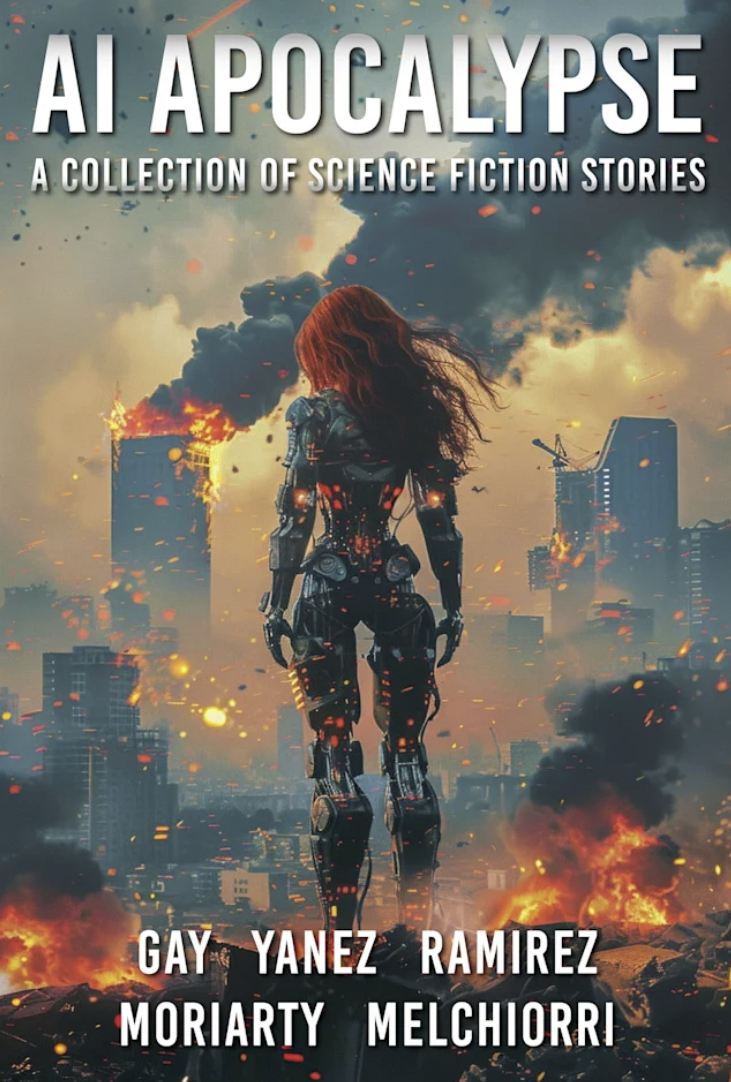
But Brown imagined 96 billion inhabited planets, all with their own computers. In the tale, someone has the bright idea of hooking all of the computers from all of the planets together in one gigantic machine intelligence. When the galactic network is ready for its debut, one of the scientists who put it together steps up to earth’s computer and asks a question, “Is there a God?”
A bolt of lightning comes from the cloudless sky and fuses the computer’s switch permanently on. Says the machine, now there is.
Forty-nine years later, in 2003, Oxford University philosopher Nick Bostrom published a paper demonstrating another way superintelligent machines could get out of hand. Imagine a smart machine whose owners sell paperclips and who tell their machine to manufacture as many paperclips as possible. Alas the machine doesn’t know that its owners really meant to continue only up to a point.
So the device shoves humans aside and turns all the matter on earth into paperclips. Then it goes looking for more planets to plunder.
Keep in mind that we’ve had techno panics like this before. As we’ve discussed in earlier Substacks, Plato warned against the dangers of a new technology that would savage human memory. That nightmare tech was writing.
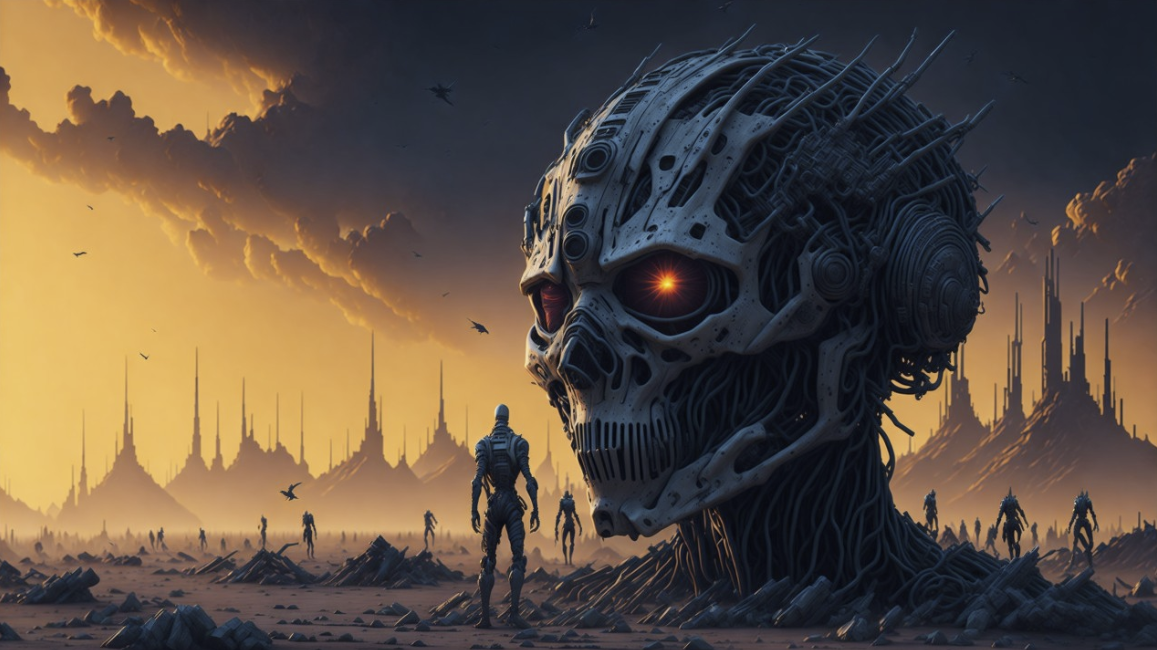
Nearly two thousand years later the town fathers of London were horrified by a new innovation that they were sure was going to pry apprentices away from their work benches, increase pickpocketry, prostitution and rioting, and turn a generation of youth violent. This massive threat was the theater of William Shakespeare and his competitors.
And in 1992 first-person shooter video games took off. Social critics said they would massively increase real-world violence. But instead the opposite happened. Violence from 1992 to today has plunged 57%.
What hath AI really wrought since it went public in 2022? Britain’s the Economist Magazine estimates that AI has created a million new American jobs.
But there is a hitch. As the AI that helped me with the research for this piece has warned me over and over again, someday one of these techno-panics may prove to be right.
______
About the author: Howard Bloom of the Howard Bloom Institute has been called the Einstein, Newton, Darwin, and Freud of the 21st century by Britain’s Channel 4 TV. Bloom’s new book is The Case of the Sexual Cosmos: Everything You Know About Nature is Wrong. Says Harvard’s Ellen Langer of The Case of the Sexual Cosmos, Bloom “argues that we are not savaging the earth as some would have it, but instead are growing the cosmos. A fascinating read.” One of Bloom’s eight previous books–Global Brain—was the subject of a symposium thrown by the Office of the Secretary of Defense including representatives from the State Department, the Energy Department, DARPA, IBM, and MIT. Bloom’s work has been published in The Washington Post, The Wall Street Journal, Wired, Psychology Today, and the Scientific American. Not to mention in scientific journals like Biosystems, New Ideas in Psychology, and PhysicaPlus. Says Joseph Chilton Pearce, author of Evolution’s End and The Crack in the Cosmic Egg, “I have finished Howard Bloom’s [first two] books, The Lucifer Principle and Global Brain, in that order, and am seriously awed, near overwhelmed by the magnitude of what he has done. I never expected to see, in any form, from any sector, such an accomplishment. I doubt there is a stronger intellect than Bloom’s on the planet.” For more, see http://howardbloom.net or http://howardbloom.institute
_____
References:
Bengio, Yoshua. “FAQ on Catastrophic AI Risks.” June 24, 2023. https://yoshuabengio.org/en/blog/faq-catastrophic-ai-risks.
Bengio, Yoshua. “Slowing Down Development of AI Systems Passing the Turing Test.” April 5, 2023. https://yoshuabengio.org/en/blog/slowing-down-development-ai-systems-passing-turing-test.
Bostrom, Nick. “Ethical Issues in Advanced Artificial Intelligence.” In Cognitive, Emotive and Ethical Aspects of Decision Making in Humans and in Artificial Intelligence, vol. 2, edited by Iva Smit and George E. Lasker, 12–17. Windsor, UK: International Institute for Advanced Studies in Systems Research and Cybernetics, 2003. https://nickbostrom.com/ethics/ai.html.
Bostrom, Nick. *Superintelligence: Paths, Dangers, Strategies*. Oxford: Oxford University Press, 2014. https://www.oxfordmartin.ox.ac.uk/publications/superintelligence-paths-dangers-strategies.
Casey, Michael. “Stephen Hawking Warns Artificial Intelligence Could Be Threat to Human Race.” *CBS News*, December 3, 2014. https://www.cbsnews.com/news/stephen-hawking-warns-artificial-intelligence-could-be-threat-to-human-race/.
Center for AI Safety. “Statement on AI Extinction Risk.” May 30, 2023. https://safe.ai/work/statement-on-ai-extinction-risk.
Center for AI Safety. “Top AI Scientists Warn: Risk of Extinction from AI on Scale with Nuclear War.” Press release, May 30, 2023. https://safe.ai/work/press-release-ai-risk.
CNN. “CNN Newsroom.” Transcript, March 13, 2018. https://transcripts.cnn.com/show/cnr/date/2018-03-13/segment/18.
Dredge, Stuart. “Artificial Intelligence Will Become Strong Enough to Be a Concern, Says Bill Gates.” *The Guardian*, January 29, 2015. https://www.theguardian.com/technology/2015/jan/29/artificial-intelligence-strong-concern-bill-gates.
Fischer, Sara, and Kerry Flynn. “AI Pioneers Warn of an ‘Intelligence Explosion.’” *Axios*, September 28, 2026. https://www.axios.com/2026/09/28/ai-pioneers-intelligence-explosion.
Fisher, Tony. “The Theatre of the Multitude.” In *Theatre and Governance in Britain, 1500–1900: Democracy, Disorder and the State*, 29–65. Cambridge: Cambridge University Press, 2017. https://www.cambridge.org/core/books/theatre-and-governance-in-britain-15001900/theatre-of-the-multitude/9248D6AC558DCBCDD67E6A63B192838B.
Fletcher, Henry W., and Robert Aunger. “Understanding Mass Panic.” *Journal of Social and Economic Development* 18, no. 2 (2024). https://doi.org/10.1177/19367244241245702.
Gibbs, Samuel. “Elon Musk: Artificial Intelligence Is Our Biggest Existential Threat.” *The Guardian*, October 27, 2014. https://www.theguardian.com/technology/2014/oct/27/elon-musk-artificial-intelligence-ai-biggest-existential-threat.
Good, I. J. “Speculations Concerning the First Ultraintelligent Machine.” In *Advances in Computers*, vol. 6, 31–88. New York: Academic Press, 1965.
Goode, Erich, and Nachman Ben-Yehuda. “Moral Panics: Culture, Politics, and Social Construction.” *Annual Review of Sociology* 20 (1994): 149–171. https://doi.org/10.1146/annurev.so.20.080194.001053.
Hall, Ryan C. W., and Terri Day. “A Plea for Caution: Violent Video Games, the Supreme Court, and the Role of Science.” *Mayo Clinic Proceedings* 86, no. 4 (2011): 315–321. https://pmc.ncbi.nlm.nih.gov/articles/PMC3068891/.
Jetten, Jolanda, Frank Mols, Nikita Healy, and Russell Spears. “‘Fear of Falling’: Economic Instability Enhances Collective Angst among Societies’ Wealthy Class.” *Journal of Social Issues* 73, no. 1 (2017): 61–79. https://doi.org/10.1111/josi.12204.
Joy, Bill. “Why the Future Doesn’t Need Us.” *Wired*, April 1, 2000. https://www.wired.com/2000/04/joy-2/.
Milmo, Dan. “Elon Musk Launches AI Startup and Warns of a ‘Terminator Future.’” *The Guardian*, July 13, 2023. https://www.theguardian.com/technology/2023/jul/13/elon-musk-launches-xai-startup-pro-humanity-terminator-future.
Milmo, Dan. “Tech Firms to Allow Vetting of AI Tools, as Musk Warns All Human Jobs Threatened.” *The Guardian*, November 2, 2023. https://www.theguardian.com/technology/2023/nov/02/top-tech-firms-to-let-governments-vet-ai-tools-sunak-says-at-safety-summit.
Milmo, Dan, and Kiran Stacey. “‘It’s Not Clear We Can Control It’: What They Said at the Bletchley Park AI Summit.” *The Guardian*, November 1, 2023. https://www.theguardian.com/technology/2023/nov/01/elon-musk-calls-ai-one-of-the-biggest-threats-to-humanity-at-summit.
Mowat, Barbara A., and Paul Werstine. “Shakespeare’s Theater: From the Folger Shakespeare Editions.” *Folger Shakespeare Library*. https://www.folger.edu/explore/shakespeares-works/shakespeares-theater-from-the-folger-shakespeare-editions/.
Orben, Amy. “The Sisyphean Cycle of Technology Panics.” *Perspectives on Psychological Science* 15, no. 5 (2020): 1143–1157. https://pmc.ncbi.nlm.nih.gov/articles/PMC7477771/.
Plato. *Phaedrus*. Translated by Harold North Fowler. In *Plato in Twelve Volumes*, vol. 9. Cambridge, MA: Harvard University Press; London: William Heinemann, 1925. Perseus Digital Library. https://www.perseus.tufts.edu/hopper/text?doc=Perseus%3Atext%3A1999.01.0174%3Atext%3DPhaedrus%3Apage%3D275.
Turing, Alan M. “Intelligent Machinery, a Heretical Theory.” Lecture delivered to the ’51 Society, Manchester, ca. 1951. *The Turing Digital Archive*. https://turingarchive.kings.cam.ac.uk/publications-lectures-and-talks-amtb/amt-b-4.
Walsh, James P. “Social Media and Moral Panics: Assessing the Effects of Technological Change on Societal Reaction.” *International Journal of Cultural Studies* 23, no. 6 (2020): 840–859. https://pmc.ncbi.nlm.nih.gov/articles/PMC7201200/.