A research team from China and Denmark have proposed a new, far more efficient, method of detecting ultralight dark matter particles in the lab

Dark matter is hypothesised form of matter that does not emit, absorb, or reflect light, making it invisible to electromagnetic observations. Although we have never detected it, its existence is inferred from its gravitational effects on visible matter and the large-scale structure of the universe.
The Standard Model of particle physics does not contain any dark matter particles but there have been several proposed extensions of how they might be included. Several of these are very low mass particles such as the axion or the sterile neutrino.
Detecting these hypothesised particles is very challenging, however, due to the extreme sensitivity required.
Electromagnetic resonant systems, such as cavities and LC circuits, are widely used for this purpose, as well as to detect high-frequency gravitational waves.
When an external signal matches one of these systems’ resonant frequencies, the system responds with a large amplitude, making the signal possible to detect. However, there is always a trade-off between the sensitivity of the detector and the range of frequencies it is able to detect (its bandwidth).
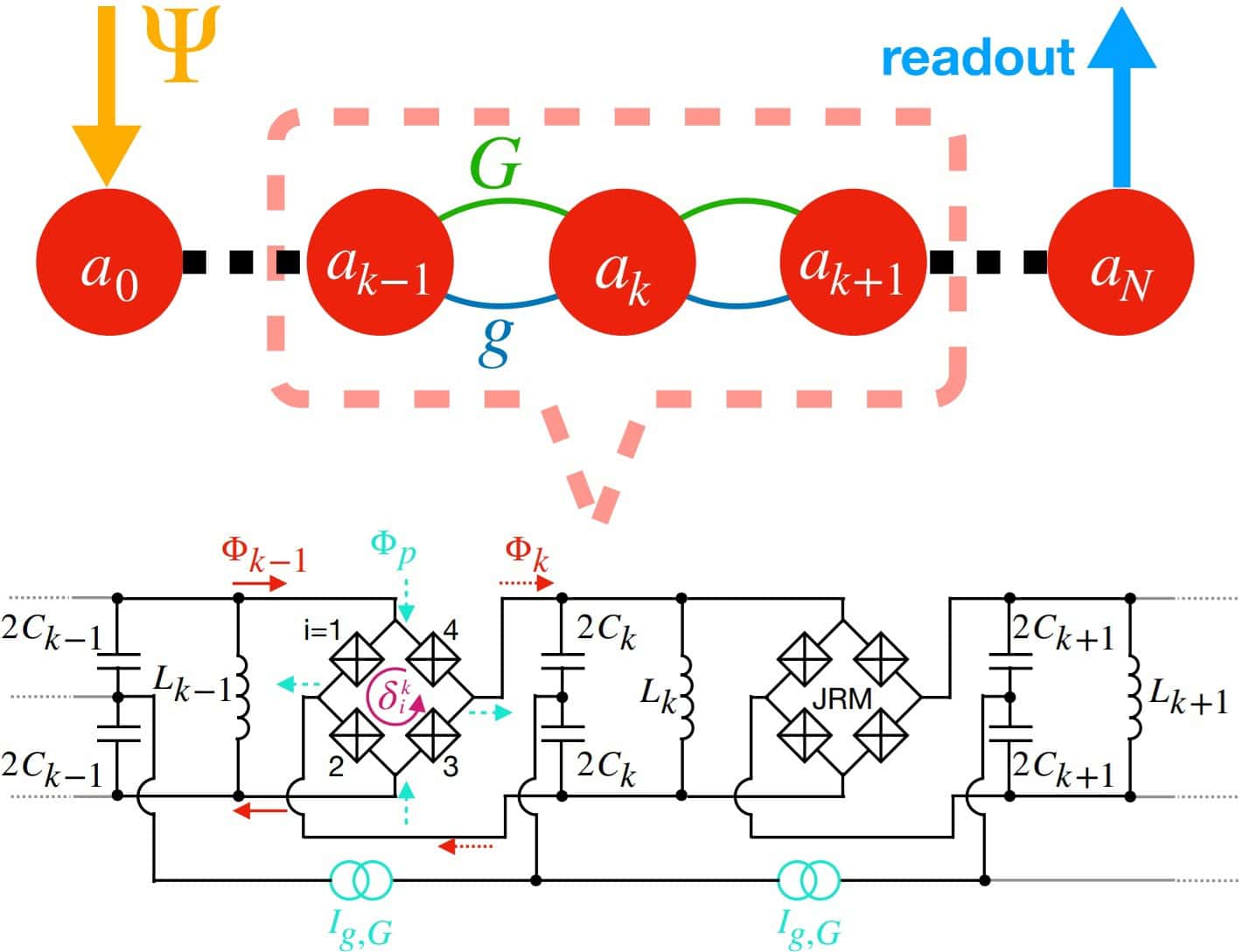
A natural way to overcome this compromise is to consider multi-mode resonators, which can be viewed as coupled networks of harmonic oscillators. Their scan efficiency can be significantly enhanced beyond the standard quantum limit of simple single-mode resonators.
In a recent paper, the researchers demonstrated how multi-mode resonators can achieve the advantages of both sensitive and broadband detection. By connecting adjacent modes inside the resonant cavity, and tuning these interactions to comparable magnitudes, off-resonant (i.e. unwanted) frequency shifts are effectively cancelled increasing the overall response of the system.
Their method allows us to search for these elusive dark matter particles in a faster, more efficient way.