Every Creature in the Galapagos Has a Mate Except Me
An excerpt from Fancy Meeting You by Louise Marburg
On the splintery old dock where we wait for the flotilla of Zodiacs that will ferry us out to the Galapagos Magic, a sea lion lazes in the sun, apparently fast asleep. “Aw,” someone says, “isn’t he cute?” There is a flurry of picture taking, both with cell phones and cameras, then a moment of silence as everyone checks how their pictures came out. No one else seems to notice the animal’s unbelievable stench. The thing smells like a Bowery bum. I gag and face the breeze.
I’m still queasy from the turbulent plane ride from Guayaquil, a city I will never step foot in again. The doorman at the hotel where I spent the night wore a Kevlar vest, and from the smeared windows of the airport van I saw soldiers with machine guns guarding the gas stations. When I tried to venture out into the suffocating heat to see what sights there were, I was warned by the concierge that I would certainly be mugged, possibly kidnapped, and if kidnapped then definitely raped. Instead, I went to the rooftop pool and practiced using my new mask and snorkel. I have a new wet suit too, purple with black chevrons on its arms, that hugs my body in a way that makes me look sexy and badass, yet still, I hope, attainable.
I am forty-nine and will turn fifty in a few days. Originally, I planned to take this cruise with a man I’d been dating, but inconveniently he broke up with me the very day, mere hours after I paid the hefty Galapagos Magic deposit. So here I am by myself on the equator with a duffle bag full of TravelSmith clothes and a copy of Darwin’s Finches.
The Zodiacs arrive. I am helped into one of them by a woman who wears a vaguely nautical uniform with a logo above her breast, the silhouette of a dolphin leaping across an orange disk. From the shore, the distance between the dock and the ship doesn’t look very far, but somehow from the boat it looks farther, and the sea seems choppier, slapping my face with a cold, salty mist.
“Hello,” says a man sitting next to me. Sixtyish, gray, and bespectacled. “I’m Bill Lutz and this is my wife, Matilda.”
Matilda pokes her head around Bill and points to two young women who are sitting on the side of the boat, their long blond hair flying around their heads in the wind. They’re identical except for their clothes, one wearing shorts, the other jeans. I’m glad they’re not dressed alike; I think it’s creepy when twins wear the same thing, as if there’s no difference between them at all. “And those two over there are our daughters, Hopie and Pat. We’re celebrating their college graduation by taking this cruise.” She is twinkly eyed and younger than Bill. She has teeth like a horse’s, protruding and yellow.
A black-and-red frigate bird flies over our heads, dipping and rising, gliding on layers of air. I have a handy little point-and-shoot that I bought for the trip. I take it out of my bag and snap what turns out to be a photo of the sky.
“There are a lot of families on this trip,” Matilda says. “Practically everyone we met at our hotel in Quito was a Galapagos Magic passenger.”
“I traveled through Guayaquil,” I say.
“Quito is the best route through Ecuador,” Bill says. “Stunning city. I hear Guayaquil is a dump.”
“Oh no, it’s gorgeous,” I say. I don’t like his attitude. “Beautiful weather.”
The boats draw up to the side of the ship. Ladders are dropped down and luggage hauled up. I climb to the deck as nimbly as I can in the wake of another passenger’s broad denim ass. We are herded into a carpeted lounge. According to the Galapagos Magic brochure, there are thirty passengers on board. Each of them appears to be attached to at least one other person.
“I hope I’m not the only passenger traveling alone,” I say to a crew member who’s doling out stateroom assignments. Her name is Estefania, according to a tag on her chest.
Estefania consults her clipboard. “You are,” she says in a surprisingly unaccented voice. She could be a news anchor in Des Moines. “If you wanted a singles’ trip you should have signed on with one of the Eclipse cruises.”
I fake a laugh. “A singles trip! God, no, I’m married. My husband was held back by business at the last minute.”
I find my stateroom and let myself in. It’s half the size of my bedroom at home and smells like an Airbnb at the beach. I peer out the single porthole. The shore appears to be moving, rather than the ship. The land slides past, barren as Mars, and gradually sinks into the sea. In the far distance is a mountain shaped like a pyramid. I didn’t know where the Galapagos Islands were until my ex-beau suggested this trip. That he asked me to take a vacation with him led me to believe we were on a path to marriage. I’ve thought that before with other men. Stupidly. I see signs where there are none. If you had told me thirty years ago that I wouldn’t be married by now, I would have laughed you out of the room. I had multiple boyfriends, often overlapping. Because marriage seemed like an inevitable destination, I didn’t give it much thought until one of those many boyfriends remarked in an offhand way that I wasn’t the kind of woman men wanted to marry. “You’re the woman they want to fuck, Laura,” he said. “You’re the temptress, not the wife.” I didn’t know whether to be offended or flattered.
Three notes sound, ding-dang-dong, like a theater tone at intermission. According to the printed schedule I was given, there is a nightly cocktail reception in the lounge. I switch my late mother’s ruby band from my right ring finger to my left. I consider a handful of names for my fake husband until I land on Alistair, which sounds like someone I would never encounter.
There is a very small shark swimming beneath me, and I am okay with it. I feel brave and nonchalant. Later, at lunch, I tell Bill and Matilda that a shark was the very first creature I saw on the very first day I ever snorkeled.
“Snorkeled?” I say. “Is that even a word?” I laugh. I love snorkeling, it’s my new favorite thing. After the shark, a sea lion swam up and did a backflip for my entertainment, and I followed a sea turtle until it sank into the depths. Black spiny sea urchins carpeted the ocean floor like a garden of lethal flowers. I thought I saw a whale-shaped shadow move through the water, but it disappeared almost instantly, a moment of artificial excitement. I was the last passenger to return to the Zodiac, which earned me a dark look from our guide Alejandro. We are not supposed to swim by ourselves.
“Did the shark have a white spot on its back?” Bill says through a mouthful of salad. Though it did have a white spot, I say it didn’t. “Because if it had a white spot, it was a Galapagos shark, and they’re perfectly harmless.”
“It was dark gray and quite large. Twice as long as you are tall.”
“Are you sure it was a shark? Sounds more like a whale,” he says.
“I would have been terrified,” a woman named Celia says. She and her husband Neal know Bill and Matilda from their hotel in Quito. We are eating on an open deck, frigate birds overhead like a squadron of hovercrafts. Hopie and Pat are sitting a few tables away with a gaggle of kids their own age. Everyone has an age they imagine themselves to be, and in my mind, I am twenty-five. Celia is in her forties, I guess, but she has gray streaks in her hair and fat upper arms, and I feel decades younger than her.
Everyone has an age they imagine themselves to be, and in my mind, I am twenty-five.
“Alistair would have loved it,” I say. “He’s very intrepid, nothing scares him. It’s a shame he had to miss it.”
“What does Alistair do?” Neal says. He has a camera with a lens as long as my forearm that he carries around with a preoccupied look on his face, as if he’s on assignment for National Geographic.
“He’s a surgeon,” I say. I was in love with a surgeon a few years ago.
“Do you have children?” Celia says.
“She has four,” Matilda tells everyone before I can speak. “A fifteen-year-old, a thirteen-year-old, an eleven-year-old, and an eight-year-old. All boys. Can you imagine?”
Apparently, this was what I said at the cocktail reception last night. I’m glad she spoke up because I had forgotten. I drank too much, which is something I often do and part of the reason my ex-beau defected; he thinks I’m an alcoholic. I might be. I’m not dismissing the idea, but what difference does it make if I am?
“I guess you don’t work outside the home with such a large family to take care of,” Celia says.
“I’m a doctor too, a psychiatrist,” I say, which creates a well of quiet. Probably they’re afraid of shrinks or don’t believe in psychotherapy. But I bet at least one of them will seek me out later in the trip and tell me their darkest secret.
“I’ve never met a psychiatrist,” Matilda says. You’re not meeting one now, I think. I work as a fact-checker for a textbook publisher in Baltimore. It’s an incredibly boring job. I keep meaning to quit and do something I love, but I haven’t thought of anything I would particularly love to do other than not work at all. I signal the waiter by waving my empty wine glass over my head. I’m not drunk, but I’m not sober. He brings me another glass rather than pouring the wine from a bottle, so I really don’t know what I’m drinking.
After lunch we all go to our staterooms to rest before the afternoon excursion to see the giant tortoises. I lie on my bed looking at old texts on my phone. There’s no Wi-Fi or cell service, so I can’t scroll through Facebook or Google random questions. Had I known I wouldn’t have civilized amenities with which to entertain myself, I would have brought some magazines. I look at a months-old text from my ex-beau, a funny video I try to access and can’t. I search for something substantive, but our texts consist of emojis and memes and shards of sentences. The only compliment I remember him giving me was that I was a “good egg,” clapping me on the back as he said it, but I don’t recall what made him say it. It’s not something you say to the woman you love. I realize now that he didn’t fall out of love with me, which was what I told myself; he was never in love with me. This should not be a revelation because he never said he was, but it is, and I’m shocked. How fucking stupid is that?
The tortoises are milling around in enclosures like cattle, each with a big number painted on its shell. They are gigantic and look inexpressibly sad. They have wrinkled, gray faces and drooping wattles and move with aching slowness, raising one huge foot and putting it stolidly down, then raising the opposite and so on, moving inch by inch to nowhere because there is literally nowhere for them to go. I expected to see them in the wild, but Alejandro tells me that they are difficult to spot in their habitat—we’d be searching the island all day. I am stunned by the heat; sweat pours from my face and body. The KoolSorb fabric that my shorts and shirt are made of is neither, as advertised, absorbent nor cool.
“How cruel, keeping them penned up like this,” Hopie says to Pat, or vice versa—I can’t tell them apart. As I am standing beside them, I make a sound of agreement.
“Wow, you’re sweating a lot,” Hopie or Pat says, as if I hadn’t noticed. Her face is pale and dry; she has a saddle of freckles over her nose. You’ll sweat when you’re fifty, I’d like to tell her.
“Sweating is healthy,” I say. I wipe my forehead and come away with a sopping hand. “I love sweating. It releases the toxins in your body.”
“I’ve heard that,” says the other one, Pat or Hopie. They have the same voice, the same face, the same bodies, the same hair. I would hate to look like someone else. I have been told all my life I’m unusual looking because of my eyes, which are swimming pool blue in contrast to my dark eyebrows and hair. No one has ever said I remind them of their cousin or friend or whoever. I’m never mistaken for a different person. I have an older sister, Nadine, who is my opposite, physically and philosophically. We don’t get along. I think how nice it would be to have a sister I enjoy as I watch Hopie and Pat put their heads together and giggle.
“What’s so funny?” I say. They look surprised. They’ve forgotten I’m here in under a minute. They don’t bother to reply.
Once we’ve seen the tortoises, we trudge off to look at birds, walking through a landscape of stunted, leafless trees. Alejandro tells us that most of the shrubs and trees will only grow leaves a couple of weeks out of the year, the rest of the time they’re bare.
“A very brief summer,” he says cheerfully. “Then the leaves fall. Ah, look, a finch!”
Everybody reaches for their binoculars. I don’t have binoculars, but I can see the bird—it’s small and brown, nothing special. Neal raises his long lens and takes several pictures while Alejandro tells us this finch has developed a beak that can crack seeds, unlike finches on the other islands. I already know about the finches and their various beaks, and I know that each island has a distinct ecosystem because I’ve read thirty excruciatingly dull pages of Darwin’s Finches and am in the process of skimming through the rest. But the two-week summer is news to me. It seems like something that would happen on another planet. I look at the pyramid-shaped mountain, which is so huge it’s visible wherever we go. It is treeless and buff-colored, shrouded in torn strips of cloud. It, too, seems eerily not of this earth.
“What is that mountain called?” I say to Alejandro.
He smiles at me as if I am a child. I wish I hadn’t asked. “It’s not a mountain. It’s the largest volcano in the islands. We call it Volcán Wolf. The Galapagos Islands were formed by volcanoes. Tomorrow we will go to a lava field, and you’ll see.”
A brilliantly colored lizard lumbers into our path. It’s the size of a large rat and looks immensely pleased.
“That’s a marine iguana,” someone’s teenage son says.
“Correct!” Alejandro says. “It’s mating season. He is looking for a wife.”
“How did you know that?” Celia asks the kid.
He holds up a paperback guide to the Galapagos. “Preparedness is the key to success,” he says. Teacher’s pet, I think. When I was his age, I was smoking pot and screwing random guys, prepared for absolutely nothing. I would have a thirty-four-year-old child now if I hadn’t had an abortion when I was sixteen. Thinking about having an adult child is the only thing that makes me feel as old as I am.
Alejandro leads us down a steep path to a cove where the Zodiacs are waiting on the shore. I’m so hot that I kick off my shoes and wade into the cool water. Hopie and Pat follow me in as Matilda warns in a scolding voice that their clothing will get wet. Then the rest of the young people rush in. They shout and dive and splash each other to the annoyance of everyone else. No one is paying attention to me, but I’m the one who started it.
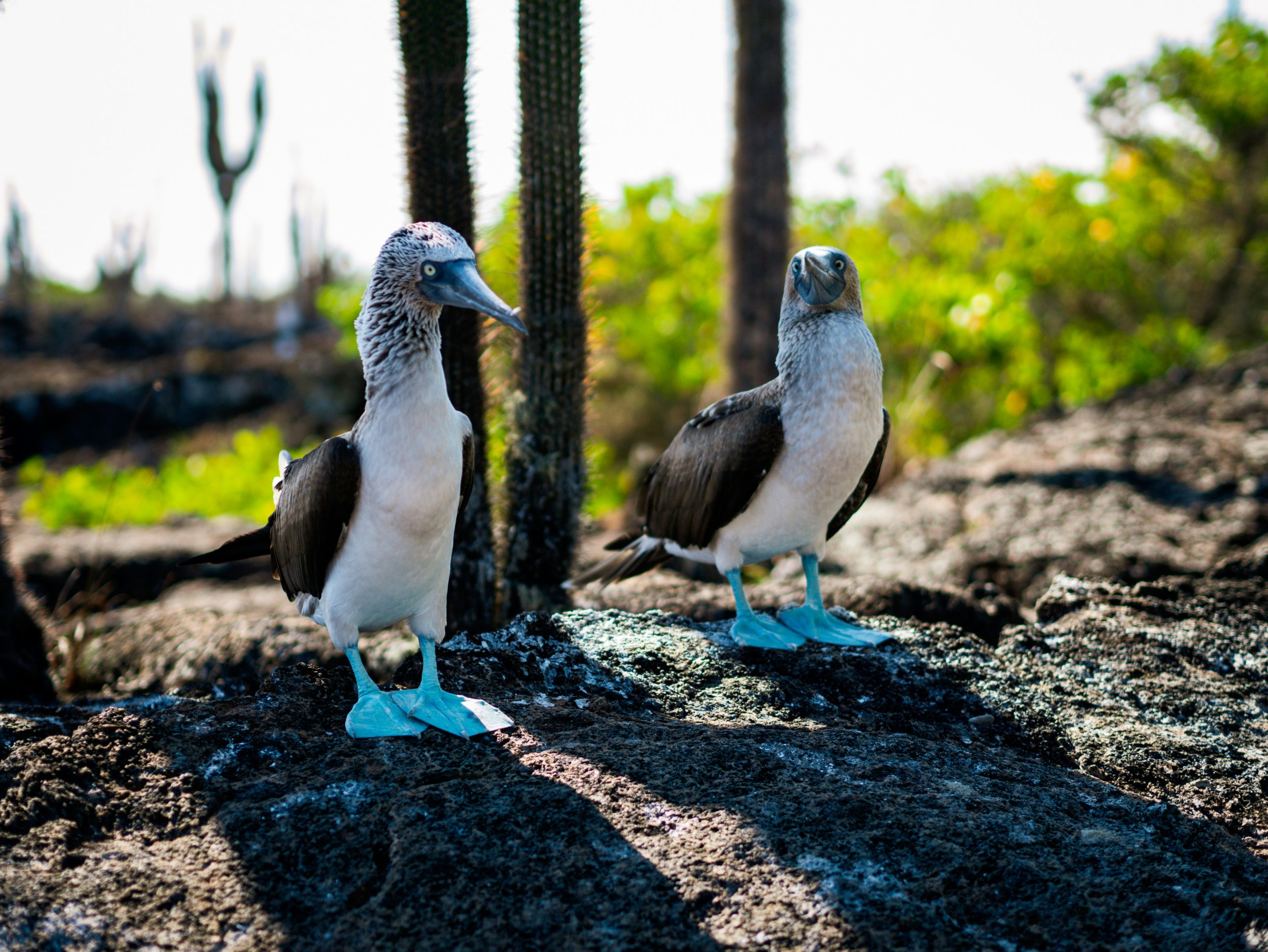
The lava field is a tar-black sea. The heat is indescribable. The sun beats down, and the lava sucks it in. I feel like I’m being cooked. We pick our way over petrified ripples and waves toward aqua green tidal pools that look like pieces of heaven. There are boobies everywhere, taking off and landing and stamping their cobalt blue feet, while armies of orange crabs scuttle around as if they are seeking something they lost. Utterly undisturbed by us tramping past them are orgiastic heaps of charcoal-colored iguanas. I think I see a penguin, but I don’t believe my eyes until somebody calls out that they see a penguin and suddenly a whole flock of them appears.
I am an impetuous liar; I don’t think things through.
The boobies regard us with mild interest. I wouldn’t be surprised if they began to talk. I stop for a moment to take it all in. This is the strangest place I’ve ever been.
Alejandro comes up behind me. “Laura,” he says in an urgent voice. He pronounces my name “Lowra.” “Esther is very upset. She says she won’t walk any further.” Esther is an old lady who is traveling with her husband Donald. They are like Jack Sprat and his wife: He’s a stick and she’s a marshmallow. They spend a lot of time at the bar on the ship, which I know because I spend as much time there myself.
“What does that have to do with me?” I say.
Alejandro puts his hands together as if in prayer. “You’re a doctor.”
I wonder who told him that. Matilda, I bet; she’d talk to a wall. “I’m a psychiatrist,” I say. “Not a doctor doctor.”
“I need you to go to her. She’s very upset.”
I wish I hadn’t said I’m a shrink. I am an impetuous liar; I don’t think things through. It’s gotten me into trouble before. I look longingly at the tidal pools and the glassy sea beyond. I am mere yards from reaching them.
“Oh, fine,” I say. I walk back, retracing my steps so I don’t trip and fall on the hard, scorching ground. Esther is sitting on a rock in the meager shade of a bare tree that is hardly more than a shrub. She is wearing a pair of madras Bermuda shorts I admire, and a pink polo shirt that goes nicely. Her white hair is set in short corkscrew curls. You wouldn’t know she’s in distress. I make her scoot over a couple of inches so I can sit on the rock with her.
“I wish I’d never come on this cruise,” she says. “I had no idea it would be so strenuous and hot.”
“The snorkeling is nice,” I say.
She sighs. “Well. I’m afraid of sharks, so I haven’t been snorkeling.”
“Don’t worry about the sharks,” I say. “They’re little and harmless, nothing to be afraid of.”
She draws back and looks at me. “I heard you saw a shark that was bigger than a man!”
I stretch out my legs and turn my face toward a small breeze for which I am pathetically grateful. “I was just bullshitting when I said that. You know who Bill is?” Esther nods. “He’s a know-it-all. I just said it to shut him up.”
Esther smiles. “He is a know-it-all, isn’t he!”
“Where is Donald?” I say.
“He was smart and stayed behind,” she says. “I called him a fuddy-duddy but look at me now.”
“You don’t have to go out onto the lava field,” I say. “In fact, I wouldn’t recommend it. But you are going to have to walk back to the Zodiacs.”
“I can’t,” she says. Tears come to her eyes. “It’s too far. I have arthritis in my hips. I hardly made it here.”
I nod as if I understand. I know nothing about arthritis except what I’ve seen in television ads. “You can’t just sit on this rock forever. I tell you what. I will personally escort you, and we can go as slowly as you like. In fact, let’s get a head start now.”
“No, I couldn’t ask you to do that,” she says. “Go on and enjoy yourself.”
If I were an old lady in need, I’d want someone to help me out. My mother has been dead for ages, so there aren’t any old ladies in my life. There is a deep nest of wrinkles where Esther’s neck meets her chest. Shallow creases crisscross her cheeks. I wonder what I’ll look like when I’m Esther’s age. My mother didn’t have the chance to get old, so I can’t refer to her example, but Nadine has vertical lines above her upper lip that I’m hoping to escape.
I stand and extend my hand. “I am your lifeline, Esther. Take it or leave it.”
She puts her hand in mine, and I pull her up off the rock. “I bet you’re a good psychiatrist,” she says.
“You’d lose that bet,” I say.
By the time we all get back to the ship and clamber up the ladder from the Zodiacs, Esther is her jolly old self. Donald is sitting on a stool at the bar, and she joins him for a prelunch snort. I wouldn’t mind having a drink too, but they seem so happy to be reunited that I leave them to their sherries and go out to the deck. I sit all alone in a patch of shade on a big metal box where the wet suits are stored.
It’s my birthday today, and I’ve been thinking about the fact since I woke up this morning. Of course, no one has wished me a happy birthday, and I feel sorry for myself about that. My fantasy was that my ex-beau would propose to me today with a diamond ring of considerable size just as we crossed the equator, and I would be engaged in two hemispheres. Where did I get such an idea? How would he even know where the equator is? It’s not as if there is a line with the word EQUATOR on it; we are not sailing a Rand McNally map. I go to the railing and gaze out at the sea, which looks strangely reddish in the flat noon light. Every day, I have been hoping to see a whale, but none has appeared. The cruise brochure specifically mentions whales, and I was looking forward to that one thing above all. A minute after I think this, the sea breaks open and a whale the size of a building explodes through the water. It is mottled gray on its back and white underneath and has a head as blunt as a prehistoric club. It pivots and allows itself to fall backward with a splash so enormous I involuntarily step back.
“Look!” I yell to no one. Everyone is at lunch. The whale sinks into the sea, leaving a pond of foam.
I go to the box and open its hinged lid, find my purple wet suit and pull it out from under all the others. I strip to my underwear and put on the wetsuit. I grab a mask and snorkel and a pair of fins and climb down the ladder we use to board the Zodiacs. On the bottom rung I hesitate before I drop into the sea. The water is soupy with plankton and smells like dead fish. I plan to swim out to where I saw the whale surface and be there when he rises again.
I hear my name. “Lowra!” Alejandro is standing on the deck. “Lowra, come back! No swimming alone!” I ignore him, but he keeps on calling. “Lowra, please!” Matilda joins him and waves at me with both arms. Bill appears and yells something I don’t understand as the twins rush out behind him. Celia and Neal, Esther and Donald—a crowd gathers around Alejandro.
“It’s my birthday,” I shout. I can’t tell if they hear me. I put the mouthpiece of my snorkel between my teeth and tighten the straps of my mask.
Hopie or Pat leans out and cups her hands around her mouth. “Happy birthday, Laura!” she calls. Her voice is reedy and joyful, as if she really means it.
I don’t think either girl has said my name before. It feels good to hear it, to watch the crowd swell. I have seen a whale on my birthday, and everyone knows who I am.