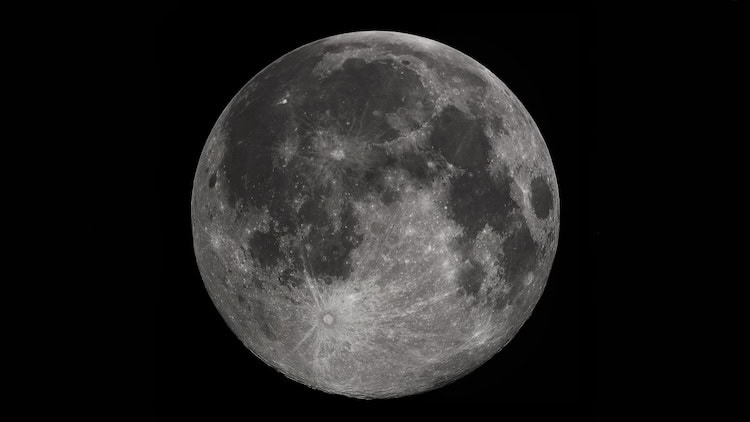
Remnants of solidified lava brought back by a Chinese mission were 1 billion years younger than material acquired by other missions decades ago, according to an article in the journal Science, suggesting the moon cooled down later than thought.
Samples brought back from US and Soviet missions were more than 2.9 billion years old. The samples acquired on China’s Chang’e-5 mission late last year — around 1.96 billion years old — suggests volcanic activity persisted longer than previously expected.
Last December, the uncrewed Chinese probe touched down on a previously unvisited part of a massive lava plain, the Oceanus Procellarum or “Oceans of Storms”. About 1,731 grammes of lunar samples were later retrieved and brought back to Earth.
One of the main objectives of Chang’e-5, named after the mythical Chinese goddess of the moon, was to find out how long the moon remained volcanically active.
“The Oceanus Procellarum region of the Moon is characterised by high concentrations of potassium, thorium, and uranium, elements that generate heat through long-lived radioactive decay and may have sustained prolonged magmatic activity on the near side of the Moon,” wrote the article’s authors, including Chinese researchers.
The article said the heat source for the magmatic activity might also be due to so-called “tidal heating”, or heat generated by the gravitational tug and pull of the Earth.
The Chang’e-5 mission made China the third country to have ever retrieved lunar samples after the United States and the Soviet Union, which 45 years ago launched the last successful mission to acquire material from the moon.
China plans to launch the Chang’e-6 and Chang’e-7 lunar missions, also uncrewed, in the next five years to explore the south pole of the moon.
© Thomson Reuters 2021