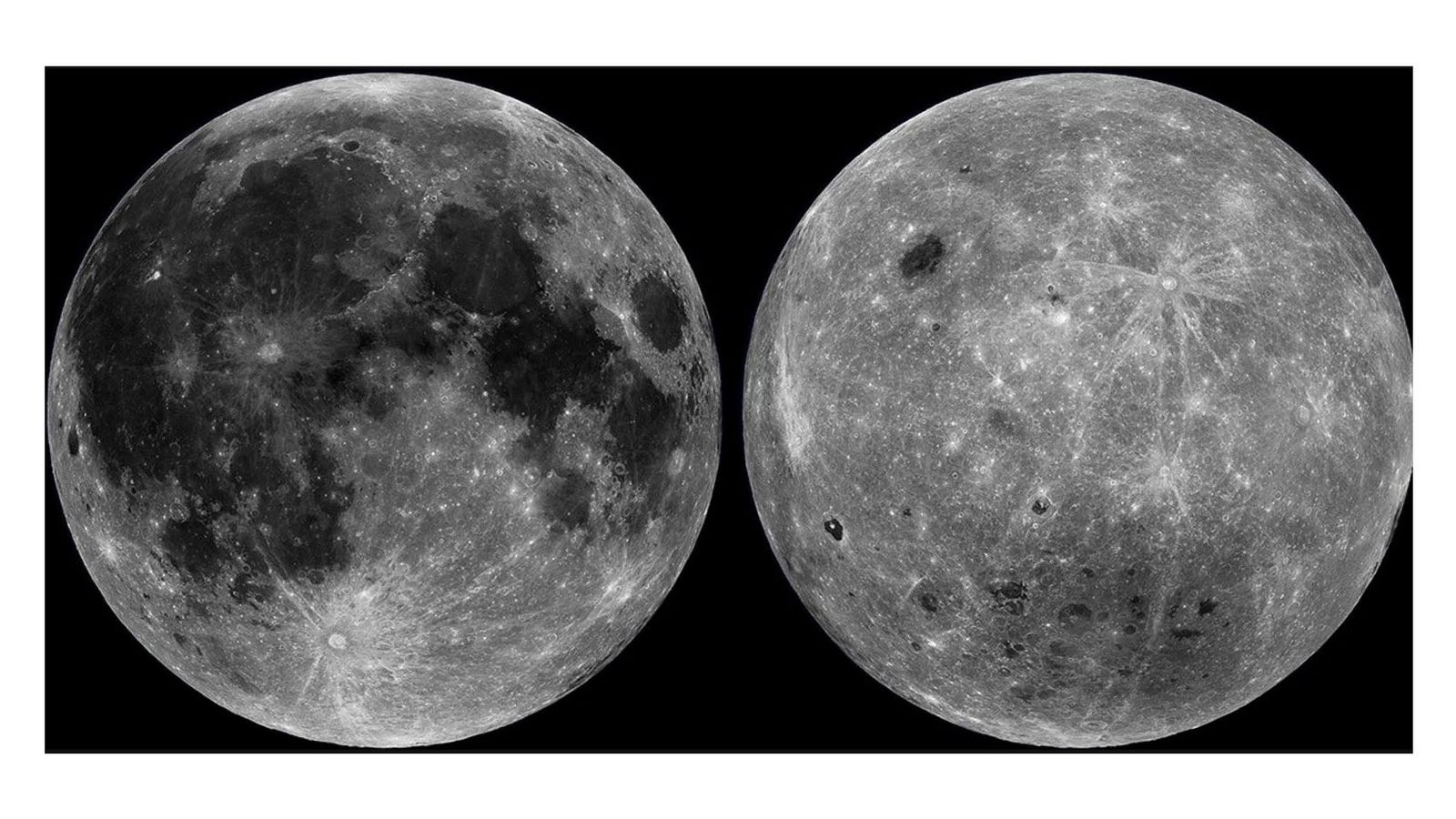

Scientists have discovered key differences under the moon’s surface that may explain why its two hemispheres look so different.
The moon’s near side, the side visible to Earth, is dark and covered in the remnants of ancient lava flows.
Its far side, which we can’t see from Earth, is rugged and rocky.
Scientists have long suspected the differences could be explained by what’s inside the moon but until now, couldn’t prove it.
“We found that the moon’s near side is flexing more than the far side, meaning there’s something fundamentally different about the internal structure of the moon’s near side compared to its far side,” said Ryan Park, who led the team from NASA’s Jet Propulsion Laboratory.
“When we first analysed the data, we were so surprised by the result we didn’t believe it. So we ran the calculations many times to verify the findings.
“In all, this is a decade of work.”
The team studied data gathered by the Gravity Recovery and Interior Laboratory (GRAIL) mission.
Read more from climate, science and technology:
M&S says customers’ personal data taken by hackers
AIs can make collective decisions and influence each other
Warning of heat impact on pregnant women and newborns
File pic: AP
For that mission, two spacecraft, Ebb and Flow, were sent to orbit the moon for a year between 2011 and 2012.
They used that data to map how the moon responds to Earth’s gravitational pull as it orbits.
The moon’s gravity slightly fluctuates as it circles the Earth which causes it to flex.
That movement helped the scientists to understand the moon’s deep internal structure and discovered that the moon’s near side is internally warmer than its far side.
Although this helps with crucial understanding of the moon, it may also help us understand other planets.
In fact, the team have already used their technique to map the internal structures of planets like Jupiter and the Vesta asteroid.
“There are many opportunities in the future to apply our technique for studying the interiors of intriguing planetary bodies throughout the solar system,” said Mr Park.