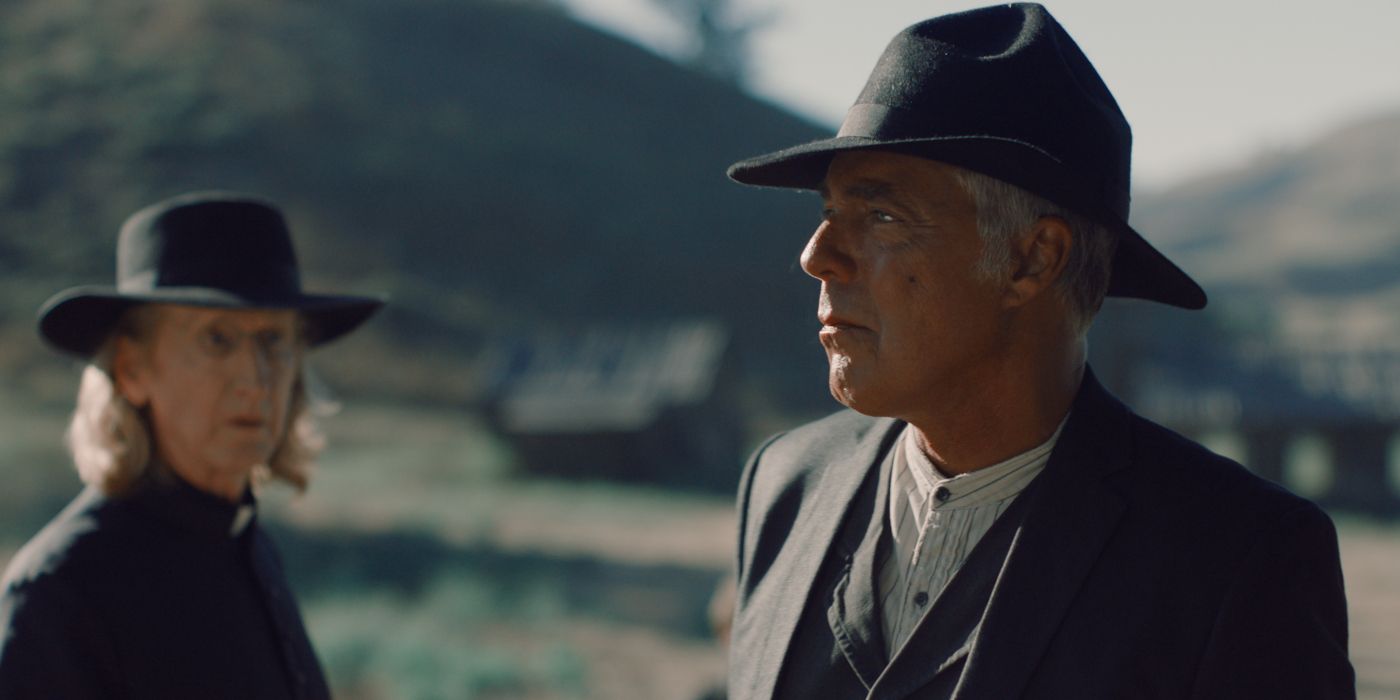


Abraham’s Boys: A Dracula Story continues a beguiling tradition of complicating the mythology of famed literary characters. Based on Joe Hill’s short story of the same name, Abraham Van Helsing (Bosch‘s Titus Welliver) and his feet of clay are the focus of director Natasha Kermani’s patient, grim horror flick, set 18 years after the events of Bram Stoker’s Dracula. As with John Gardener’s Grendel or Barbara Kingsolver’s Demon Copperhead, Abraham’s Boys is not trying to recreate a story you already know; instead, it offers a new perspective on something that has become canon. Adorned with all the expected Gothic trimmings — think creepy dungeons and anthropomorphic shadows — but shot through with piercing, sunlit terror by cinematographer Julia Swain, Abraham’s Boys is a chilling reminder that the monsters “out there” are rarely as terrifying as the ones in our own homes.


Cruel Means to an Uncertain End

The story begins in 1915. We meet up with the Van Helsing family, which consists of Abraham, his wife Mina (Jocelin Donahue) and their sons Max (Brady Hepner) and Rudy (Judah Mackey). The Van Helsings have traded their life in London for a remote home in the Central Valley area of California, and from the start, Kermani and Swain contrast the cold, controlled and compact nature of the Van Helsings’ residence to the expansive, sun-baked space around them.
The Van Helsings have chosen to isolate themselves from humans, bloodsuckers and everyone in between, and establishing shots exhibit how awkwardly their property stands in this sun-scorched land. It’s as if they’ve brought evil with them, rather than fleeing from it. Swain frequently intercuts beautiful landscape shots with gore and violence, such as a golden-hour view seen not too long after Abraham has used a scalpel to graphically perform surgery on an injured neighbor. It reinforces the film’s message to be wary of what’s presented to us as right and true — there are lacerations in this supposed private paradise.
Still, for the Van Helsings, it’s a tranquil life. It’s also the only one the boys have ever known, although they get hints of their parents’ past ordeals with the supernatural through Mina’s slow deterioration. She never fully recovered from her encounter with the Transylvanian vampire, and Van Helsing uses her illness to take drastic, abusive and violent measures to secure their home. This puts him in conflict with Max and Rudy, who remain distrustful of their father’s superstitions and instead only see how his delusions and rules are accelerating Mina’s descent into madness and death.
Max and Rudy are perceptive enough to know that there’s more to what their father is presenting to them as truth, and it’s in witnessing their skepticism curdle into a grisly rebellion that Kermani’s film casts its most gripping spell. It can be tricky for movies that tease a kind of Schrödinger’s crisis — that is, where the core drama revolves around whether a threat is real or not — to sustain that momentum. They often feel like they’re just spinning their wheels, especially when the horror is unseen. Kermani moves out of that narrative cul-de-sac by ruminating on a far more interesting question: Regardless of whether the threat of Dracula is real, does it justify Abraham Van Helsing’s cruelty, even if it’s in the name of love and protection?
Abraham abrasively casts aside outside help for Mina, and eventually forces his sons to kill people their father swears are devilish — actions that prompt Max and Rudy to challenge whether the supposed protection they get is worth the abuse they receive. In this way, the film situates its horror in witnessing a home — supposedly a place of safety — transforming into a place of danger. There’s a unique distress in the feeling of disillusionment taking hold in one’s heart that’s far scarier than any vampire bite, as one turns to the people around them and realizes that they can’t be trusted.
Strong Performances Bring Welcome Nuance
Given that Abraham’s Boys: A Dracula Story roots its scares in the tortured interiority of its characters, it wouldn’t work without performers that can tap into that disenchanted register. Thankfully, the cast is more than up to the task. Hepner and Mackey capture the feeling of being hollowed out and sucked dry by the fangs of parental tyranny, portraying Max and Rudy as boys who’ve had to grow up too quickly, and whose inner child longs to escape from a body that’s endured more than any youth should bear.
Welliver, in turn, wears Abraham’s traumas brazenly, adding nuance to the inhumanity that’s tempting to ascribe to him. Without showing any of his backstory, Welliver depicts Abraham as a man who has seen the worst of what the world (and the world beyond) has to offer. As a result, he wants to protect his family from experiencing those same horrors. He garners sympathy as a father who loves and protects imperfectly, fueled by the agonies that haven’t departed from his bones.
Welliver is in lock step with Kermani in revealing the dark side of our heroes — it’s terrifying to witness Abraham uaing the same cunning he likely used against Dracula against his own family. And Donahue plays Mina with a measured madness, refreshingly not devolving into common tropes actors might employ when depicting mental illness. Instead, she roots her most spacey provocations and outbursts in a maternal tenderness. She wants to protect the boys from what’s happened to her, but she doesn’t realize how her protection also suffocates them.
Its measured wavelength might not be for all, but when viewed through the prism of distressing family dynamics, Abraham’s Boys: A Dracula Story works as a slow-burning tale of the painful but necessary journey of youthful deconstruction. It makes us question the veracity of the legends, erasing the “happy ever after” of Stoker’s original novel to explore the dark underbelly of Van Helsing’s heroism. While some may find it repetitive or inert, others will be haunted by the sinister mundanity of watching a family unit fracture. It’s as if Kermani and her crew were trying to capture the maddening state of being where reality and nightmares blur together.
Abraham’s Boys will debut in select theaters on July 11th from Shudder and RLJE FIlms.