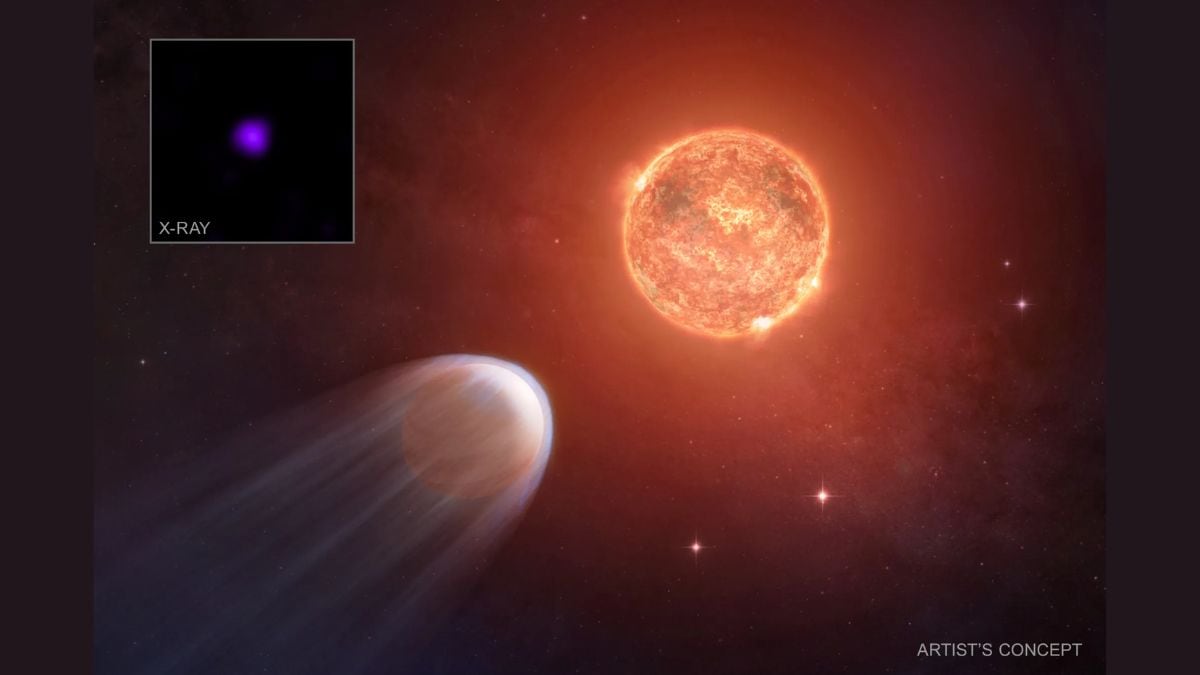

NASA’s Chandra X-ray Observatory, together with data from the Hubble Space Telescope, has revealed a “baby” exoplanet rapidly losing its atmosphere. The planet, named TOI 1227 b, orbits a faint red dwarf star and is only about 8 million years old. Powerful X-ray blasts from the star are stripping away the planet’s thick gas envelope. Models indicate TOI 1227 b is shedding an amount of gas equal to Earth’s entire atmosphere every ~200 years. The team notes the planet’s atmosphere “simply cannot withstand the high X-ray dose it’s receiving”. This finding offers a rare, real-time look at atmospheric erosion, showing how a young world can be dramatically reshaped by its star early on.
Observations of an Eroding Planet
According to the study, astronomers used Chandra’s X-ray data (and earlier Hubble observations of the planet’s transit) to study TOI 1227 b. This Jupiter-sized world orbits extremely close to its star – much closer than Mercury is to the Sun – and is about a thousand times younger than Earth. The host star is unleashing intense X-rays on the planet.
In artist’s illustrations and models, this appears as a blue tail of gas streaming off TOI 1227 b as its atmosphere is ripped away. Computer simulations show the radiation will “rapidly” strip off the gas. Remarkably, the planet is already losing the equivalent of an Earth’s atmosphere about every 200 years. If conditions persist, TOI 1227 b could ultimately shrink from a gas giant to “a small, barren world”.
Implications for Planetary Evolution
This discovery highlights the key role of stellar radiation in young planetary systems. High-energy X-rays (and ultraviolet light) from an active young star can heat and blow away a planet’s atmosphere. As co-author of the study Joel Kastner explains, understanding exoplanets requires that scientists “account for high-energy radiation like X-rays”. In this case, the star’s output acts like “a hair dryer on an ice cube,” gradually blowing the gas off the planet. Such photoevaporation is thought to explain why many intermediate-size exoplanets end up smaller or stripped to their cores.