
[ad_1]
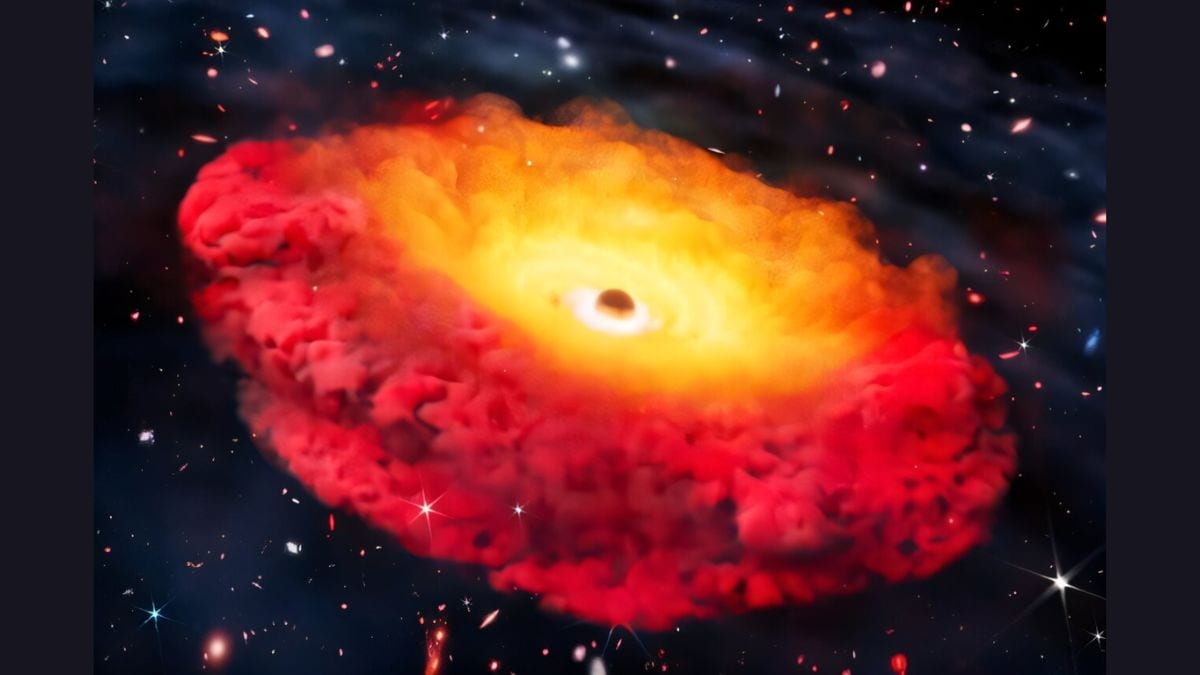
Astronomers have discovered the most distant black hole yet, an ancient quasar more than 13 billion light years from our own Earth, incredibly close to the limit of where scientists even expect supermassive black holes to form. The cosmic behemoth of a galaxy, known as CAPERS-LRD-z9, provides a wide-window echo back in time to one of the furthest peeks into our early universe yet, only shortly after the Big Bang, when our cosmos was a fraction (3%) of its current age. Now, researchers led by those in The University of Texas at Austin’s Cosmic Frontier team have found what are likely very powerful gas outflows and also evidence that some of the very first black holes were born much, much heavier than previously believed.
Early Black Hole Found in ‘Little Red Dot’ Galaxy Challenges Growth Models
According to a study published in The Astrophysical Journal this week, researchers led by those at The University of Texas at Austin’s Cosmic Frontier team are announcing they have made the most sensitive measurements to date less than a billion years after the Big Bang, and these neonatal black holes were producing gas outflows fast enough — and over a long enough period — to halt stars forming in surrounding galaxies.
More recently discovered, the Little Red Dots galaxy appears to be just the sort of ominous-sounding crimson that would shoot a vibrant deep red due to intense radiation taking place among giant black holes and gas clouds.
A little galaxy of mass in all that more than enough of less, those hundreds of millions of suns among which all those stars are caught. This, in turn, birthed the supermassive galactic monsters — either quickly overcooked giants or premature sizes.
JWST high-z key science theme & imaging science exposure for mapping the process of supermassive black hole formation, growth, and evolution at high spatial detail.
[ad_2]
View Original Source Here