New research has emerged, showing when quantum systems are absolutely separable and fundamentally non-entangled
Quantum entanglement is a uniquely quantum link between particles that makes their properties inseparable. It underlies the power of many quantum technologies from secure communication to quantum computing, by enabling correlations impossible in classical physics.
Entanglement nevertheless remains poorly understood and is therefore the subject of a lot of research, both in the fields of quantum technologies as well as fundamental physics.
In this context, the idea of separability refers to a composite system that can be written as a simple product (or mixture of products) of the states of its individual parts. This implies there is no entanglement between them and to create entanglement, a global transformation is needed.
A system that remains completely free of entanglement, even after any possible global invertible transformation is applied, is called absolutely separable. In other words, it can never become entangled under the action of quantum gates.
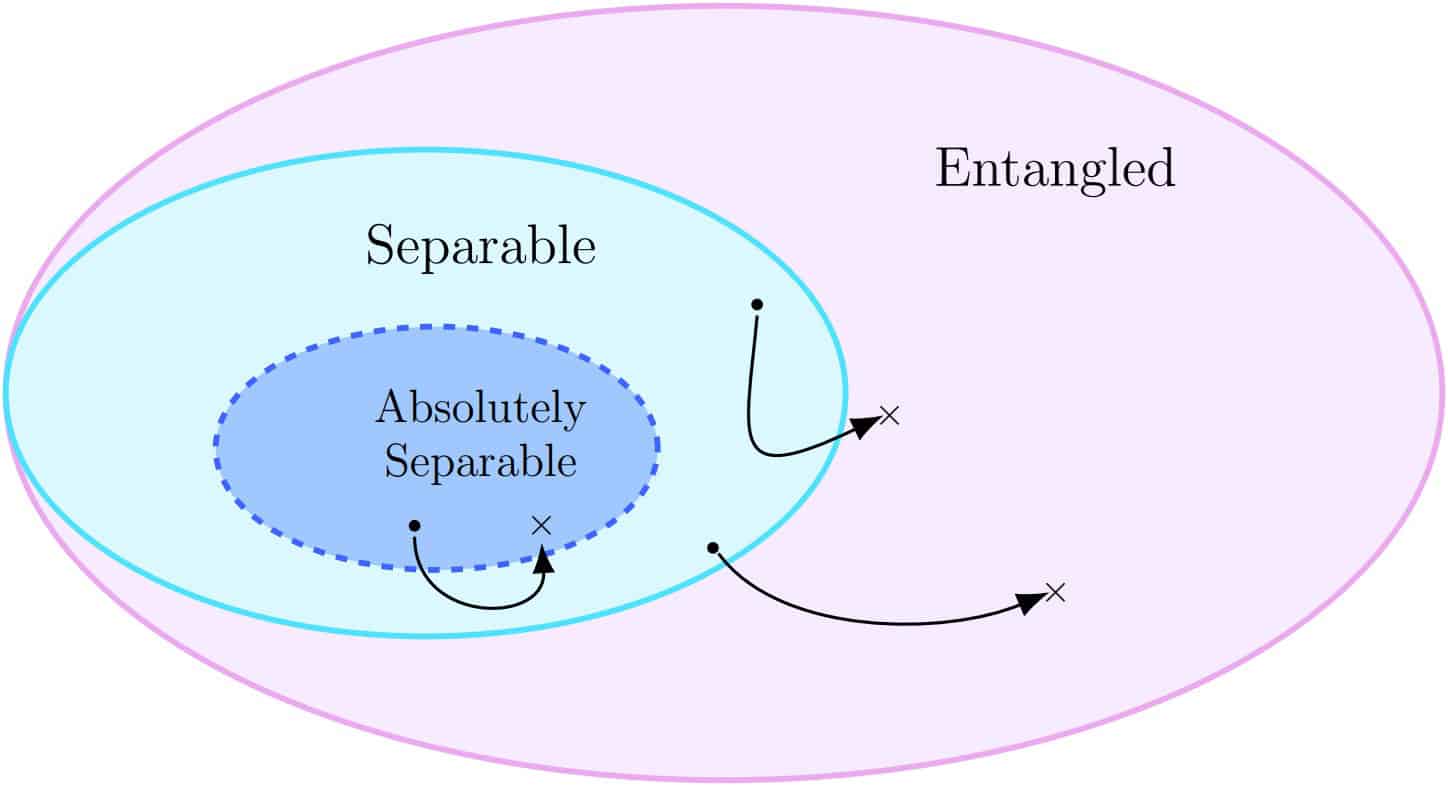
Necessary and sufficient conditions to ensure separability exist only in the simplest cases or for highly restricted families of states. In fact, entanglement verification and quantification is known to be generically an NP-hard problem.
Recent research published by a team of researchers from Spain and Poland has tackled this problem head-on. By introducing new analytical tools such as linear maps and their inverses, they were able to identify when a quantum state is guaranteed to be absolutely separable.
These tools work in any number of dimensions and allow the authors to pinpoint specific states that are on the border of being absolutely separable or not (mathematically speaking, ones that lie on the boundary of the set). They also show how different criteria for absolute separability, which may not always agree with each other, can be combined and refined using convex geometry optimisation.
Being able to more easily and accurately determine whether a quantum state is absolutely separable will be invaluable in quantum computation and communication.
The team’s results for multipartite systems (systems with more than two parts) also reveal how little we currently understand about the entanglement properties of mixed, noisy states. This knowledge gap suggests that much more research is needed in this area.