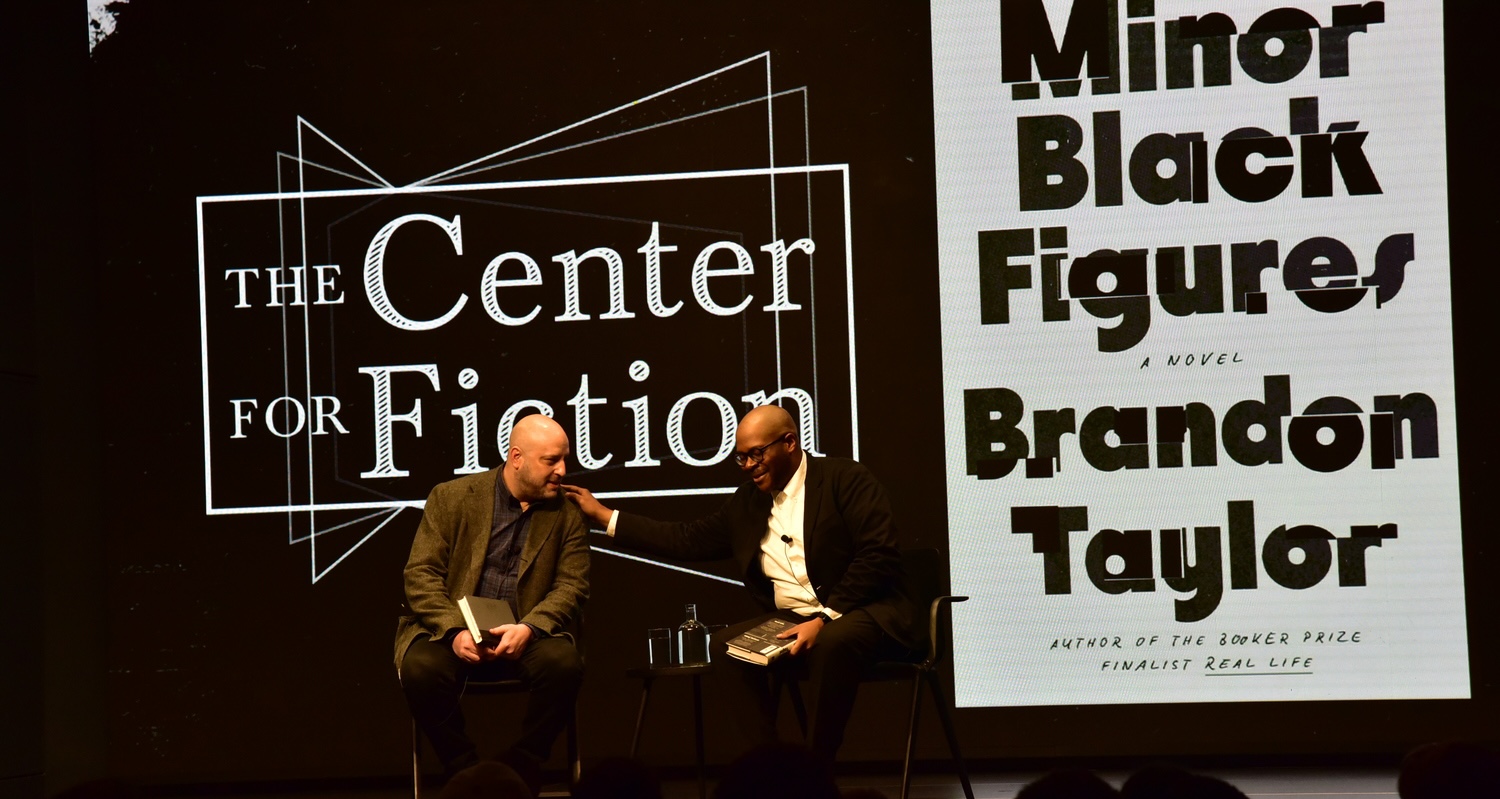
The Center For Fiction welcomed Brandon Taylor, Booker Prize finalist and bestselling author of Real Life and Filthy Animals, back to our stage to celebrate the release of his highly anticipated novel Minor Black Figures. Matthew Sitman, host of the Know Your Enemy podcast, joined Taylor in conversation.
Article continues after advertisement
In Minor Black Figures, Taylor casts a sharp gaze on the New York art scene through the eyes of Wyeth, a young Black painter caught in the throes of creative struggle. As Wyeth searches for inspiration, he confronts the fraught relationship between Black and white art and wrestles with the complex ways the Black body is perceived and represented. Alongside these tensions, he also faces compromises demanded of artmaking and the simple act of living.
From the conversation:
Matthew Sitman: The thing I really was interested in was the choice of making Wyeth an artist—a painter, and not a writer, and how much you were able to riff on, write about, think through the creative process in that different mode.
And I think especially interesting to me were the dynamics around him being a Black painter and the perception of Black art in this space you’re describing in New York City, this elite Soho gallery space. And there was one line in particular I wanted to read because it’s about a painter, but I wondered if you felt this applied to you as a writer, too.
There is a kind of racist, essentialist logic to a lot of the way that we talk about art, especially Black art in this country.
And it is when Wyeth is talking to Chloe, this is the line: “every Black painter had two careers, a career among their Black contemporaries and a career among their white contemporaries. As much as he hated that logic, after all, some Black painters weren’t famous because they were bad painters. But it did have, at bottom, a sense of truth.”
And I just wondered, again, you’re a writer, but this painter. It was very interesting to me to follow along as this painter worked through the dynamics around race in his art and especially in that moment. Say more about that.
Brandon Taylor: Gonna get me in trouble. I’m gonna get canceled.
MS: That was my goal.
BT: I knew it. I knew, I felt it, it’s all my Catholic slander. I mean, I feel that way. I certainly feel that way, there is how your work is conceived, received and conceptualized and contextualized among your Black peers when you’re a Black writer, a Black artist, or a Black anything.
They talk about you in the context of how your work fits into various other discourses around Black art. And then there is a conversation about your work and how it intersects or sort of integrates into larger artistic discourses about America or whatever, or the contemporary moment.
And I always think when we discuss Black contemporary art, there are two conversations happening. There’s like the Black contemporary, and then there’s the contemporary. And somehow, the Black contemporary is never allowed to signify that outer, larger conversation, like it’s never allowed to sort of stand in for that larger conversation for reasons that are historical, social and having largely to do with racism and all this other stuff.
And so, in part, Wyeth is a painter because I wanted to describe a bunch of stuff, but also, he’s a painter because it let me have some distance from a lot of the conversations around my own work and around the conversations around my peers’ work. And it let me sort of look at how discourses around Black art function and unfold, and other media, and then other forms and modes.
And what I found is they’re actually kind of the same. I think it’s amazing how similar those conversations are. And so it’s almost like no matter what the medium is, almost regardless of what the art itself is, the conversation is the same. The dynamics are the same.
Am I allowed to have my own aesthetic reasons as a Black artist in America, or am I always part of a larger cultural conversation? Do I ever get to just be a painter?
Like I could paint a red circle, a blue square, or an octopus, and people would say the exact same things about the work, like the work is immaterial to the discourse in a way. And that to me feels really stupid and kind of evil. So I think in this book I was trying to figure out, what is it about those discourses, even the ones that feel progressive, that feel kind of racist to me in how they unfold? What is this racist logic that cuts on both sides of the street in the way that we talk about Black art, even when in a sort of affirming way, that feels kind of reductive and racist to me? And to add or not even add nuance, but to take the received conversations around race and art and identity and representation, and to just explode them out and see what’s actually inside of them.
Because I think what people will find is, when they start to unpack a lot of those conversations, that at bottom there is a kind of racist, essentialist logic to a lot of the way that we talk about art, especially Black art in this country. But that’s just my take and do with that what you will.
MS: One of the other interesting parts of the novel is, and I’m always interested in the choices novelists make about how many things like social media, science, contemporary events, you include or not. And this is very heavy on those, I would say. But one of the really fascinating wrinkles to this Black artist’s career was when during the BLM protests, one of his images went viral.
BT: Yeah. And that’s right. That’s right. I will say I was cackling as I was writing that.
MS: But that is a real thing that happens though. And you get in some great little digs like, they were paying attention to this Black artist now. In this moment where—we all know what was happening on Instagram during the spring of 2020.
You know, people you never thought were that woke with the most elaborate, long—I just kind of wondered about that bit of viral fame in this fraught moment. It was very fresh and interesting. And I wondered what you brought to that plot detail.
BT: Yeah, so Wyeth’s art is that he takes scenes from European cinema usually. And he just, like, puts Black people in it. He doesn’t have an aesthetic project beyond that, he’s just like, well, I know what Black people look like, and I like these tableaux. I’m just going to like, stick Black people in them.
And, you know, when he was in art school, his Black classmates were like, our people are dying. Please stop doing your European fanfiction—which, fair—and his white classmates were like, why are you putting Black people in these pristine, beautiful European scenes? And he was sort of confused about the response because he had a very naive approach to his work.
And so one thing that he does is he sort of paints a scene from Bergman and he puts Black people in it, and then he uploads it and because of what’s happening on Instagram at that time, people read it as like a commentary on the sort of precarious nature of Black life and the murder of Black men.
And he goes mega viral, and then someone offers him a pile of money, and then he says to that guy— this is not a spoiler. It’s like in chapter two, you’ll get there. But he’s like, “you know, this is just Bergman,” and the guy’s like, “I know. That’s why it’s so beautiful. I love that you’ve done this.”
And it makes Wyeth feel crazy because he’s like, I’m just doing the same thing I was doing before. But somehow the sort of surrounding conversation around my work has changed, and that change has now made it so that people want to give me piles of money for doing what essentially I was doing, and they’re reading a political project into this when I don’t have one.
And then he’s thinking, what if they find out I don’t have a political project and I reveal to be a fraud, I’m going to get in so much trouble. And then people view his refusal of this projection of a political project as an attempt to distance himself from it. And so the book tries to understand, Wyeth tries to figure out, well, am I anxious about this because I don’t want to be over there with all the other Black artists?
Or am I anxious about this for my own aesthetic reasons? Am I allowed to have my own aesthetic reasons as a Black artist in America, or am I always part of a larger cultural conversation? Do I ever get to just be a painter? Yes.
MS: Yes. I love those kinds of—you’re wrestling with that.
BT: Yeah. I mean, and I have no answer and neither does he. I mean, do we ever get to just be anything really?
MS: Yeah. I thought the kind of “can’t win” nature of that problem came through—the frustration came through there.
BT: Yeah. I love putting him in the vice. Just turning the crank.
*
Brandon Taylor is the author of the novels The Late Americans and Real Life, which was shortlisted for the Booker Prize and the National Book Critics Circle John Leonard Prize, and named a New York Times Book Review Editors’ Choice and a Science + Literature Selected Title by the National Book Foundation. His collection Filthy Animals, a national bestseller, was awarded The Story Prize and shortlisted for the Dylan Thomas Prize. He is the 2022-2023 Mary Ellen von der Heyden Fellow at the Dorothy and Lewis B. Cullman Center for Scholars and Writers.
Matthew Sitman is the co-host of the Know Your Enemy podcast and a writer in New York City.
___________________________________

The Center for Fiction is a literary nonprofit based in Downtown Brooklyn. Our mission is to support readers and writers of all ages and histories, and to build community through fiction. We offer a wide range of programming for local and national audiences, including Events, Reading Groups, and Writing Workshops. Our home in Brooklyn features a Bookstore, Café & Bar, Library, and Writers Studio. Members of The Center for Fiction enjoy invitations, discounts, access to our Library collection, and more. Join today.