Scientists have built an electronic circuit that is able to mimic a subtle symmetry normally only found in particle physics
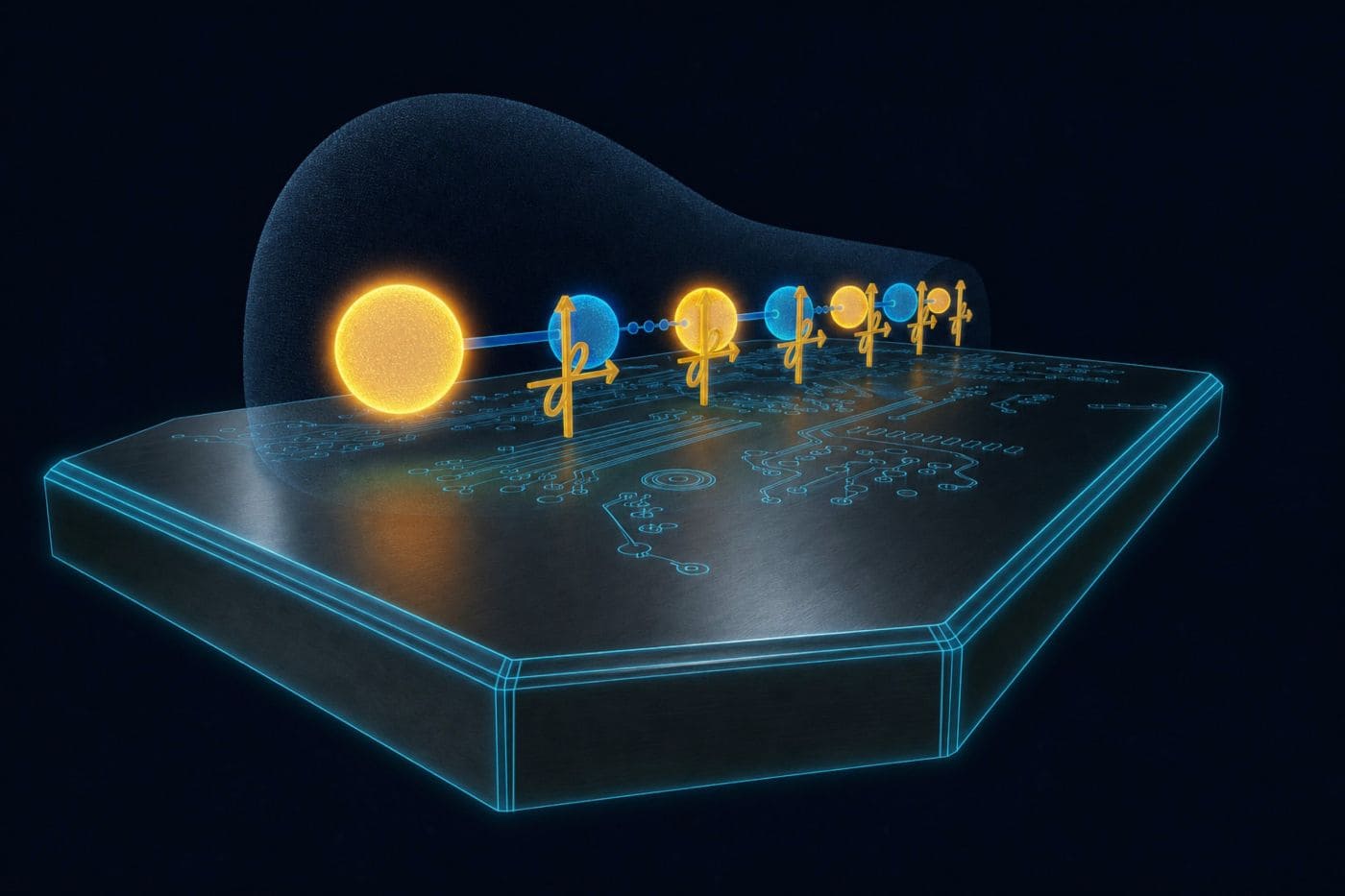
Physics ideas often travel far from their origins, but few make the leap from the Standard Model of particle physics to a circuit board. A surprising new experiment shows that custodial symmetry, best known for stabilising fundamental particle masses, can also emerge in an entirely classical electrical system built from off‑the‑shelf components.
Symmetry plays a central role across physics. As formalised by Noether’s theorem, every continuous symmetry is linked to a conserved quantity. This principle underpins everything from energy conservation to modern field theory. In particle physics, custodial symmetry acts as a safeguard, suppressing large corrections and keeping key quantities stable even when other symmetries are broken. A classical analogue of this idea was theoretically proposed several years ago, but its experimental realisation had remained elusive until now.
A team of researchers from China have now brought this concept to the laboratory using a topolectrical circuit — an electrical analogue of a topological lattice. Their system is based on the Su–Schrieffer–Heeger (SSH) model, a one‑dimensional chain known for hosting edge states that remain pinned to a boundary as long as a certain symmetry is present. The researchers deliberately disrupted that symmetry by introducing memristors: circuit elements whose resistance changes depending on how they have been used in the past.
Surprisingly, the edge states do not simply vanish. Instead, the team finds that a weaker form of protection remains. By measuring how the circuit’s behaviour changes, they identified a correction that shrinks smoothly as the memristive effect is reduced. This closely mirrors how custodial symmetry suppresses mass‑like corrections in quantum field theory.
The novel work shows how tabletop circuits can serve as accessible testbeds for ideas drawn from fundamental physics, opening new ways to explore symmetry, topology and memory using electronics rather than particles.