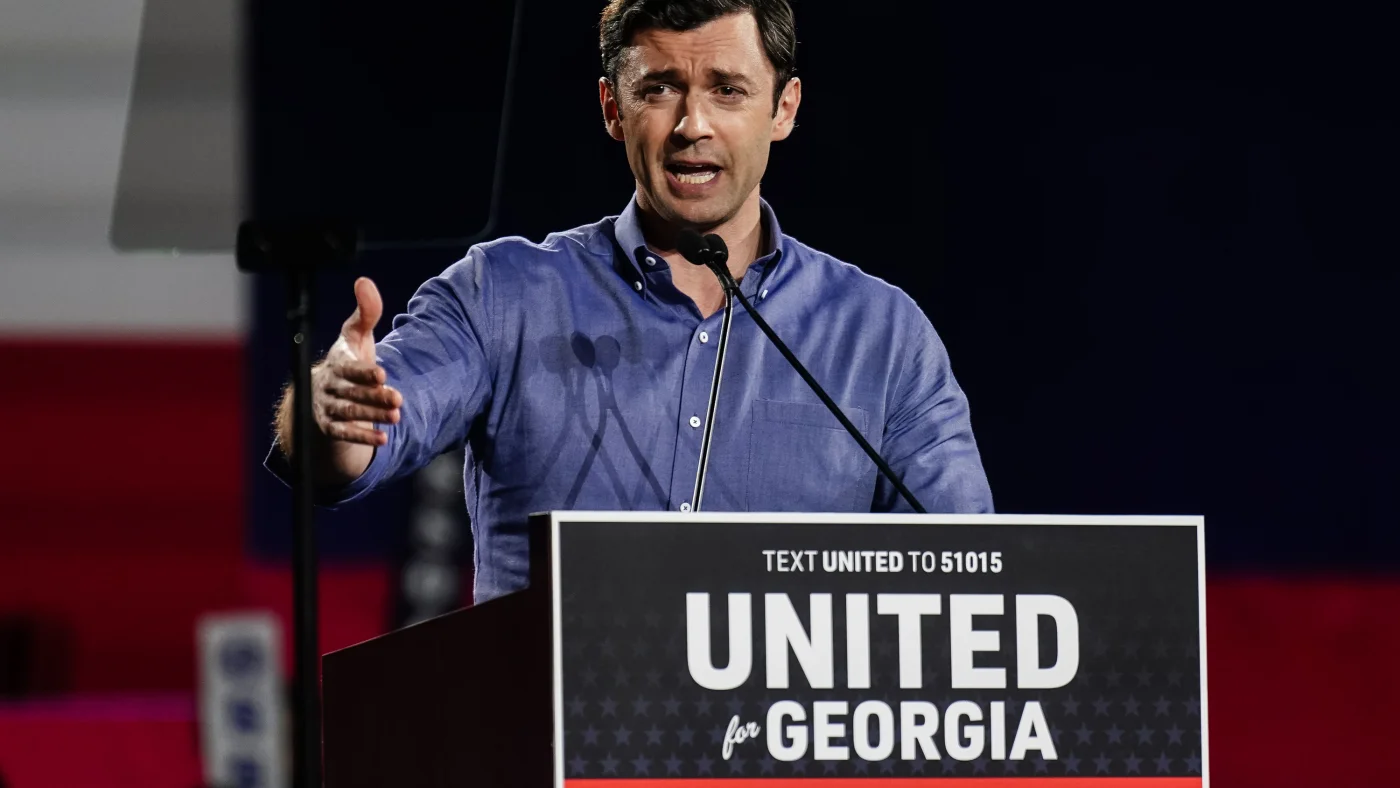


Sen. Jon Ossoff, D-Ga., speaks during a campaign event on October 17, 2026 in Marietta, Georgia.
Elijah Nouvelage/Getty Images
hide caption
Elijah Nouvelage/Getty Images
📲 Get the latest on the midterms & more in the NPR App
In key U.S. Senate races this year, candidates are soliciting donations from outside of their home states, and their out-of-state messaging is different from what they’re running locally.
An NPR analysis of Google Ads for four major Senate races — Iowa, Georgia, Ohio and Texas — found that the Democratic and Republican candidates spent more than $15 million on advertising related to fundraising in the 2025-26 election cycle. About three quarters of that went to ads that ran nationally.
Often, these ads focus on national talking points — such as attacking or defending President Trump, or turning the Senate blue or red — rather than local issues. For candidates like Georgia Sen. Jon Ossoff and Iowa Democratic nominee Josh Turek, more than 80% of their itemized individual contributions have come from out of state.
The funneling of funds has affected at least four of the competitive Senate races, where a majority of the money is coming from outside the state. ActBlue and WinRed, two major grassroots fundraising platforms, are a major catalyst for out-of-state fundraising.
Because this technology is inexpensive to run, it incentivizes candidates to rely on digital ads, according to Zachary Albert, a professor of politics at Brandeis University.
“ActBlue and WinRed really reduced the transaction costs for contributing,” Albert said. “Even if you’re only yielding like a $5 or $10 contribution from someone like the costs of soliciting that are so much lower than they used to be, that it makes it worthwhile.”
With both parties — and each candidate — now having fundraising platforms, political hopefuls increasingly need to stand out from the crowd and are often shifting their messaging to a broader audience, which can result in using polarizing messaging to solicit funds.
Nationalized talking points
For in-state and out-of-state ads, candidates tend to have two different sets of talking points, according to Wesleyan Media Project’s Michael Franz.
“In a general election campaign for a [local] TV ad, a candidate will never say, ‘I’m the Democrat,’ because they want to appeal to moderates and swing voters and they want voters across the aisle,” Franz said. “But with a digital ad that’s airing outside of your state, the party label becomes more important.”
This is reflected in many digital ads. Former Ohio Democratic Sen. Sherrod Brown — who is seeking to regain a place in the Senate — calls to turn his state blue while Georgia Republican Rep. Mike Collins asks people to help turn his state’s Senate seat red. Republicans currently control the Senate but there are a number of toss-up races giving Democrats a path to taking back the chamber.

Iowa Republican Senate candidate, Rep. Ashley Hinson speaks at a rally on October 22, 2026 in Sioux City, Iowa as President Trump looks on.
Anna Moneymaker/Getty Images
hide caption
Anna Moneymaker/Getty Images
Iowa Republican Rep. Ashley Hinson touts her America First credentials in ads for her Senate race, saying she’s “America First,” while Ossoff in Georgia attacks Trump directly.
According to Michael Heseltine, a researcher at Oxford University who studies how members of congress use social media to communicate, says while there is a large amount of locally-focused messaging, candidates are increasingly spending more time and energy on national talking points.
“[If] we continue on that trend, you’ll probably find more and more members who have neglected their constituencies or at least not presented themselves as representatives of their constituencies,” he said.
In a statement to NPR, the Ossoff campaign denied targeting audiences by location, and says the campaign “is powered by small-dollar donors because the Senator refuses donations from corporate PACs and federal lobbyists.”
The other campaigns declined to comment or did not respond to interview requests.
Daniel Hopkins, a political science professor at the University of Pennsylvania, believes we’re in a new era of campaigning, where candidates now have two major stakeholders to appeal to: a voter base which is local, and a donor base which is often larger and nationwide.
“When Jon Ossoff is trying to compete for votes, he’s competing against Georgia Republicans,” Hopkins said. “But when Jon Ossoff is trying to compete for dollars, he’s competing for attention and for donations, ultimately with other prominent Democratic candidates.”
The rise of out of state funds
The amount of out-of-state funds for congressional campaigns has been rising each election cycle, according to OpenSecrets.
In order to get these funds, candidates are urged to promote the party platform. Hopkins attributes this to two causes; the party platforms becoming more homogenous and changes in campaign finance laws.

“It used to be that the pathway to success was to rise up through your local party, building the support of local elites in your community,” he said.
“The path to political success increasingly goes through a set of, ‘ATM districts’ around the country that are known to give a lot of money either to Democrats or the Republicans,” Hopkins explained.
In states that are dominated by one party, donors might elect to send their funds to a more competitive state to help influence elections, according to Sarah Bryner, a director who studies campaign finance at Public Agenda, a research organization focused on democracy.
“People from California really don’t feel like they have much to do because their state’s going to go blue regardless,” she said. “So they support candidates in states like Georgia or Texas.”
Democrats took the lead, but Republicans are catching up
While both parties now benefit from out-of-state funds, Democrats tended to rely on them, due to weaker local funding systems in competitive states like Ohio and Michigan. As a result, Democrats built a system for grassroots donations — ActBlue which launched in 2004 — nearly 15 years before Republicans, who launched WinRed in 2019.

While some of the Democratic advantage in out-of-state fundraising can be attributed to Republican incumbents’ connections to local funding, part of it can be attributed to the Democratic Party’s diverse base of voters.
“You’re having to bring together that diverse coalition, not necessarily around some unified ideological agenda, but based on a kind of discrete policy [that] claims to represent particular groups,” said Brandeis University’s Zachary Albert.
Meanwhile, Republicans were initially slow to realize the potential for small dollar fundraising until Trump.
“The Republicans realized, especially during Trump, that they do have a national audience of small donors ready to activate behind their preferred candidates for their preferred agenda,” Public Agenda’s Sarah Bryner said.
Looking forward
While some states are trying to limit outside funds, like Hawaii implementing a cap on out-of-state donations starting in 2027, it’s difficult to regulate at a national level, according to University of Massachusetts political science professor Raymond La Raja.
“It’s going to be hard to do constitutionally, especially because the Supreme Court has ruled you can’t prevent groups from spending as much money as they want in elections,” he said.

In June, the Supreme Court ruled in favor of coordinated campaign spending which allows more out of state funds to be spent in elections. So far, the National Republican Senatorial Committee has spent three times as much on advertisements at this point than in the previous midterms.
La Raja suggested fund matching, where local donations would be matched with public funds, using New York City as a model. He believes this would shift candidates to focus more on their constituents’ issues rather than national ones.
Bryner mentioned the Alaska top donor disclosure law as an option to localize fundraising. There, ads have to list the top three donors. Colorado and Virginia have similar laws for online and broadcast ads.
While funding can influence how a candidate talks about their race locally and nationally, Bryner isn’t convinced this will completely tip the scale of elections. Candidates who’ve outraised with out-of-state funds, like Amy McGrath, who ran against Republican Sen. Mitch McConnell in Kentucky and Beto O’Rourke against Republican Sen. Ted Cruz in Texas, often lose against their opponents. She advises against appealing to donors out-of-state because ultimately it doesn’t translate into votes.
“As much as money in politics is such a factor in America, voters are still ultimately who makes the final decision” Bryner said. “And if you’re getting all your money from outside of the state, those people can’t vote for you.”