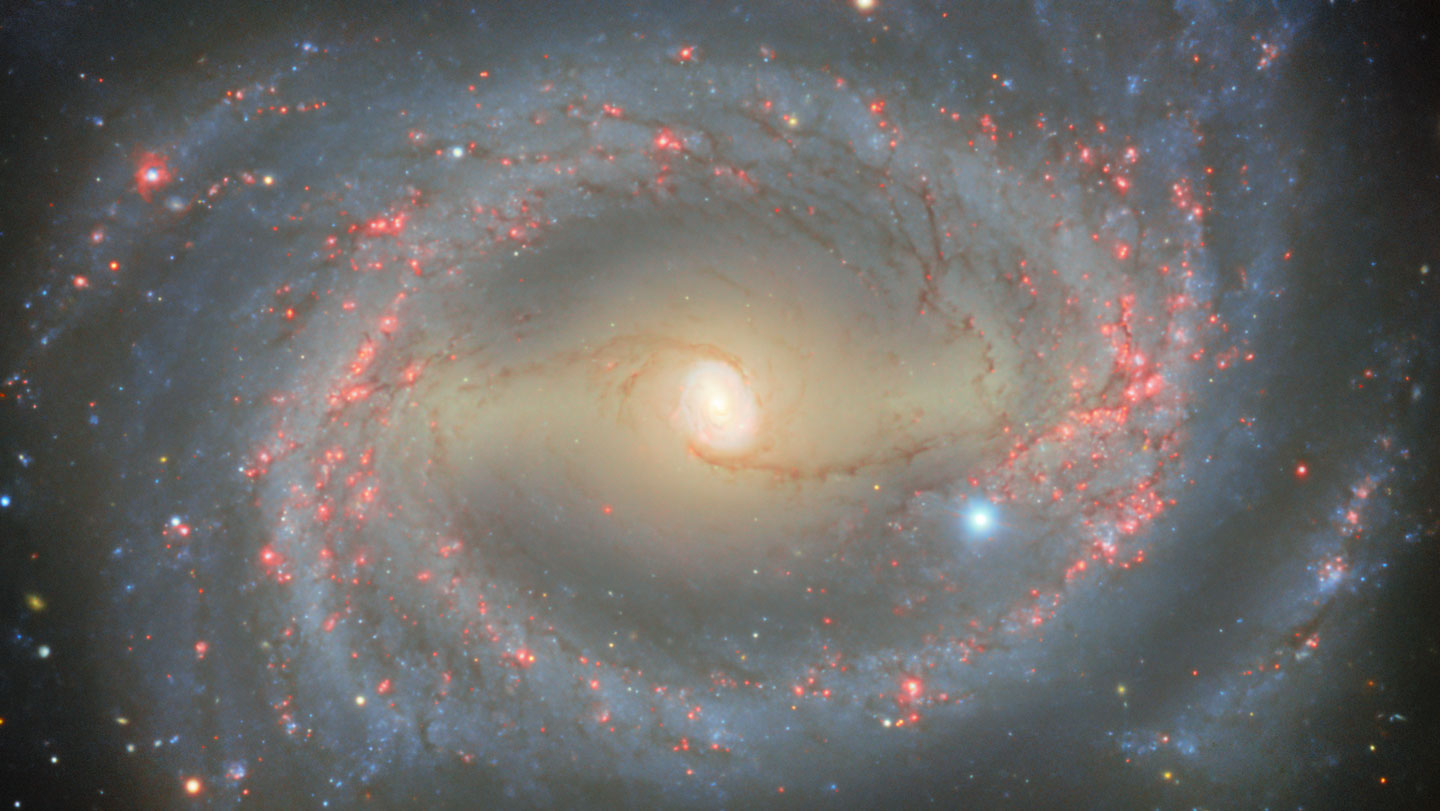
When astronomers first spotted the supernova now designated SN 2026ahvu, it was just one of the dozens detected every day. But scientists soon realized this one was something very special, and they’ve been hustling to study it ever since.
“I think almost everyone in the world is trying to trigger a telescope and look at this,” says astrophysicist Sumit Sarbadhicary of Johns Hopkins University.
Soon after scientists spotted the explosion on November 2, they determined it hadn’t yet peaked in brightness, giving scientists an early glimpse at the event. Even more thrilling, within a day of the explosion’s discovery, astronomers had classified it as a type Ia supernova. These particular outbursts are rare, but they’re astronomical superstars: Scientists use their trademark explosion pattern as a “standard candle” to measure distance into the universe — most notably to discover that the universe’s expansion is accelerating. And to round out a trifecta of reasons to be excited, these blasts rarely occur so close to Earth.
Astronomers know type 1a supernovas occur upon the reignition and resulting self-destruction of a white dwarf star, the small cool remnants of a star like the sun that’s too small to become a superdense neutron star or black hole at its demise. Scientists also know that powering back on requires reaching about 1.44 times the mass of the sun, which can occur only if something is giving the white dwarf extra mass.
But scientists aren’t sure what that something is — whether these supernovas are triggered by a second white dwarf or some sort of star that’s still burning. Usually, these explosions occur so far away that astronomers can’t get a good look at where they come from. But SN 2026ahvu is perhaps 50 million light-years or less away from Earth.
“They happen so rarely at this distance that it could hopefully help us figure out why this white dwarf exploded in the first place,” says astronomer Yvette Cendes of the University of Oregon in Eugene, who has been arranging for radio telescopes to observe the outburst.
Sarbadhicary and colleagues have already submitted preliminary findings November 6 at arXiv.org suggesting that the former white dwarf was less than 100 million years old. That’s remarkably young compared with other supernovas of this type, and may help scientists finetune their understanding of these outbursts.
“These explosions have been enduring mysteries for us for decades, and whenever something happens this close, it’s just really exciting,” Sarbadhicary says.